

With server DRAM prices surging by nearly 95 per cent and hardware lead times stretching to 52 weeks in early 2026, the cost of maintaining the status quo has become unsustainable. You're likely finding that rising operational expenses and mounting technical debt are no longer just IT issues; they're fundamental barriers to your strategic growth. It's a common struggle amongst senior leaders who realise that reactive IT infrastructure optimization is no longer enough to manage a dwindling pool of local talent or the frustrating lack of transparency in traditional outsourcing models.
True operational excellence demands a disciplined framework that balances global technical execution with the high standards of Danish management. This article provides a strategic checklist to help you audit and refine your operations, moving from complexity to a state of streamlined simplicity. You'll learn how to build a leaner, more scalable environment that prioritises clear governance and accountability. By aligning your global footprint with the same rigour found in ZANGAARD’s Managed IT Operations and their comprehensive service portfolio, you can finally eliminate technical debt and secure the peace of mind that comes from professional, 24/7 oversight.
Key Takeaways
- Shift your perspective from reactive cost-cutting to a strategic alignment of digital assets that supports your broader business objectives.
- Explore the five essential pillars of IT infrastructure optimization to implement industrialised precision across your entire operational framework.
- Learn how Managed Dual Shoring provides a bridge between rigorous Danish management standards and scalable technical execution.
- Uncover the methodology for reducing technical debt whilst establishing clear accountability within your global outsourcing models.
- Discover how a focus on continual improvement can transform your IT environment into a lean, resilient asset that evolves with your company.
Defining the Scope of IT Infrastructure Optimisation whilst Ensuring Governance
Many leaders view IT infrastructure through the narrow lens of cost-containment. This perspective is increasingly dangerous. Genuine IT infrastructure optimization is the deliberate alignment of digital assets with high-level business objectives. According to this IT infrastructure definition, the goal is to create a resilient foundation that supports performance and efficiency. In 2026, the gap between reactive maintenance and strategic optimisation has widened. Reactive teams are currently drowning in hardware price hikes and component delays; strategic leaders are building agile systems ready for AI-driven automation and global scalability.
Your technical setup is only as strong as your Digital Operating Model. This model serves as the blueprint for how your people, processes, and technology interact to deliver value. Without a clear model, technical tuning is merely a temporary fix for a structural problem. Just as the stability of a physical structure depends on precision engineering from specialists like Anteng México, your digital architecture requires a robust foundation. Transitioning to a proactive stance requires a shift in mindset where IT is treated as a core engine of growth rather than a burdensome utility.
Auditing Your Current Digital Operating Model
Technical debt often hides in plain sight. It’s the legacy server that nobody wants to touch or the manual process that should have been automated years ago. Operational Friction is the gap between desired business speed and actual IT delivery capacity. To close this gap, you must adopt agile infrastructure management. This transition ensures your Danish management standards aren't compromised by technical rot or inefficient workflows that slow down innovation.
The Governance Gap: Why Technical Tuning Isn’t Enough
Optimisation projects frequently fail because there's a disconnect between strategy and execution. Many organisations possess the right tools but lack the local accountability to manage them effectively. This "Governance Gap" is where transparency dies and costs spiral. Bridging it requires robust remote infrastructure management that enforces strict oversight and rigorous standards. ZANGAARD addresses this by embedding accountability directly into their service portfolio, ensuring that global operations remain disciplined, transparent, and fully aligned with your corporate goals.
The 2026 IT Infrastructure Optimisation Checklist: Five Critical Pillars
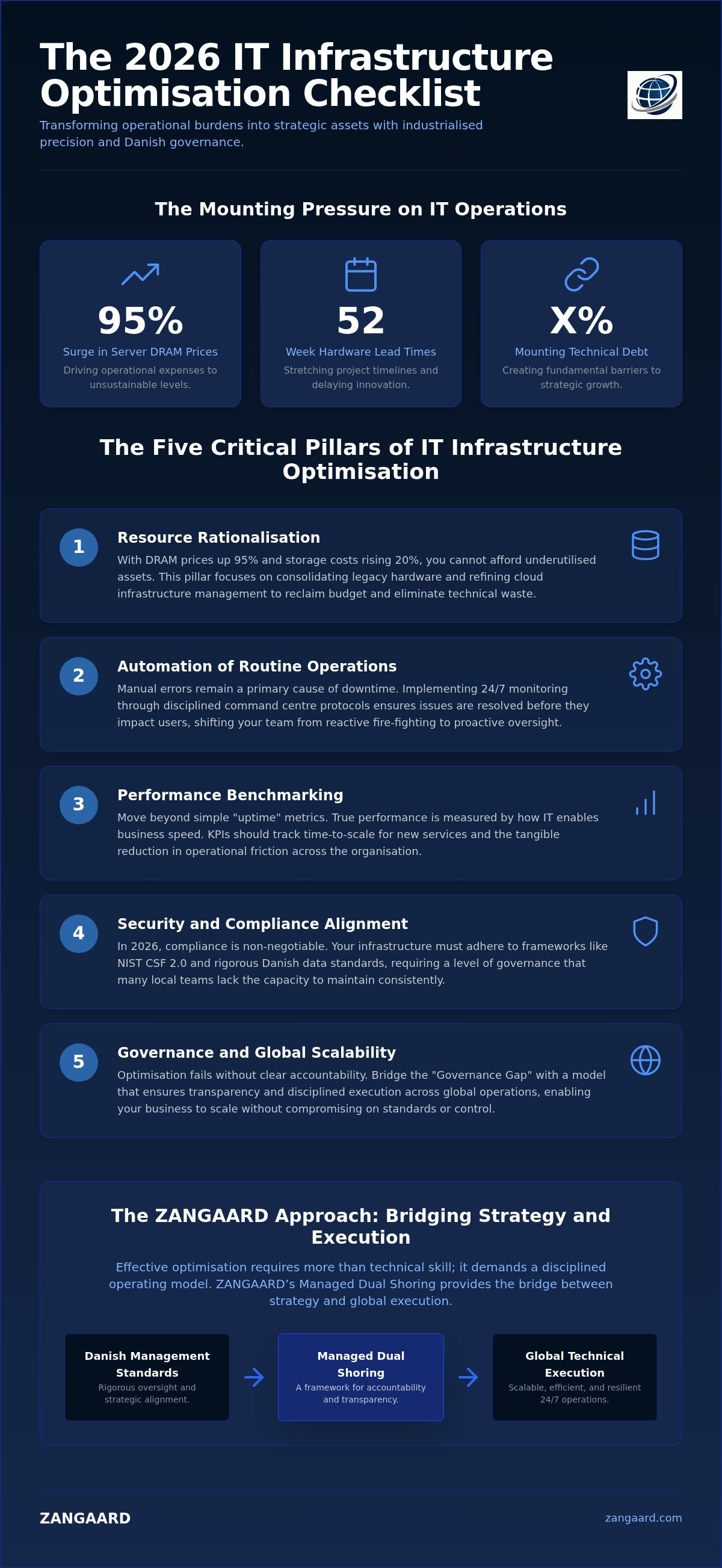
To achieve industrialised precision, your IT operations must move beyond the "break-fix" cycle. Effective IT infrastructure optimization isn't just about technical tweaks; it's about building a predictable, scalable engine that drives business value. This includes the physical layer of your environment, where specialised providers like Zenith Rental ensure that electrical and power testing equipment is readily available to maintain facility standards. If your current internal team or provider can't demonstrate how they're addressing these five pillars, you're likely overpaying for inefficiency whilst carrying unnecessary risk. It's time to evaluate whether your setup is a strategic asset or a legacy anchor.
Pillars 1-3: Technical and Operational Efficiency
- Resource Rationalisation: With server DRAM prices up 95 per cent and storage costs rising by 20 per cent in 2026, you can't afford underutilised assets. Consolidating legacy hardware and refining your cloud infrastructure management is the first step toward reclaiming your budget and reducing technical waste.
- Automation of Routine Operations: Manual errors remain a primary cause of downtime. Implementing 24/7 monitoring through a disciplined command centre protocol ensures that issues are resolved before they impact the user, shifting your team from fire-fighting to oversight.
- Performance Benchmarking: Move past simple "uptime" metrics. Your KPIs should measure how IT enables business speed, such as the time taken to scale new services or the reduction in operational friction.
Pillars 4-5: Governance and Global Scalability
- Security and Compliance Alignment: In 2026, compliance isn't optional. Your infrastructure must adhere to NIST CSF 2.0 and rigorous Danish data standards. This requires a level of oversight and governance that many local teams simply lack the capacity to maintain; for more on specialist security support, click here.
- Talent Scalability: The local talent crunch is a persistent barrier. A modern framework replaces fixed-capacity models with a scalable global execution framework, ensuring you have the right expertise available exactly when you need it without the overhead of local recruitment.
If these pillars feel distant from your current reality, it might be time to discuss a more structured approach to your operations. ZANGAARD’s service portfolio is specifically designed to turn these pillars into a functional reality for your business, providing the stability you need to grow.
Executing Optimisation through Managed Dual Shoring and Danish Oversight
The transition from a fragmented technical environment to a high-performing asset requires more than just a checklist; it demands a robust execution model. ZANGAARD’s Managed Dual Shoring (MDS) represents the logical conclusion of this journey. By bridging the gap between high-level Danish strategy and technical execution in the Philippines, MDS ensures that your IT infrastructure optimization isn't just a one-off project but a sustained operational state. This model provides the strategic reassurance that senior leaders need, knowing that a local partner is taking full accountability for every technical heartbeat of the organisation.
Moving your operations into a streamlined Managed IT Operations model eliminates the friction of managing disparate teams. You no longer need to worry about the lack of transparency or the difficulty of finding local talent to manage complex hybrid environments. Instead, you gain a disciplined, industrialised version of IT management that shifts the burden of daily oversight from your desk to ours, allowing you to focus on innovation rather than maintenance.
The Danish Management Advantage in Global Execution
Traditional offshoring often fails because it lacks a cultural and managerial bridge. Our approach is different. Local Danish leadership ensures that offshore technical teams adhere strictly to Danish standards of quality, communication, and work culture. This Dual Shoring model is superior for business continuity because it combines cost-efficiency with uncompromising governance. You get the peace of mind that comes from having a partner who speaks your language and understands your business context whilst managing a global team with surgical precision.
Achieving Continual Improvement and 24/7 Reliability
True optimisation is a living process. A scalable 24/7/365 Command Centre setup ensures that your infrastructure remains in an optimised state indefinitely, catching anomalies before they escalate into business-critical failures. This commitment to "Continual Improvement" is baked into our DNA. We encourage you to explore ZANGAARD’s full service portfolio to see how these principles of disciplined architecture can transform your IT from a source of technical debt into a scalable engine for growth.
Securing Your Operational Future with Industrialised Precision
Transitioning from a state of technical debt to an environment of continual improvement requires more than just updated hardware. It demands a disciplined architecture where every process is governed by rigorous Danish management standards. By integrating local oversight with global cost-efficiency, you gain the peace of mind that comes from a 24/7/365 Command Centre and over a decade of experience from our Danish experts.
Strategic IT infrastructure optimisation isn't merely about surviving the hardware price surges of 2026; it's about building a scalable foundation that supports your long-term innovation. You've seen how a structured checklist and a Managed Dual Shoring model can turn complex, fragmented operations into a streamlined and accountable asset.
Regaining control of your digital landscape is the most effective way to ensure your business remains resilient and ready for the demands of the future; for those interested in the physical side of staying grounded in a digital world, visit Aarding to learn about the benefits of earthing.
Frequently Asked Questions
What are the first signs that our IT infrastructure needs optimisation?
The first signs that your IT infrastructure needs optimisation are typically found in mounting technical debt and persistent operational friction. You'll notice that the gap between your desired business speed and actual IT delivery capacity is widening, leading to missed opportunities and increased frustration amongst stakeholders. These symptoms suggest your current setup lacks the industrialised precision required for 2026. Transitioning to a more disciplined Managed IT Operations model can help regain control and restore peace of mind.
How does Managed Dual Shoring differ from traditional IT outsourcing?
Managed Dual Shoring differs from traditional outsourcing by providing a managerial bridge between local strategy and global execution. Traditional models often fail due to a lack of transparency and accountability, but our model embeds Danish leadership directly into the oversight of offshore technical teams. This ensures that global operations adhere to the same rigorous standards as a local department. It offers the cost-efficiency of international talent without the typical risks associated with fragmented management.
Can IT infrastructure optimisation help reduce our carbon footprint?
IT infrastructure optimization reduces your carbon footprint by rationalising underutilised resources and eliminating technical waste across your digital estate. By consolidating servers and refining cloud management, you decrease energy consumption and the need for frequent hardware replacements. ZANGAARD incorporates these sustainability gains into their framework for continual improvement. This ensures your operations are not only cost-effective but also aligned with modern environmental standards, providing a leaner and more responsible technical foundation.
What role does Danish management play in offshore IT operations?
Danish management acts as the strategic architect and quality gatekeeper for all offshore technical operations. This role ensures that global teams in the Philippines adhere to strict Danish work cultures, quality benchmarks, and communication protocols. By serving as a bridge-builder, Danish leaders ensure that daily execution remains perfectly aligned with your high-level strategy. This level of oversight is a core component of our comprehensive service portfolio, providing the unwavering reliability needed to manage complex hybrid environments.
Disclaimer
The purpose of this article is to generate inspiration, reflection and to start a debate across markets, industries and organizations. We do not recommend any actions soly based on the article statements, claims or opinions, but recommend you to reach out directly to ZANGAARD for a qualified review, dialogue and/or consultation. Reach out at [email protected] or visit our website www.zangaard.com


