

A provider can appear competent until the same IT problems keep returning. The clearest signs of a bad managed service provider include unresolved recurring faults, missed service-level agreements, poor communication and reporting that leaves you unsure what is happening. Together, these patterns point to weak accountability, not just an occasional technical setback.
It is reasonable to expect clear updates, documented processes and a service that keeps pace with your business. This article explains how to assess warning signs, when a change may be justified and how to plan a handover while keeping track of access, system documentation, contract terms and service-level agreements. It also shows what to examine in your current arrangement so your next step is based on evidence, not frustration.
Key Takeaways
- Look beyond isolated faults: recurring problems, unclear updates and missed service-level agreements can reveal weaknesses in support and accountability.
- Assess ticket handling by tracking how issues are acknowledged, progressed, escalated and communicated through to resolution.
- Plan a provider change around a documented handover, clear ownership and continuity of access to systems and essential information.
- Review contract terms and service-level agreements alongside operational records to understand responsibilities, performance and exit arrangements.
1. What Makes Managed Service Provider Companies Good or Bad?
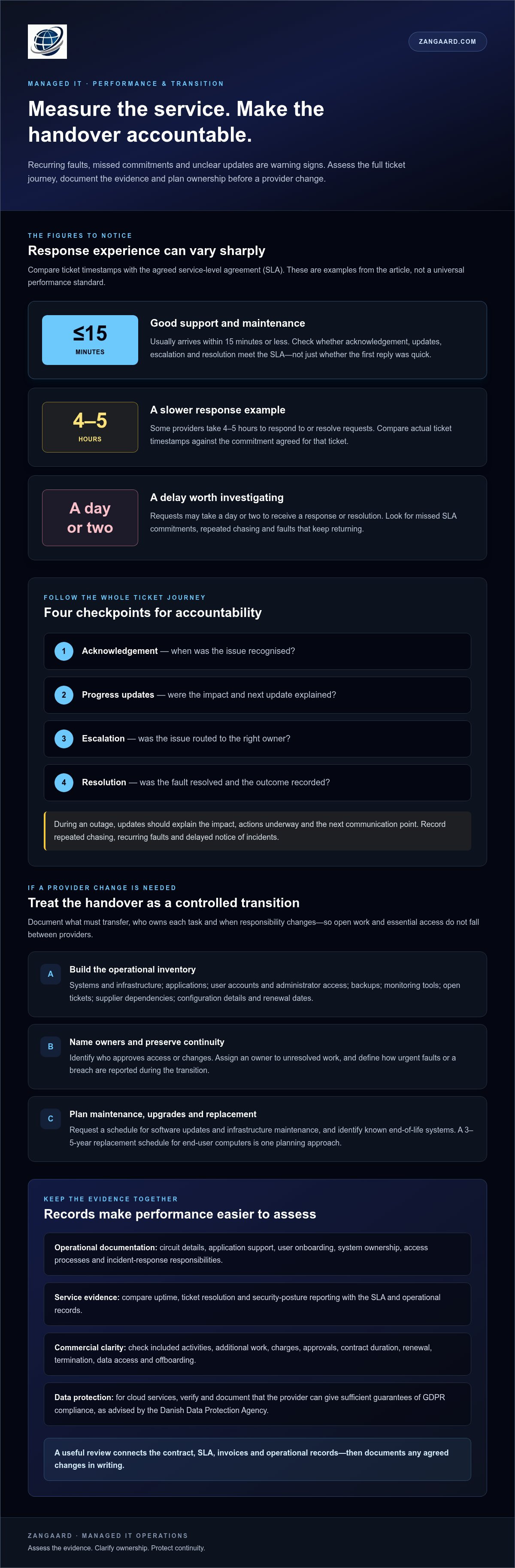
Judge support by the full ticket journey, not one fast reply. A capable MSP sets service-level agreements (SLAs) for acknowledgement, updates, escalation and resolution, then reports performance against them. Good support and maintenance usually arrive within 15 minutes or less. Some providers take 4-5 hours, or even a day or two, to respond to or resolve requests. Compare ticket timestamps with the agreed SLA to identify missed commitments.
Communication should remain clear when infrastructure fails. A dependable MSP partner explains technical issues in plain language, uses more than one communication channel and gives you a direct route to the person overseeing your service. During an outage, updates should explain the impact, actions underway and next communication point. If your team must repeatedly chase answers, or learns about a security breach days after it happened, record the incident and raise it promptly. Recurring faults and poor follow-up can signal weak issue resolution.
For GDPR and data protection, Danish businesses should verify and document that a cloud provider can give sufficient guarantees of GDPR compliance before using its service, according to the Danish Data Protection Agency. Review how the provider records its data-handling practices and responsibilities, particularly when outsourcing involves cloud services.
Warning signs of poor cybersecurity include no developed security strategy, no clear incident response, and no recovery plan covering backups and disaster recovery. Ask how vulnerability assessments, endpoint protection and incident response planning fit into ongoing operations. Constant monitoring alone is not evidence of sound protection; request clear reporting on security posture and how incidents are escalated. A structured managed IT services approach can connect support processes with infrastructure oversight, helping teams assess whether responsibilities and communications are clearly defined.
2. Changing MSPs and planning a handoff
A provider change is safest when managed as a controlled transition, not a sudden cut-off. Start by documenting your systems, business priorities and current service gaps. Then record who owns each handover task, what information must transfer and when responsibility changes. Clear expectations help internal teams keep routine work moving while the incoming provider learns the environment.
Build an inventory of infrastructure, applications, user accounts, administrator access, backups, monitoring tools, open tickets and supplier dependencies. Note configuration details and renewal dates, then identify who can approve access or changes. For example, assign an owner to an unresolved server issue during the transfer so it does not fall between providers. Include a process for reporting a breach or urgent fault throughout the transition.
Use the handoff to examine maintenance and upgrade planning. Ask for a schedule of software updates, infrastructure maintenance and known end-of-life systems. Planned work can reduce avoidable downtime and reveal risks that reactive support leaves hidden. A 3-5-year replacement schedule for end-user computers is one approach to planning asset replacement rather than waiting for devices to fail.
Technology choices should reflect business requirements, not simply the systems already in place. List operational needs, constraints and growth plans before comparing options. Assess how each fits existing workflows and security controls. A provider should explain its recommendation in terms your decision-makers can evaluate.
Write the handover expectations into a transition plan, including ownership, access transfer, documentation and outstanding work. For a more structured view of the operational change, explore IT service transition support as part of your planning.
3. Documentation, contracts and service-level agreements
Clear records make service performance easier to assess and handovers easier to manage. Use a shared documentation platform for circuit details, application support information and user onboarding procedures. Add system ownership, access processes and incident response responsibilities, so teams can find operational details without relying on informal messages. Missing records are a red flag when routine problems require repeated explanations or delay a response.
Compare the contract with the services delivered and invoices received. Check which activities are included, how additional work is handled, how charges are presented and who approves changes. The agreement should describe service-level agreements (SLAs), including response expectations, escalation routes and reporting measures. Track uptime, ticket resolution and security posture against those commitments. If invoices use unclear service descriptions, ask for each charge to be linked to an agreed service or approved change.
Before signing a new or renewed agreement, circulate the draft through the appropriate internal channels. Give stakeholders time to assess whether its terms reflect business goals, and do not rush the decision. Pay close attention to contract duration, renewal, termination, data access and offboarding processes. Overly complicated exit terms can cause frustration and make a future transition harder to manage.
Renegotiation can address changing needs without making every disagreement a reason to leave. Document the problems, their operational impact and the changes required, such as clearer reporting or revised response commitments. Record agreed amendments in writing and align the SLA, service description and invoicing terms. A provider that documents the process from onboarding through offboarding gives both parties a clearer basis for accountability and continuity.
ZANGAARD: Managed IT Operations
ZANGAARD supports businesses seeking clearer operational ownership, more consistent IT management or a structured provider change. Its Managed IT Operations and IT Infrastructure Management support oversight of day-to-day services and the systems they depend on. A Scalable Service Desk can support changing service needs, while Outsourcing Services can help organisations structure IT delivery beyond their internal teams.
ZANGAARD is a relevant option when recurring operational problems, unclear responsibilities or limited capacity affect service continuity. Its Managed Dual Shoring model combines Danish management and local oversight with offshore operations in the Philippines, bringing global delivery together with Danish management standards. The right scope depends on your organisation’s operational needs and existing environment.
Explore ZANGAARD’s IT services to consider how its services relate to your operational priorities, or visit zangaard.com to get in touch.
Make your next IT partnership a deliberate choice
Use the signs of a bad managed service provider as a prompt for a measured decision, not an impulsive one. Set out what your business needs from IT, which responsibilities must have clear owners and what a successful transition should preserve. This turns dissatisfaction into practical criteria for deciding whether to repair the current relationship or move on.
Before committing to a change, align business leaders and internal teams on priorities, risks and acceptable transition arrangements. A clear decision process helps protect continuity while giving the next partnership a stronger operational foundation. The aim is not simply to replace a provider, but to establish a service model that supports the way your organisation works.
A considered next step can restore clarity and give your team a more confident basis for planning what comes next.
Frequently Asked Questions
What Makes Managed Service Provider Companies Good or Bad?
A good provider makes responsibility visible: you can see who owns a task, what outcome is expected and how progress is governed. A weak provider leaves these points unclear, so business teams spend time coordinating work that should be managed. For example, clear ownership between the provider and your internal project lead during a new system rollout helps prevent overlooked approvals and dependencies.
What are the most common signs of a bad managed service provider?
Common signs of a bad managed service provider include recurring faults without lasting corrective action, unexplained service changes and reports that do not help leaders make decisions. Look for patterns across incidents and business impact, not just individual complaints. If a recurring login failure affects a particular team, for instance, the provider should investigate the underlying cause and show whether the issue returns.
How can you tell if an MSP is failing to meet its SLA?
Compare the service-level agreement with timestamped records for the relevant tickets and incidents. Check whether the SLA measures acknowledgement, action, resolution or another milestone, as these are different obligations. A ticket marked “responded” may still lack a meaningful update or assigned owner. Record exceptions and review them alongside the agreement’s exclusions, business hours and escalation conditions.
What response and resolution times should a good MSP provide?
There is no single suitable target for every request. Response and resolution commitments should reflect business impact and urgency. A blocked finance system needs a different priority from a routine account query. The SLA should define separate targets for acknowledging, progressing and resolving each priority, with escalation steps if work stalls. Assess the targets against operational needs and the consequences of downtime.
How can you assess an MSP’s communication and transparency?
Test communication through a routine request and a planned service change. Note whether updates identify the owner, decision needed, current status and next step, and whether reports explain service trends rather than simply presenting ticket totals. Ask leaders and users to compare their experiences. Differences between formal reports and day-to-day feedback can reveal gaps in visibility or ownership.

Disclaimer
The purpose of this article is to generate inspiration, reflection and to start a debate across markets, industries and organizations. We do not recommend any actions soly based on the article statements, claims or opinions, but recommend you to reach out directly to ZANGAARD for a qualified review, dialogue and/or consultation. Reach out at [email protected] or visit our website www.zangaard.com


