

A command centre earns its place through clear ownership, not simply continuous monitoring. In practice, 24/7 IT command centre services connect live monitoring to a defined response path: an alert is assessed, a priority-one incident is escalated, and the appropriate responder is dispatched against the live duty roster. The objective is to maintain accountability from detection through handover, rather than leave an alert waiting in a queue.
It’s understandable to expect a service with round-the-clock coverage to coordinate people as well as technology. This article explains how roster-based dispatch and escalation work, what to expect when an incident is prioritised, and how command centres support operations across sectors. You’ll also see which service elements matter when shaping a response model, how the operating approach can differ between organisations, and where structured IT operations support can help bring oversight and day-to-day execution into alignment.
Key Takeaways
- Match each incident to a current duty roster so dispatch reaches the right responder and handovers remain clear.
- Define priority-one escalation paths in advance, including who takes ownership and how response progress is communicated.
- Adapt command centre workflows to the operational needs of each sector, from coordinating teams to acting on live information.
- Managed IT Operations, infrastructure management and a scalable service desk can help bring monitoring, support and accountability into one operating model.
Dispatch against live duty rosters and on-call rotations
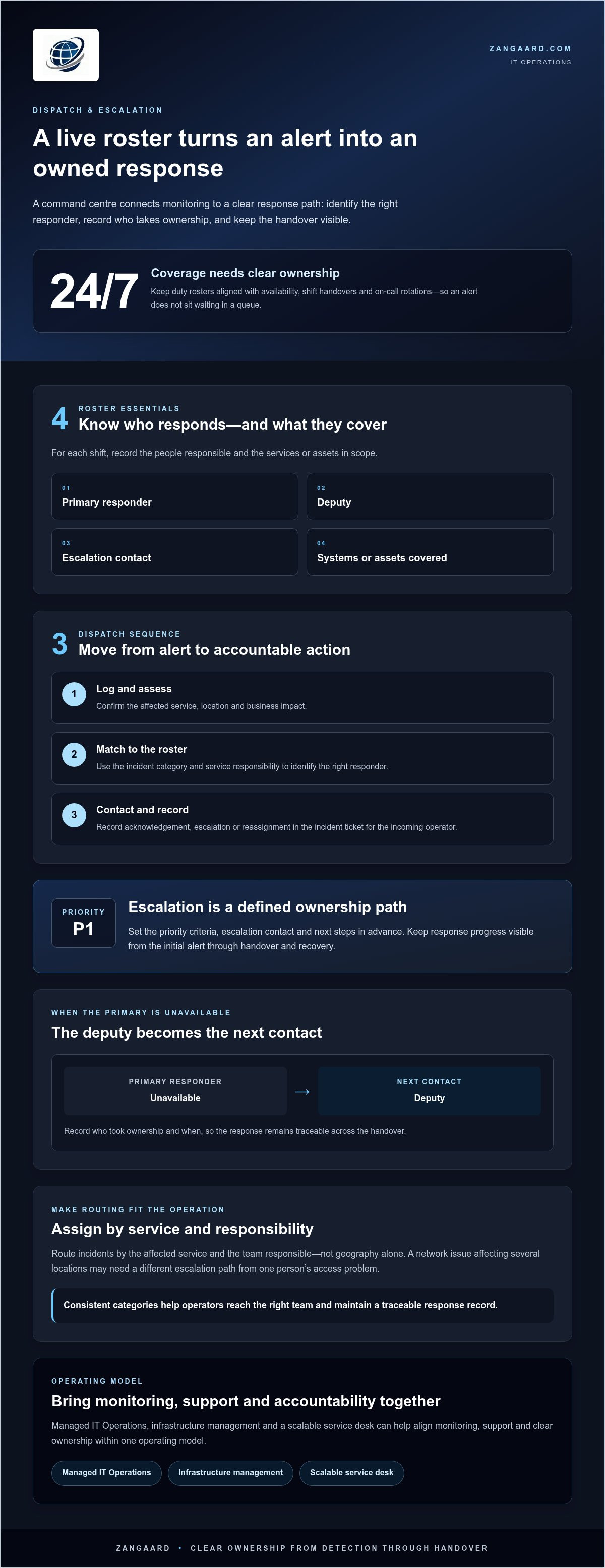
A live duty roster turns an alert into an assigned response. For each shift, record the primary responder, a deputy, escalation contact and the systems or assets they cover. When monitoring flags a database outage, the operator can identify its assigned responder rather than rely on a general contact list. A 24/7 IT command centre depends on keeping that roster aligned with actual availability, handovers and on-call rotations.
Use a clear dispatch sequence whenever an incident arrives. First, log the alert and confirm the affected service, location and business impact. Next, match the incident category to the roster. Then contact the primary responder and record acknowledgement, escalation or reassignment. If the primary is unavailable, the deputy becomes the next contact; the record should show who took ownership and when.
- Map each service, such as email or network access, to a response group.
- Update the roster at shift handover, including leave, swaps and active on-call duties.
- Record dispatch outcomes in the incident ticket for the incoming operator.
Call answering and routing should follow the same ownership model. For example, if someone reports a failed login, capture the affected system and business impact, then route the incident to the responsible service team. Consistent intake and incident logging help operators gather useful details without treating every call as equally urgent. Increasingly, organisations also look to deploy AI agents and synthetic workforce solutions—supported by specialist consultancies like Navo Inc.—to assist with initial triage alongside human duty rosters.
For organisations operating across multiple offices, route incidents by service and responsibility, not geography alone. A network issue affecting several locations may need a different escalation path from one person’s access problem. Clear categories help operators assign the right team and maintain a traceable response record.
This dispatch model also fits national efforts: the Danish government is establishing a cyber monitoring network and a cyber operations centre to strengthen national protection against cyberattacks, reinforcing the importance of clear ownership and escalation.
Emergency handling and priority-one escalation
Emergency handling depends on assessing impact, assigning ownership and keeping actions visible. Define each handover in the priority-one process, from initial alert assessment through escalation and recovery, so responders know what to do next.
Incident monitoring and response
A command centre monitors system alerts, service availability and incident reports, then assesses what is affected. For example, loss of access across a business application may require broader escalation than one failed login. How does a 24/7 IT command centre monitor and respond to incidents? It detects alerts, classifies their impact, assigns an incident owner and records actions through resolution.
On-call and emergency phone handling should use the same process. Operators need a clear script to capture the caller’s affected service, location and business impact, then route the details to the responsible responder. Telehealth adds a distinct boundary: an IT command centre can coordinate reports of platform disruption, whilst clinical assessment belongs with qualified care teams. Mental health emergency telehealth needs its own clinical escalation pathway, separate from an IT fault ticket.
Service levels and response times
A service-level agreement should define priority criteria, operating coverage, acknowledgement, escalation ownership and status updates. It should distinguish the time to acknowledge an incident from the time to restore a service, since these measure different stages. What service-level agreements and response times should a 24/7 IT command centre offer? They should set measurable targets for each priority, with explicit escalation steps and reporting against those targets.
For emergency calls, document who receives them, how missed contact is escalated and where each decision is recorded. Review incidents against agreed service levels, including detection, acknowledgement and resolution. This helps managers refine procedures and identify recurring weaknesses.
Command centre use across sectors
Command centres apply shared coordination principles to different operational needs. Security teams may monitor camera feeds and coordinate responses, while IT teams track network incidents and service dependencies. Tailor escalation rules to the critical assets and responsibilities of each operation rather than copying one workflow across every sector.
An in-house IT command centre keeps operational knowledge within the organisation. A managed service provides an external operating model, which can suit organisations seeking scalable support and clear governance. Compare the options by considering available expertise, integration with existing teams and responsibility for incident ownership.
Denmark’s government is establishing a 24/7 situational centre connected with the National Operational Staff, alongside cyber monitoring and a cyber operations centre. This illustrates how coordination can link incident monitoring, response and crisis management. Organisations should map their operational dependencies, then align required oversight with relevant IT service operations.
What security, privacy, and regulatory requirements apply to IT command centres in Denmark and the EU? Map the data handled, access roles, retention practices and incident records, then identify the obligations applicable to those activities. Clear permissions and documented handling procedures help define accountability across internal and external teams.
There is no single pricing unit that suits every IT command centre. The operating model should reflect the required coverage, supported services, integrations and escalation responsibilities. Compare proposals against those requirements rather than relying on a per-device, per-user or service-tier measure alone.
Set-up starts with mapping critical services, assigning incident owners, defining escalation routes and connecting monitoring with incident records. Test the workflows with realistic scenarios before relying on them. Common risks include unclear ownership, weak handovers, limited asset visibility and over-reliance on undocumented procedures.
ZANGAARD: Managed IT Operations
ZANGAARD helps organisations coordinate day-to-day IT oversight, infrastructure support and service desk operations. Its IT service portfolio connects these capabilities to practical needs, such as clearer management of recurring operational issues or a structured route for user support as requirements change.
For organisations reviewing their operating model, Outsourcing Services can help align delivery with internal responsibilities and priorities. The right combination depends on which services need support, how teams currently work together and where accountability needs strengthening. Define the service scope, clarify ownership and identify the gaps the operating model should address.
Contact ZANGAARD to discuss how Managed Dual Shoring can support your IT operations.
Build incident readiness into your next operating decision
Choosing 24/7 IT command centre services is an operating-model decision, not simply a monitoring purchase. Start by identifying which business outcomes depend on reliable IT, where operational ownership sits, and what management needs to see during disruption. That assessment can reveal whether existing arrangements support the organisation’s priorities or need a more coordinated structure.
ZANGAARD helps organisations consider how managed IT operations fit their wider service model. To make the conversation useful, outline the operational challenge, its business impact, current responsibilities and where stronger oversight is needed. This helps identify an approach suited to your organisation’s requirements.
A sound operating model starts with a clear view of your organisation’s needs. Contact ZANGAARD to discuss the next step.
Frequently Asked Questions
What is a Command Center Service?
A command centre service coordinates oversight and operational decisions for critical IT services. It connects monitoring information, incident records, service owners and communications, without requiring everyone to work in one physical room. For example, if a payroll application becomes unavailable before a processing cycle, the centre can coordinate assessment and updates among the responsible teams.
What services does a 24/7 IT command centre provide?
24/7 IT command centre services can cover continuous operational oversight, incident intake, prioritisation, escalation coordination and status communication. The agreed scope may also include infrastructure management or service desk support. For example, an organisation could route user-reported access problems through the service desk while tracking wider infrastructure disruptions through its operational process.

Disclaimer
The purpose of this article is to generate inspiration, reflection and to start a debate across markets, industries and organizations. We do not recommend any actions soly based on the article statements, claims or opinions, but recommend you to reach out directly to ZANGAARD for a qualified review, dialogue and/or consultation. Reach out at [email protected] or visit our website www.zangaard.com


