

More meetings will not necessarily bring local and remote colleagues closer. Fostering collaboration between local and remote teams starts with asynchronous work: clear goals, documented decisions and agreed response times let people contribute without being online at the same time.
That does not mean real-time conversations or personal connections do not matter. It means building collaboration into the way work is organised, so colleagues can find the information they need, take ownership and know when a discussion requires everyone’s input.
Learn how to establish effective asynchronous working, choose team-building activities that help people connect and embed collaboration in company culture. These practical steps can help distributed teams work with greater clarity and trust.
Key Takeaways
- Clarify ownership, goals and communication expectations so colleagues can contribute without waiting for a real-time response.
- Use relaxed virtual activities to create opportunities for connection beyond routine work discussions.
- Make collaboration part of everyday culture through shared goals, open communication and recognition of contributions.
- When distributed IT operations need clearer coordination, consider how managed IT services can support consistent ways of working.
1. How do I build a culture of collaboration on my team?
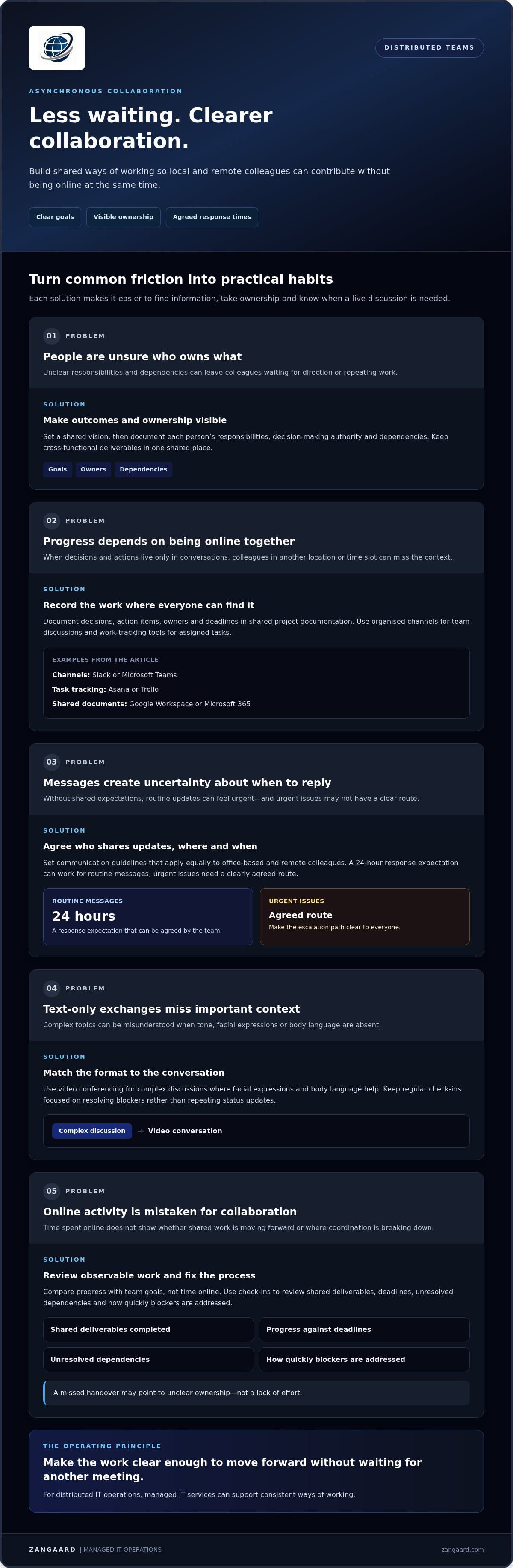
Start with a shared vision that links local and remote work to clear outcomes. Document each team member’s responsibilities, decision-making authority and dependencies so ownership is visible across departments. For example, a product launch plan can set out distinct deliverables for marketing, operations and IT in one shared place. This strengthens cross-functional working and makes progress easier to track. Trust grows when managers assess agreed outcomes rather than monitor every interaction. This approach can improve productivity while encouraging teamwork across locations.
Build trust through transparent decisions, consistent follow-through and communication guidelines that apply equally to office-based and remote employees. Set expectations for who shares updates, where they belong and when a reply is needed. A 24-hour response expectation can work for routine messages, whilst urgent issues need a clearly agreed route. The costs of tools and practices depend on existing subscriptions, the platforms selected and the time spent in meetings. Compare those costs with the coordination needs the tools must support.
Reduce reliance on synchronous communication by recording decisions, action items, owners and deadlines in shared project documentation. Use Slack or Microsoft Teams for organised team or project channels, and Asana or Trello to track assigned work. Google Workspace and Microsoft 365 allow colleagues to collaborate on documents and access current information. Text-only exchanges can cause misunderstandings, so use video conferencing for complex discussions where facial expressions and body language help. For real-time voice connectivity across hybrid workplaces, providers like Nexgen Australia equip organisations with modern office phone and VoIP systems to bridge distributed teams. Regular check-ins should resolve blockers, not simply repeat status updates.
Measure collaboration through observable work: shared deliverables completed, progress against deadlines, unresolved dependencies and how quickly blockers are addressed. Review these indicators during check-ins, then ask team members what is slowing coordination. For example, missed handovers may signal unclear ownership rather than a lack of effort. Compare outcomes with team goals, not time spent online. This gives managers a practical view of productivity and helps identify process changes that can strengthen collaboration.
2. Virtual team-building activities
Choose activities that invite participation rather than passive attendance. A remote team might run a virtual quiz, share stories about a project or solve an online puzzle together. Informal coffee chats create space for conversation beyond deadlines and task updates. Rotate hosts so office-based and remote colleagues can shape the virtual working environment. Interactive activities give people the chance to contribute different strengths and build connections beyond their immediate work.
Use these sessions to support knowledge sharing, not just socialising. For example, invite one team member to demonstrate a useful process, then ask colleagues from another function to share how they approach the same task. A shared document can capture practical tips and questions for later. Mentoring pairs and cross-team discussions also help people learn who holds relevant expertise, making collaboration easier when a project needs input from several teams.
Give everyone equal access by publishing meeting notes, learning materials and opportunities on shared platforms. Set transparent criteria for training, project assignments and recognition, and invite remote employees to contribute in live or written formats. This gives anyone unable to attend a live session a clear way to participate and follow up.
Recognition makes contributions visible across locations. In a virtual team meeting, acknowledge a specific piece of work and explain how it supported a shared outcome. Mark project milestones with online celebrations, such as a team coffee or a short round of appreciation, while keeping participation optional. Pair these moments with regular knowledge-sharing sessions to support engagement and make collaboration part of everyday practice, not a one-off event.
3. Embedding collaboration in company culture
Culture becomes credible when leaders reward collaborative behaviour in everyday decisions. Set shared goals that connect individual work to organisational outcomes, then recognise contributions from both office-based and remote colleagues. For example, praise the person who documents a handover as well as the colleague who completes the task. This shows that sharing knowledge is part of performance, not an optional extra. Managers should also model transparency by explaining decisions and inviting questions.
Build collaboration into project management instead of relying on goodwill. Give each project a shared workspace with clear decision owners, dependencies and milestones. Ask teams to record how decisions affect other functions, so colleagues can act without waiting for informal office conversations. Make regular check-ins include structured problem-solving, not just progress reports. If a handover fails, review the workflow and clarify responsibilities rather than blaming an individual.
Make employee input part of the regular working rhythm. Invite people from different locations and functions to contribute to planning, review meetings and process improvements. For example, rotate the facilitator so one group does not dominate every discussion. Leaders should address conflict early, focus on observable behaviour and keep conversations tied to work outcomes. These approaches help establish consistent expectations for everyone, wherever they work.
Look for practical signs that the culture is changing: shared projects completed, recurring handover issues and participation in problem-solving sessions. Discuss these patterns with employees, then adjust processes where collaboration is difficult. If morale drops after a new workflow is introduced, ask which step creates friction and test a specific improvement. The central lesson is simple: culture lasts when recognition, project routines and leadership behaviour reinforce the same collaborative standards.
ZANGAARD: Managed IT Operations
ZANGAARD provides Managed IT Operations for organisations that need dependable IT support across local and remote teams. When unclear service processes, recurring issues or fragmented support disrupt collaboration, structured operational oversight can help teams work more consistently. IT Infrastructure Management supports the systems people rely on, while a Scalable Service Desk gives staff a clear route for IT requests. Outsourcing Services can also help organisations align support capacity with operational needs.
These services support the technology and operational foundations of distributed work; they complement, rather than replace, clear team goals and communication practices. Explore ZANGAARD’s IT services to see how they may fit your organisation’s needs.
Visit zangaard.com to learn more about ZANGAARD.
Build collaboration into the next stage of work
Lasting progress depends on building collaboration into everyday decisions rather than treating it as a separate initiative. As your teams evolve, review where handovers slow down, which processes depend on informal office conversations and whether remote colleagues can contribute on equal terms. These observations offer a practical starting point for fostering collaboration between local and remote teams, with changes grounded in operational priorities.
Where IT coordination is part of the challenge, ZANGAARD can help organisations consider how operational support and infrastructure fit distributed ways of working. A focused conversation about your workflows, responsibilities and where teams need better continuity can keep improvements grounded in your organisation’s needs. Use it to identify a practical first step, then assess how that change supports shared priorities and smoother work across locations.
With clear ownership and well-planned operational foundations, your people can build a more connected way of working across locations.
Frequently Asked Questions
First of all, why asynchronous work?
Asynchronous work suits tasks that do not require an immediate exchange, such as reviewing a proposal or preparing a handover. It gives colleagues time to consider the details and respond with useful context, rather than interrupting focused work. Use a live conversation when a decision is urgent or the issue is too ambiguous to resolve in writing, supported by dependable business phone solutions from Business Telecom to ensure teams can connect immediately.
How do I build a culture of collaboration on my team?
Make collaboration part of how people join, develop and review work. During onboarding, explain how teams share expertise and involve colleagues in decisions. In performance conversations, recognise contributions that help others succeed, such as documenting a process or offering specialist input. These signals show that collaboration is valued in practice, not just in company statements.
How do I get a reluctant team member to participate in collaboration?
Speak privately first and ask what makes participation difficult, rather than assuming a lack of interest. The barrier might be unclear expectations, limited confidence or a meeting format that leaves little room to contribute. Offer a specific, manageable invitation, such as asking which ideas they would put forward by the end of the day, then acknowledge their input.
How do I handle conflict that's damaging team collaboration?
Address the disagreement directly and promptly, before assumptions become habits. Ask each person to describe what happened, its impact on the work and what would help resolve it. Keep the discussion focused on observable actions, not judgements about character. Finish by recording the agreed next step and arranging a follow-up to see whether cooperation has improved.
How do I improve collaboration on a remote or hybrid team?
Trace one recent handover from request to completion, then identify where ownership or context became unclear. Assign a named owner to each transition and make the required information easy to find. Fostering collaboration between local and remote teams also means giving remote colleagues an equal way to raise blockers and influence decisions, rather than simply receiving updates.

Disclaimer
The purpose of this article is to generate inspiration, reflection and to start a debate across markets, industries and organizations. We do not recommend any actions soly based on the article statements, claims or opinions, but recommend you to reach out directly to ZANGAARD for a qualified review, dialogue and/or consultation. Reach out at [email protected] or visit our website www.zangaard.com


