

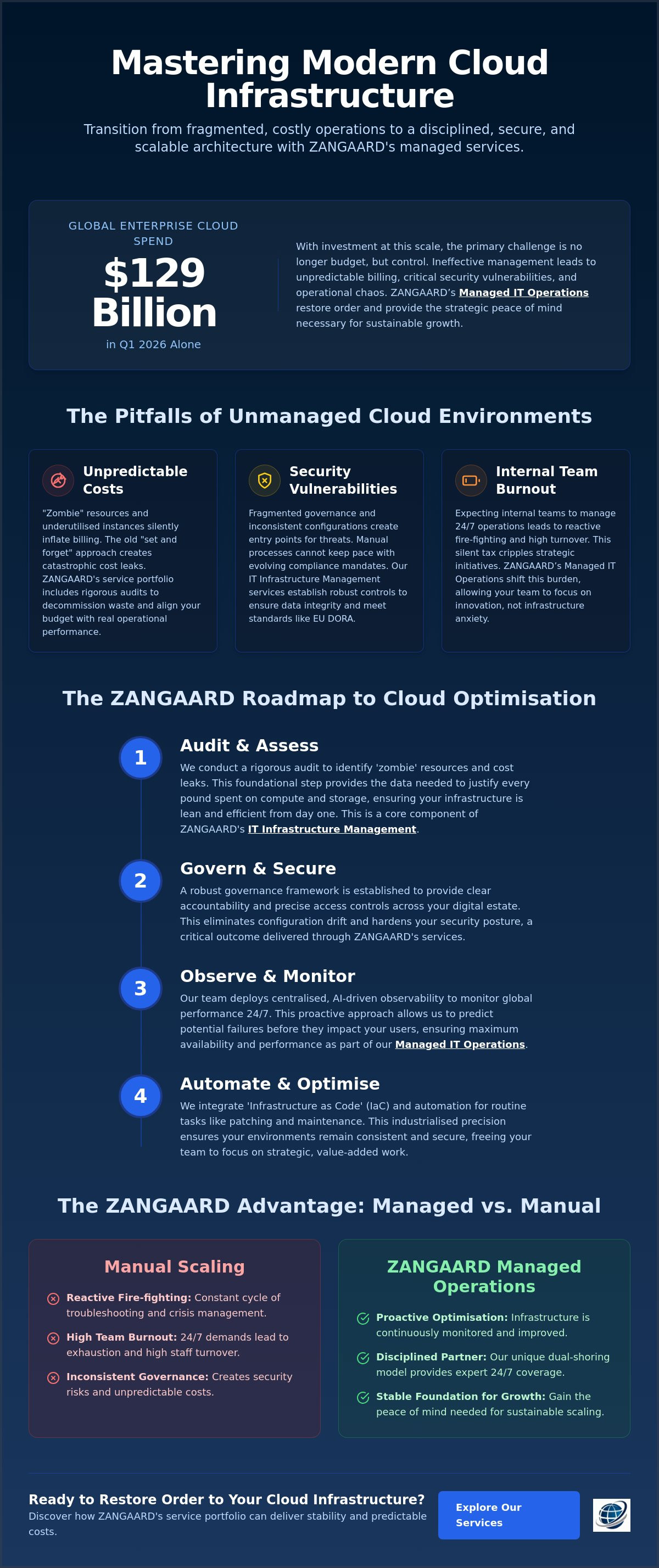
With global enterprise spending on cloud infrastructure reaching a record $129 billion in the first quarter of 2026, the scale of investment is no longer the primary hurdle for growth. Instead, many leaders find themselves trapped in a cycle of unpredictable billing and security vulnerabilities born from fragmented governance. You likely feel the pressure of managing complex, 24/7 operations whilst struggling to find the internal talent necessary to maintain a steady hand. Effective cloud infrastructure management in this era requires more than just technical tools; it demands a shift toward a disciplined, managed model that balances global performance with absolute local accountability.
At ZANGAARD, we specialise in restoring order to these high-stakes environments through our Managed IT Operations and comprehensive IT Infrastructure Management. This article explores how to transition from chaotic, fragmented setups to a stable architecture that delivers predictable costs and strategic peace of mind. We will outline the frameworks used by our experts to ensure your growth remains scalable, secure, and under your control.
Key Takeaways
- Understand why modern cloud infrastructure management has evolved from simple resource provisioning into a disciplined orchestration of global digital assets to ensure 24/7 availability.
- Learn how to conduct a rigorous environment audit to identify cost leaks and decommission underutilised resources, ensuring your budget remains aligned with operational performance.
- Discover the methodology for establishing a robust governance framework that provides clear accountability and precise access controls across your entire digital estate.
- Explore how ZANGAARD’s Managed IT Operations utilise a unique dual-shoring model to combine high-calibre technical execution with strategic local leadership.
- Identify the strategic steps to transition toward a model of local accountability that offers the peace of mind required for sustainable scaling through our service portfolio.
What is Cloud Infrastructure Management in a Global Context?
At its core, cloud infrastructure management is the disciplined orchestration of virtual servers, storage, and networking assets to ensure 24/7 availability and peak performance. Whilst the foundational concepts of Cloud computing remain constant, the execution has moved far beyond simple resource provisioning. In the current high-stakes environment, where global enterprise cloud spending reached $129 billion in the first quarter of 2026, management is no longer a background task; it is the central nervous system of the modern enterprise.
We have entered an era of 'Composed Authority' over digital assets. The 'set and forget' behaviours of previous years now lead to catastrophic cost leaks and security gaps. Business leaders must align their architecture with critical outcomes, ensuring that every virtual machine and storage bucket serves a specific, governed purpose within the broader organisational strategy. This shift requires moving from passive oversight to active, managed operations that prioritise stability and transparency.
The Core Pillars of Cloud Governance
Effective governance rests on two fundamental supports: technical efficiency and regulatory rigour. Within our service portfolio, we approach these pillars through a lens of industrialised precision.
- Compute and Storage: This involves balancing cost-efficiency with high-performance scalability. With Azure Archive and AWS Glacier Deep Archive pricing at $0.00099 per GB as of 2026, the challenge isn't just finding space; it's managing the complex retrieval and egress fees that often surprise unmanaged teams.
- Security and Compliance: With the EU DORA regulation coming into full effect in January 2026, real-time risk monitoring is now a legal mandate for many. Maintaining data integrity whilst meeting international standards requires a level of oversight—often provided by specialists such as CyberOne—that manual processes cannot provide.
Why Managed Operations Beat Manual Scaling
Manual scaling often hides a silent tax: internal team burnout. In a 24/7 digital economy, relying on internal staff to manage round-the-clock operations leads to reactive troubleshooting and high turnover. Transitioning to ZANGAARD's Managed IT Operations shifts this burden to a disciplined partner. We move your organisation from a state of constant fire-fighting to proactive infrastructure optimisation. This ensures that your technical environment remains a stable foundation for growth rather than a source of operational anxiety.
How to Organise Your Cloud Management Roadmap
Transitioning from a fragmented cloud setup to a disciplined operational model requires a methodical sequence. It's not enough to simply move workloads; you must orchestrate them. A structured roadmap ensures that cloud infrastructure management becomes a catalyst for growth rather than a source of financial friction. This process begins with high-level strategy and moves steadily toward granular, automated execution.
Auditing for Cost and Performance
The first step involves a rigorous audit of your existing environment to identify 'zombie' resources and cost leaks. These underutilised instances, often left running after temporary projects conclude, silently inflate monthly billing whilst providing zero value. Performance baselining is the foundation of cloud ROI because it provides the data necessary to justify every pound spent on compute and storage. By aligning your resource allocation with the NIST definition of cloud computing, you ensure your infrastructure remains elastic and measured rather than bloated and unmonitored.
Implementing Automation and Observability
Once your environment is lean, you must define a governance framework to establish clear accountability. This leads naturally into the implementation of intelligent observability across all geographical centres. Using 'Infrastructure as Code' (IaC) ensures that your environments remain consistent across global regions, which effectively eliminates the configuration drift that often invites security vulnerabilities.
- Step 1: Audit for 'zombie' resources and decommission idle instances.
- Step 2: Define governance and access controls to ensure local accountability.
- Step 3: Deploy centralised observability to monitor global performance.
- Step 4: Integrate automation for routine patching and maintenance.
Integrating AI-driven monitoring allows your organisation to predict potential failures before they impact the user experience. This proactive stance is a core component of our Managed IT Operations, where we handle the burden of maintenance so you can focus on strategic scaling. If you're ready to regain control, exploring a structured service portfolio is the first step toward long-term operational stability.
Scaling Cloud Infrastructure with Managed Dual Shoring
Scaling cloud infrastructure management requires more than just automated scripts; it necessitates a human management model that bridges geographical divides. Many firms struggle with the 'management gap' where tools are present, but the expertise to wield them across time zones is missing. Our approach, known as Managed Dual Shoring, solves this by combining the strategic rigour of Danish leadership with high-calibre technical execution from our teams in the Philippines. This structure ensures that whilst your technical assets are monitored 24/7, you maintain a single point of local accountability that understands your business culture.
Bridging the talent gap is no longer about finding a single 'unicorn' engineer. It's about accessing global specialist teams under a unified management standard. Implementing a secure cloud architecture ensures that your growth is resilient against the vulnerabilities of a 24/7 digital economy. By shifting the burden of daily operations to a disciplined 24/7 Service Desk, your internal leaders are freed to focus on high-level strategy rather than reactive troubleshooting.
The Advantage of Danish Management
Local oversight removes the friction often inherent in traditional offshoring. We maintain industrialised standards of transparency and reporting, ensuring that complex cloud operations never become a 'black box'. This 'favourite' choice for growing firms provides the peace of mind that comes from knowing your global digital estate is being handled by a steady, disciplined hand. Our Managed IT Operations act as a bridge, connecting your high-level business goals with daily technical excellence.
Integrating Your Cloud Strategy
A stable, well-managed cloud environment serves as the springboard for long-term Digital Transformation Consulting. Instead of fighting fires, your organisation can begin to leverage cloud-native features that drive true competitive advantage. We provide the roadmap and the steady execution needed to turn technical complexity into operational simplicity, often collaborating with platform specialists like kagool.com to ensure seamless integration.
Explore our Managed IT Operations and Service Portfolio to see how we handle cloud complexity for you.
Secure Your Foundation for Future Growth
Achieving scalable growth in 2026 requires a departure from the reactive provisioning of the past. Success now depends on the seamless integration of high-level governance with rigorous technical execution. By auditing for cost leaks and implementing intelligent observability, you can transform your digital estate into a stable foundation for innovation. This disciplined approach ensures that cloud infrastructure management remains a strategic asset rather than an operational burden.
ZANGAARD has provided Danish managed operations since 2014, offering a specialised Managed Dual Shoring model that bridges the gap between global technical execution and local accountability. Through our Managed IT Operations and 24/7 Service Desk, we provide the steady hand needed to navigate complex, high-stakes environments. You don't have to manage this complexity alone; our service portfolio is designed to give you the peace of mind that comes from knowing your operations are handled by experts who prioritise transparency and precision. Secure your cloud operations with ZANGAARD's Managed IT Services and step into a more predictable, secure future.
Frequently Asked Questions
What is the difference between cloud management and cloud governance?
Cloud management focuses on the daily orchestration of digital assets, whilst cloud governance establishes the strategic framework of rules and policies that guide those operations. Governance ensures compliance with regulations like EU DORA; management handles the technical execution of virtual servers and storage. Through our service portfolio, we integrate both disciplines to ensure your infrastructure is not only operational but also fully aligned with corporate risk standards and accountability.
How can I reduce my cloud infrastructure costs in 2026?
Reducing costs in 2026 requires a shift from passive monitoring to active FinOps and resource right-sizing. You can achieve this by conducting a rigorous audit to eliminate 'zombie' resources and leveraging archive storage options, such as Azure Archive, which currently offers pricing at $0.00099 per GB. Our Managed IT Operations provide the continuous oversight needed to identify these cost leaks before they impact your monthly billing, ensuring predictable expenditure whilst you scale.
Is it better to manage cloud infrastructure in-house or through a provider?
Managing cloud infrastructure management in-house often leads to talent burnout and reactive troubleshooting in a 24/7 digital economy. Partnering with a specialised provider offers access to industrialised standards and round-the-clock support that most internal teams struggle to maintain. ZANGAARD's IT Infrastructure Management shifts the burden of maintenance from your staff to our experts, providing a stable environment with local accountability and strategic peace of mind.
How does Managed Dual Shoring improve cloud security?
Managed Dual Shoring improves security by combining high-calibre technical execution with local, Danish-led oversight. This model eliminates the communication gaps found in traditional offshoring and ensures that security patches are applied across global regions without human error. By integrating our 24/7 Service Desk, your organisation benefits from constant vigilance and a unified management standard that adheres to rigorous international security frameworks, protecting your digital assets regardless of the time zone.
Disclaimer
The purpose of this article is to generate inspiration, reflection and to start a debate across markets, industries and organizations. We do not recommend any actions soly based on the article statements, claims or opinions, but recommend you to reach out directly to ZANGAARD for a qualified review, dialogue and/or consultation. Reach out at [email protected] or visit our website www.zangaard.com


