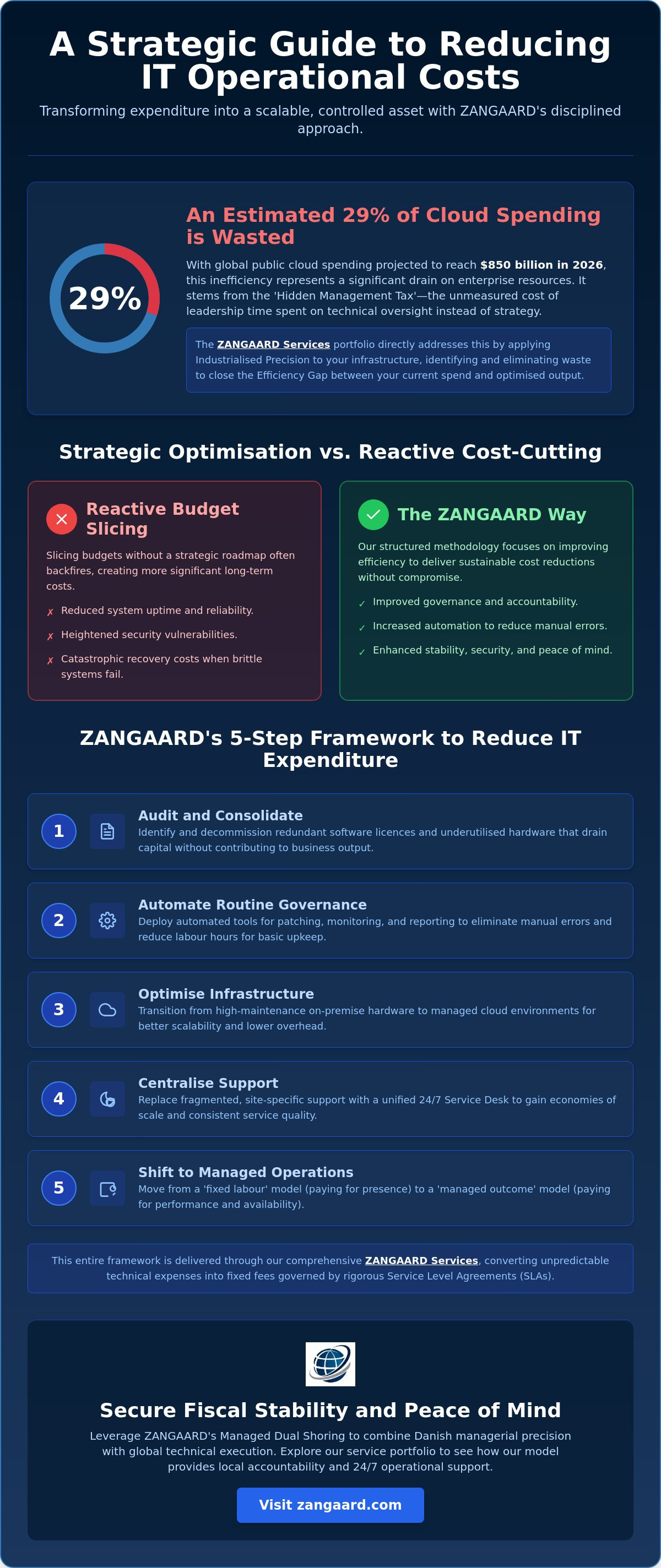
With global public cloud spending projected to reach $850 billion in 2026, it's sobering to realise that an estimated 29% of that investment is entirely wasted. You've likely felt the pressure of rising domestic talent costs and the persistent drag of legacy infrastructure; meanwhile, the management overhead of traditional offshore teams often costs more in lost time than it saves in currency. Many leaders find themselves searching for how to reduce IT operational costs without sacrificing the reliability their enterprise demands.
At ZANGAARD, we solve these inefficiencies through our ZANGAARD Services and comprehensive service portfolio, applying disciplined architectural precision to your infrastructure. This guide provides a structured methodology for lowering expenditure whilst maintaining high-quality service delivery and operational control. We'll explore how to transform unpredictable IT budgets into scalable, controlled assets through local accountability and our 24/7 Service Desk framework, ensuring your digital transformation consulting leads to genuine fiscal stability and the peace of mind that comes from expert oversight.
Key Takeaways
- Define the efficiency gap within your IT OpEx to identify exactly where recurring maintenance costs don't align with your primary strategic goals.
- Eliminate the "Hidden Management Tax" by offloading the burden of technical oversight to a disciplined Managed IT Operations framework.
- Discover how to reduce IT operational costs through a five-step strategic audit that targets redundant software licences and underutilised hardware.
- Leverage the synergy of Managed Dual Shoring to combine Danish managerial precision with the technical execution found in our service portfolio.
- Secure peace of mind and a scalable budget by transitioning to a model that offers local accountability alongside 24/7 operational support.
Understanding IT Operational Costs and the Efficiency Gap
IT operational costs (OpEx) represent the recurring financial commitments required to sustain an enterprise's digital heartbeat, encompassing infrastructure maintenance, security protocols, and continuous technical support. Achieving true IT cost transparency is the essential first step in identifying where capital is being deployed effectively versus where it's being drained by invisible inefficiencies. Many executives investigating how to reduce IT operational costs overlook the "Hidden Management Tax," which is the disproportionate amount of time senior leadership spends supervising technical staff rather than focusing on high-level strategy. Traditional scaling models are failing to remain cost-effective as domestic talent costs rise and infrastructure complexity grows beyond the capacity of standard in-house teams. At ZANGAARD, we introduce "Industrialised Precision" through our ZANGAARD Services to close this gap, replacing fragmented processes with disciplined, repeatable operational frameworks that ensure every pound spent delivers measurable value.
The Real Cost of In-House IT Management
Recruiting and retaining specialised talent in a competitive market drives up payroll and training expenses to levels that often outpace inflation. Beyond direct salaries, unoptimised legacy systems create technical debt that requires constant, expensive intervention from senior engineers who should be innovating. Within our service portfolio, we address these drains by modernising infrastructure management and shifting the burden of daily oversight away from your internal leaders. The Efficiency Gap is the distance between your current operational spend and your fully optimised output.
Why Generic Cost-Cutting Often Backfires
Slicing budgets without a strategic roadmap often results in reduced system uptime and heightened security vulnerabilities that invite long-term disaster. Reactive cuts might lower immediate spending, but they frequently lead to catastrophic recovery costs later when brittle systems fail under pressure. Strategic optimisation focuses on how to reduce IT operational costs by improving governance, automation, and accountability rather than simply removing essential resources. This disciplined approach ensures that cost reduction doesn't compromise the stability or security of your enterprise operations.
Five Strategic Steps to Reduce IT Operational Expenditure
Reducing expenditure requires more than just trimming line items; it demands a fundamental shift in how resources are governed and deployed. Complexity is the enemy of cost control. By auditing software licences and hardware utilisation, enterprises can strip away the redundant layers that inflate budgets without adding value. Implementing a structured framework for how to reduce IT operational costs involves five critical actions:
- Audit and Consolidate: Identify and decommission redundant software licences and underutilised hardware that drain capital without contributing to output.
- Automate Routine Governance: Deploy automated tools for patching, monitoring, and reporting to eliminate manual errors and reduce the labour hours required for basic upkeep.
- Optimise Infrastructure: Transition from high-maintenance on-premise hardware to managed cloud environments that offer better scalability and lower overhead.
- Centralise Support: Replace fragmented, site-specific support with a unified 24/7 Service Desk to gain economies of scale and consistent service quality.
- Shift to Managed Operations: Move away from a "fixed labour" model, where you pay for presence, to a "managed outcome" model, where you pay for performance and availability.
Leveraging Managed IT Operations for Predictability
Transitioning to ZANGAARD Services allows an organisation to convert variable, unpredictable technical expenses into fixed monthly fees. This shift provides the strategic reassurance that comes with rigorous Service Level Agreements (SLAs), ensuring that quality is maintained whilst internal management burdens are significantly reduced. By offloading the operational weight to our expert teams, leaders regain the capacity to focus on growth rather than daily troubleshooting. You can explore our full service portfolio to see how this model integrates into your existing structure.
Cloud and Infrastructure Optimisation
Financial agility is achieved by moving from heavy capital expenditure (CAPEX) to a more flexible operational expenditure (OPEX) model through specialised IT Infrastructure Management. This approach allows for the integration of global expertise at a more sustainable price point, utilising remote management to maintain high standards without the costs of a physical local presence. It's a disciplined way to ensure your infrastructure remains modern and secure without the traditional price tag of domestic scaling. If you're ready to stabilise your budget, our team can help you map out a transition that prioritises both efficiency and performance.
Managed Dual Shoring: The Ultimate Vehicle for Cost-Efficiency
Managed Dual Shoring represents the sophisticated evolution of traditional outsourcing, designed specifically to address the "Offshore Risk" that plagues many international enterprises. By integrating Danish management standards with high-calibre technical execution in the Philippines, ZANGAARD provides a transparent, accountable framework for how to reduce IT operational costs. This model functions as a disciplined bridge between high-level strategy and daily execution, ensuring that the burden of management never shifts back to the client. It replaces the fragmented nature of conventional offshoring with a synergistic approach where different geographical locations work in harmony.
Danish Management Standards vs. Traditional Offshoring
Standard offshoring often creates a "black box" where quality and communication are sacrificed for lower hourly rates. Our approach replaces this uncertainty with the transparency of Danish-led governance, maintaining rigorous oversight that ensures cost-reduction never results in a drop in service quality. Through ZANGAARD Services, we provide the local accountability required to maintain high standards whilst leveraging global cost advantages. This synergy allows for a "no-nonsense" attitude toward quality that traditional, unmanaged models simply cannot replicate.
Realising ROI through Global Talent Scalability
A dual-shore model allows your enterprise to scale technical capabilities 24/7 without the prohibitive overhead of domestic recruitment or the complexities of local hiring. This industrialised approach to Managed IT Operations offers the "peace of mind" that only comes when complex, high-stakes infrastructure is handled by a disciplined global architect. By utilising our 24/7 Service Desk and infrastructure management, you achieve a predictable IT budget and the operational stability necessary for modern growth. It is the ultimate vehicle for those seeking a simplified, controlled version of international expertise that delivers unwavering reliability.
Securing Long-Term Stability through Operational Precision
Achieving a lean, high-performing IT department requires more than simple budget cuts; it demands a fundamental re-engineering of your service delivery. We've explored how identifying the hidden management tax and modernising legacy infrastructure closes the efficiency gap. By implementing a structured five-step audit and embracing Managed Dual Shoring, your organisation can finally solve the puzzle of how to reduce IT operational costs without compromising on quality or security.
ZANGAARD brings over 10 years of operational excellence to this challenge, bridging the gap between high-level strategy and daily execution. Our model provides the strategic reassurance of Danish management and local accountability alongside the scalable technical execution found in our service portfolio. It's time to shift the burden of daily oversight to an expert partner who values thoroughness as much as you do. This disciplined approach ensures your enterprise remains agile whilst maintaining the highest standards of governance.
Explore ZANGAARD’s Managed IT Operations and Service Portfolio to establish a predictable, scalable budget today. You'll find that regaining control over your digital environment is the first step toward true operational peace of mind. For businesses looking to extend this efficiency to their physical supply chain, you might also discover Delgate and their expertise in Canadian courier solutions.
Frequently Asked Questions
What is the fastest way to reduce IT operational costs without firing staff?
The most immediate method is the consolidation of redundant software licences and the automation of manual governance tasks like patching and reporting. By implementing Managed IT Operations, an enterprise can eliminate the "Hidden Management Tax" without reducing headcount. This strategic shift addresses how to reduce IT operational costs by redirecting your existing talent toward high-value innovation whilst we handle the resource-heavy maintenance through our disciplined service portfolio.
How does Managed Dual Shoring differ from traditional IT outsourcing?
Managed Dual Shoring differs from traditional outsourcing by providing local Danish accountability and high-level governance over technical execution in the Philippines. Unlike standard "black box" models that often lead to a loss of control, our approach ensures every operational outcome is managed by a disciplined global architect. This synergy allows you to scale technical capabilities 24/7 whilst maintaining the same rigorous standards you'd expect from a domestic team.
Can I maintain security and compliance whilst reducing IT spend?
You can maintain high security and compliance standards by replacing fragmented, manual processes with standardised, automated governance frameworks. Our IT Infrastructure Management ensures that patching, monitoring, and reporting are handled with industrialised precision. Reducing spend through optimisation actually strengthens your posture by removing the vulnerabilities inherent in unmanaged legacy systems, providing the strategic reassurance that your enterprise remains protected whilst costs are controlled.
What IT functions are the easiest to transition to a managed model for immediate savings?
The 24/7 Service Desk and routine infrastructure monitoring are the most straightforward functions to transition for immediate fiscal impact. These areas often carry high domestic labour costs and significant management overhead that can be quickly optimised through our service portfolio. Moving these to a managed model allows for instant scalability and predictable monthly fees, effectively illustrating how to reduce IT operational costs through the industrialised delivery of essential support services.
Disclaimer
The purpose of this article is to generate inspiration, reflection and to start a debate across markets, industries and organizations. We do not recommend any actions soly based on the article statements, claims or opinions, but recommend you to reach out directly to ZANGAARD for a qualified review, dialogue and/or consultation. Reach out at [email protected] or visit our website www.zangaard.com


