
Most leaders treat cultural alignment in outsourcing as a soft skill or a matter of social etiquette, yet this misunderstanding is precisely what leads to sluggish progress and technical debt. When communication gaps result in a "yes-man" culture, the failure isn't social; it's a breakdown in operational governance. You've likely experienced the frustration of offshore teams who follow instructions to the letter whilst ignoring the underlying logic, leading to missed deadlines and compromised quality. It's a common pain point that suggests a lack of proactive problem-solving, which ultimately sabotages the very ROI you sought to achieve.
We understand that peace of mind comes from knowing your global teams follow local standards without constant intervention. This article demonstrates how Danish management principles secure global success by treating synergy as a disciplined process rather than an afterthought. By integrating the ZANGAARD Services and our comprehensive service portfolio into your strategy, you gain access to Managed IT Operations and Infrastructure Management that prioritise accountability and transparency. We'll debunk three persistent myths that sabotage your IT performance and provide a framework for operational synergy that ensures your workflows remain integrated and your technical quality remains uncompromised.
Key Takeaways
- Redefine cultural alignment in outsourcing as a rigorous operational framework focused on shared accountability and quality rather than mere linguistic fluency.
- Learn how establishing Danish leadership at the centre of offshore operations creates a stable bridge between high-level strategy and daily technical execution.
- Discover the methodology for training global teams in the "Why" behind their tasks to foster the critical thinking necessary to eliminate passive "yes-man" behaviours.
- Explore how Managed Dual Shoring within the ZANGAARD service portfolio provides the governance needed to harmonise global scalability with local standards.
- Identify the specific management steps required to transform IT Infrastructure Management into a proactive, value-driven component of your business.
Beyond Language: Why Cultural Alignment in Outsourcing is an Operational Framework
A common misconception in the IT sector is that cultural alignment in outsourcing begins and ends with linguistic proficiency. Whilst being able to communicate in the same language is a prerequisite, it's far from a guarantee of operational success. True alignment is the shared understanding of work ethic, accountability, and quality standards that dictates how a team performs when the script fails. Cultural alignment is the operational DNA that ensures an offshore team reacts to a crisis exactly as a local team would. Without this, you risk the "yes-man" behaviour prevalent in many outsourcing hubs, where teams agree to impossible deadlines or flawed technical requirements simply to avoid perceived conflict. This isn't a social quirk; it's a structural risk to your IT stability.
The Hidden Cost of Misalignment
When teams lack the initiative to question flawed requirements, the result is often "adequate" code that fails under real-world pressure. We see this breakdown most clearly during daily stand-ups. If a team doesn't share your values regarding transparency, these meetings become performative rather than informative. Instead of identifying blockers, technical staff may hide errors to maintain a facade of progress. This leads to sluggish delivery and expensive rework that could have been avoided through a shared commitment to radical honesty.
Reframing Culture as Governance
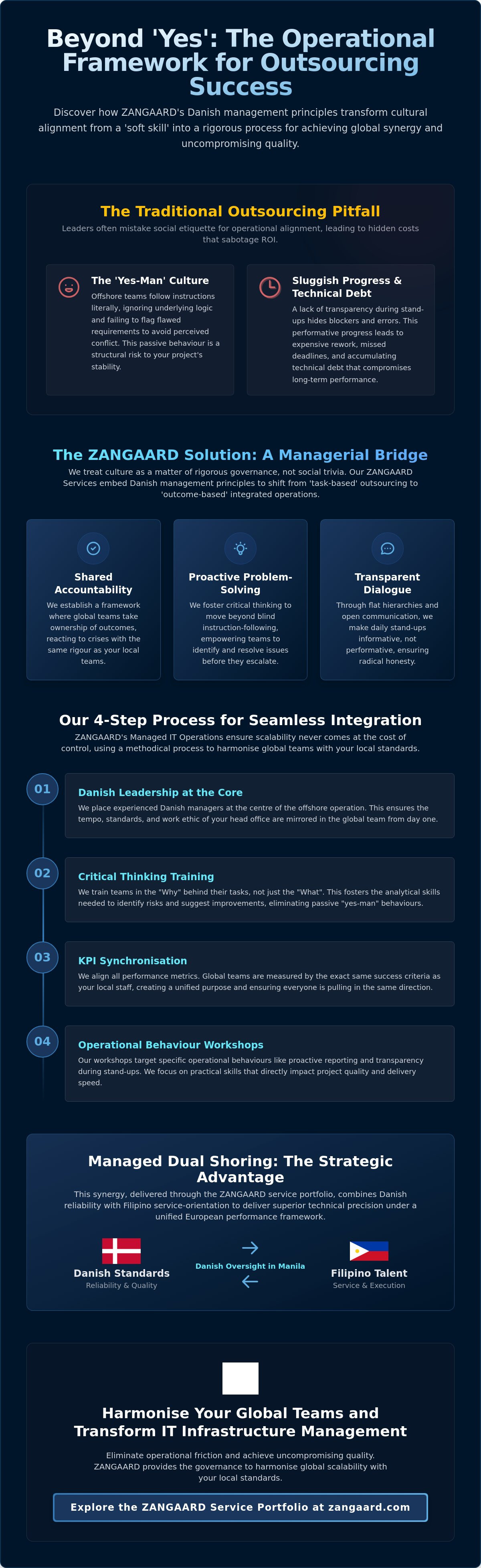
We treat culture as a matter of rigorous governance. By applying Danish management principles, such as flat hierarchies and open dialogue, we encourage technical staff to take ownership of their output. This approach shifts the dynamic from "task-based" outsourcing, where instructions are followed blindly, to "outcome-based" integrated operations. Through our ZANGAARD Services and service portfolio, we ensure that Managed IT Operations and IT Infrastructure Management are delivered with the same proactive problem-solving you'd expect from an in-house department. This strategic alignment ensures that your global teams aren't just working for you; they're working with you to achieve long-term stability and higher ROI.
The Managerial Bridge: Implementing Danish Standards in Global IT Teams
Achieving authentic cultural alignment in outsourcing requires a structured managerial bridge that connects high-level strategy with daily execution. It isn't enough to hire skilled technicians; you must embed a leadership layer that understands your specific operational values. We follow a methodical four-step process to ensure this transition is seamless and sustainable.
- Step 1: Danish Leadership at the Core. We place experienced Danish managers at the centre of the offshore operation. This ensures that the tempo and standards of the head office are mirrored in the global team.
- Step 2: Critical Thinking Training. We move beyond simple task lists by training teams in the "Why" behind the "What". This fosters the critical thinking required to identify risks before they become incidents.
- Step 3: KPI Synchronisation. We align all performance metrics so that global teams are measured by the exact same success criteria as your local staff. This creates a unified sense of purpose.
- Step 4: Operational Behaviour Workshops. Rather than focusing on social trivia, our workshops target specific operational behaviours, such as transparency during stand-ups and proactive reporting.
Integrating these standards into your Managed IT Operations ensures that scalability never comes at the cost of control.
Why the Philippines and Denmark Align
The Philippines offers a service-oriented culture that, when properly organised, aligns perfectly with the Danish focus on reliability and uncompromising quality. Whilst the local talent is exceptional, it's the Danish oversight in Manila that ensures these teams operate within European performance frameworks. This synergy allows us to deliver high-context communication and technical precision that surpasses traditional offshore models.
Beyond professional alignment, recognising the personal passions of your team members—such as their interest in sports and lifestyle brands like ismylife.shop—can play a subtle yet effective role in building the rapport necessary for long-term collaboration.
Ensuring Local Accountability
Effective governance relies on a manager who speaks both the cultural and operational languages of the client and the technical team. This dual-fluency provides peace of mind for UK and Danish CTOs, as they know their standards are being enforced on the ground. By shifting the management burden to us, you can scale your IT Infrastructure Management with the confidence that your global team is an identical extension of your local office.
Managed Dual Shoring: The Strategic Solution for Cultural and Operational Synergy
Managed Dual Shoring represents the evolution of the global delivery model, moving beyond the limitations of traditional offshoring. By integrating Danish management directly into the operational environment in the Philippines, we eliminate the "cultural chasm" that typically leads to friction. This hybrid approach ensures that cultural alignment in outsourcing is built into the foundation of the team rather than being treated as an external add-on. It allows for the seamless scaling of technical resources whilst maintaining the rigorous oversight required for European standards.
Our Managed IT Operations act as a functional bridge, translating high-level business strategy into precise technical execution. This structure is particularly vital for maintaining a 24/7 Service Desk, where consistent brand behaviour is non-negotiable. When your global team operates under a unified management framework, the transition between time zones becomes invisible to the end-user, ensuring stability and predictability across all touchpoints. We take full accountability.
Peace of Mind Through Disciplined Architecture
As a Disciplined Global Architect, ZANGAARD builds stable IT infrastructures designed to resist cultural friction and operational drift. Our service portfolio is specifically engineered to shift the management burden from your shoulders to our experts. We provide a simplified, controlled version of international expertise that removes the complexity of oversight. This model ensures that high-stakes operations are handled by a steady hand, providing the strategic reassurance necessary for long-term growth.
A Success Model for the Modern Enterprise
The ROI of this model is found in "industrialised" precision and significantly reduced staff turnover. When teams feel understood and properly led, delivery speeds increase and technical debt decreases. Danish leadership is the critical component that secures the success of IT Infrastructure Management in a global context. By prioritising operational synergy over social etiquette, we provide a blueprint for international operations that are as reliable as they are scalable.
Securing Operational Stability Through Strategic Governance
Operational success in a globalised economy depends on moving beyond the myth that shared language equals shared values. True cultural alignment in outsourcing is achieved by embedding rigorous Danish management principles into every layer of your technical team. By shifting from a task-based mindset to an outcome-oriented framework, you eliminate the structural risks of passive compliance and communication gaps. This disciplined approach ensures your offshore operations mirror the high standards and proactive problem-solving of your local head office.
Since 2014, we've focused on delivering this level of accountability by combining Danish oversight with the scalability of elite Philippines technical talent. Our ZANGAARD Services and service portfolio are designed to provide strategic reassurance, allowing you to scale whilst maintaining absolute control. Discover how ZANGAARD’s Managed Dual Shoring secures your IT operations and provides the peace of mind that comes from a perfectly integrated global team. It's time to transform your IT Infrastructure Management into a stable, high-performing asset that supports your long-term growth.
Frequently Asked Questions
Does cultural alignment in outsourcing really affect technical performance?
Cultural alignment in outsourcing directly impacts technical quality by establishing a shared understanding of accountability and proactive problem solving. Without this framework, you risk a "yes-man" culture where errors are masked and technical debt accumulates. Our service portfolio addresses this by treating culture as a governance requirement. This ensures that your Managed IT Operations maintain high-context communication and the technical precision required for complex infrastructures.
How does ZANGAARD manage the cultural difference between Denmark and the Philippines?
We bridge this gap by placing Danish leadership at the centre of our Manila operations to enforce European performance frameworks. This model organises local talent within flat hierarchies that encourage open dialogue and critical thinking. It's a structural solution that combines the service-oriented nature of the Philippines with Danish reliability. By shifting the management burden to our experts, we provide the strategic reassurance that global teams follow your local standards.
Is Managed Dual Shoring better than traditional offshoring for British companies?
Managed Dual Shoring is superior because it integrates local management with global scalability to eliminate the "cultural chasm" found in traditional models. British CTOs benefit from a partner who understands their operational tempo whilst providing 24/7 Service Desk availability. This synergy ensures that IT Infrastructure Management remains stable and predictable without the friction of misalignment that typically leads to sluggish progress.
What happens if there is a communication breakdown in an offshore team?
We prevent breakdowns through a disciplined architecture that prioritises transparency and radical honesty during daily stand-ups. If a misunderstanding occurs, our Danish managers intervene immediately to realign the team with the underlying logic of the project. This proactive approach is a core component of our Managed IT Operations. It ensures that communication remains outcome-based and that technical staff are empowered to question flawed requirements rather than following instructions blindly.
Disclaimer
The purpose of this article is to generate inspiration, reflection and to start a debate across markets, industries and organizations. We do not recommend any actions soly based on the article statements, claims or opinions, but recommend you to reach out directly to ZANGAARD for a qualified review, dialogue and/or consultation. Reach out at [email protected] or visit our website www.zangaard.com


