

What if the primary risk to your offshore IT operation isn't the physical distance, but the management vacuum often left in its wake? Many IT leaders find themselves trapped in a cycle of constant firefighting, where offshore teams feel like a "black box" of opaque processes and inconsistent quality. You likely recognise the frustration of managing across time zones whilst finding that Danish standards of precision have been lost in translation. It's a common struggle to maintain local accountability with offshore team structures when the burden of oversight falls entirely on your local staff.
This article explores how you can regain control and transform your international operations into a seamless extension of your local office. You will discover how ZANGAARD’s Managed Dual Shoring model bridges the gap between scalability and rigorous oversight, providing the peace of mind that comes with disciplined governance. We will examine the shift from a management tax to a streamlined architecture that enforces quality at the source, allowing you to scale without sacrificing the standards that define your business.
Key Takeaways
- Challenge the misconception that physical proximity equals control and learn why traditional "body shopping" models often lead to a loss of operational oversight.
- Discover how Managed Dual Shoring maintains local accountability with offshore team operations by integrating Danish leadership directly into your global delivery model.
- Master the transition from reactive micro-management to strategic governance, ensuring that your offshore technical output aligns with rigorous local quality standards.
- Explore how 24/7/365 Command Centres provide the real-time transparency required to manage complex, high-stakes IT infrastructure with complete peace of mind.
- Learn how to build a scalable IT department that functions as a seamless, disciplined extension of your local office without the burden of a "management tax".
The Accountability Gap: Why Traditional Offshoring Fails the 'Local' Test
Many executives believe that losing sight of a team means losing control of the outcome. This is a fallacy. Control isn't a function of geography; it's a function of governance. When companies engage with traditional offshoring models, they often mistake physical presence for operational oversight. This confusion creates a void where local standards begin to erode the moment they cross a border, whilst your internal benchmarks for quality are lost in translation. This is the "Accountability Gap," the point where strategy and execution become dangerously disconnected.
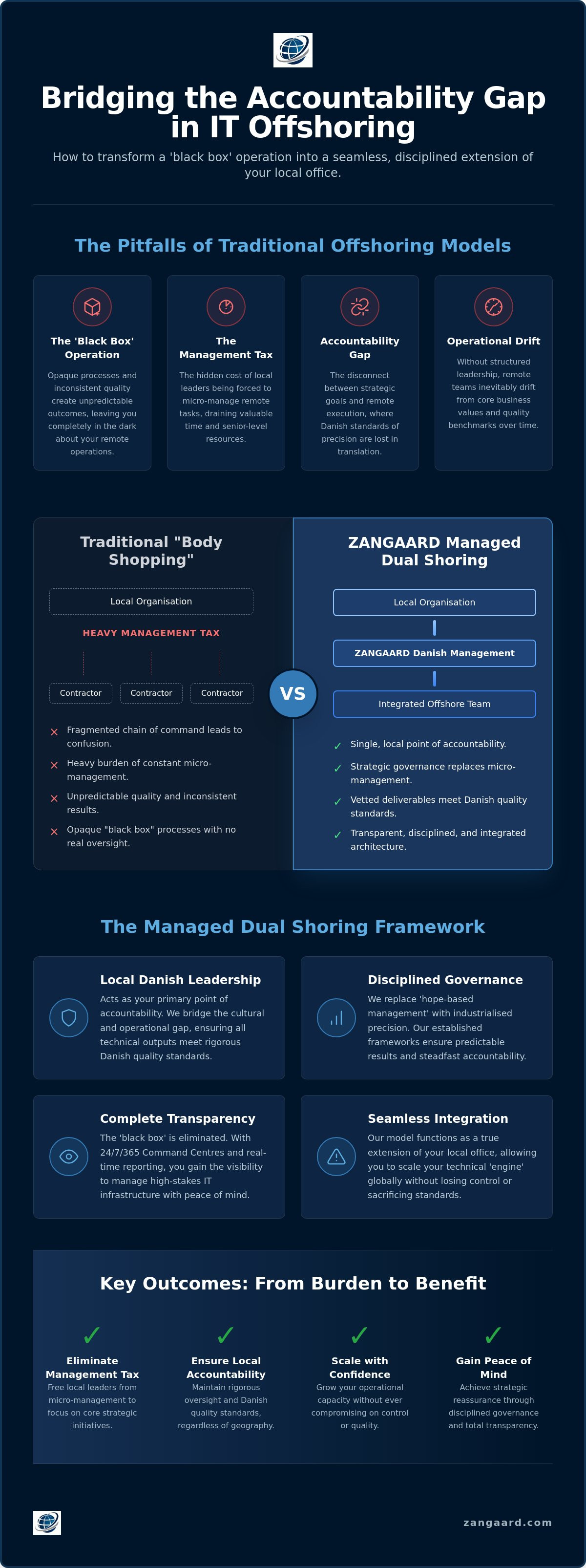
The "Body Shopping" model, where individual contractors are hired directly, is particularly prone to this failure. It fragments the chain of command and forces your local senior staff to act as supervisors for remote individuals rather than managing a cohesive service. This shift creates a heavy "Management Tax" on your organisation. The Management Tax is the hidden cost of local leaders micro-managing offshore tasks. Instead of reducing the load, this model increases the burden on your most expensive local talent, who must now spend their time fixing inconsistent quality.
Navigating these complexities requires a robust administrative foundation. For companies looking to expand into the Netherlands, ICSPayroll provides specialised Employer of Record services that ensure compliance and reduce the management burden on your local team.
The structural flaw in direct-to-contractor models
Without intermediate leadership, "operational drift" becomes inevitable. Your core business values and quality benchmarks aren't intentionally ignored; they are simply absent from the remote environment. This lack of structure prevents you from achieving true local accountability with offshore team operations, as there is no bridge between your strategic expectations and their daily execution. The result is a "black box" operation where results are unpredictable and transparency is non-existent.
Why cultural misalignment erodes operational accountability
Cultural differences in professional behaviour regarding "ownership" can lead to missed deadlines or issues being hidden until they become critical. In some regions, a cultural hesitation to report bad news early can blindside a Danish management team. Bridging the gap between Danish expectations of transparency and Philippines-based execution requires a sense of "Composed Authority." This disciplined approach ensures that local accountability with offshore team members is enforced through shared standards. You can explore how we establish these standards through our Managed IT Operations portfolio.
Bridging the Distance: How Managed Dual Shoring Restores Governance
Managed Dual Shoring (MDS) isn't just another outsourcing model; it's a structural realignment designed to eliminate the risks of remote operations. By keeping the strategic "brain" local whilst the technical "engine" scales globally, this model ensures that your high-level strategy is never lost in translation. This approach allows you to maintain local accountability with offshore team members by placing a Danish management layer between your business and the technical delivery centre. It replaces the "black box" of traditional offshoring with a transparent, disciplined architecture.
The Danish leadership within our model acts as the primary point of accountability for every technical output. You aren't forced to manage remote individuals or navigate cultural nuances yourself. Instead, you work with a partner who shares your language, culture, and business standards. This creates a framework for strategic reassurance where every deliverable is vetted against your specific benchmarks before it ever reaches your desk.
The role of local Danish oversight in offshore success
ZANGAARD's Danish management ensures that "Danish quality" is a daily operational reality, not just a distant goal. We act as bridge-builders, translating complex business requirements into actionable technical tasks for Philippines-based teams. This ensures that the "engine" runs at peak efficiency without drifting from your core objectives. You can see how this Managed Dual Shoring service functions as a seamless extension of your own office by reviewing our operational model.
Standardising performance through shared operational frameworks
We move your operations from "hope-based management" to industrialised precision using established governance frameworks. These frameworks ensure that local accountability with offshore team structures remains steadfast, providing the peace of mind that comes with predictable results. ZANGAARD’s framework completely eliminates the need for clients to worry about offshore HR, payroll, or operational logistics. If you want to explore how a disciplined global architecture can stabilise your IT department, you might reach out to our consulting team for a strategic overview.
Implementing Robust Oversight: A Framework for Strategic Reassurance
The transition from reactive micro-management to strategic oversight is the final step in reclaiming control over your global operations. By delegating the "how" of technical execution to a disciplined partner, local leadership can refocus on high-level architecture and business growth. This shift is only sustainable when a partner provides genuine local accountability with offshore team management, creating a clear boundary between strategy and operation. A robust framework restores governance by ensuring that every offshore action aligns with your local business objectives.
When evaluating a potential partner, it's vital to distinguish between simple recruitment or staff augmentation services and true managed accountability. A recruitment-led model leaves the management burden on your local staff, whereas a managed partner takes full ownership of the technical output. Integrating these teams into a wider Managed IT Operations portfolio ensures that your offshore engine functions as a cohesive, high-performance unit rather than a collection of isolated contractors.
From micro-management to industrialised precision
Securing business continuity through 24/7 accountability
Real-time transparency is non-negotiable for high-stakes IT infrastructure. Our 24/7/365 Command Centres provide a constant, Danish-led oversight layer that guarantees global reliability and proactive response. This is where local accountability with offshore team structures is truly proven; if a critical incident occurs, the response is managed by a team already operating under your specific quality benchmarks. To see how these elements combine to restore stability, you are invited to explore the ZANGAARD Service Portfolio and discover how control is regained.
Reclaiming Control Through Disciplined Governance
The myth that offshoring requires a trade-off in control is dismantled when you implement a structure rooted in Danish-led management with local oversight. You've seen how the Accountability Gap is closed through Managed Dual Shoring, shifting the burden of micro-management away from your local leaders. By anchoring your global operations in disciplined governance, you ensure that high-stakes IT infrastructure remains resilient and 24/7/365 operational reliability becomes the standard. Establishing true local accountability with offshore team structures isn't just about cost savings. It's the catalyst for a scalable, predictable IT department that reflects your own high standards.
Transitioning to a model of strategic reassurance allows you to focus on your core business whilst we manage the technical minutiae. It's time to replace the "black box" of traditional offshoring with a partnership that values transparency and industrialised precision. We look forward to helping you build a global IT operation that feels like a natural, controlled extension of your local office.
Frequently Asked Questions
Can I really have local accountability with a team based in the Philippines?
Yes, you achieve this by shifting the point of responsibility from a remote individual to a local management layer. ZANGAARD's model ensures that you deal with a Danish partner who assumes full responsibility for the Philippines-based technical output. This structure provides local accountability with offshore team benefits, as the legal and operational responsibility remains firmly within your own cultural and regulatory context.
What is the difference between traditional offshoring and Managed Dual Shoring?
Traditional offshoring usually involves "body shopping," where you hire remote contractors and manage them yourself. Managed Dual Shoring is a comprehensive service model where ZANGAARD provides the leadership, infrastructure, and governance. We act as the bridge between your strategy and global execution, delivering Managed IT Operations that function as an extension of your office rather than a separate entity.
How does ZANGAARD ensure Danish management standards are followed offshore?
We enforce these standards through embedded Danish leadership and a decade of experience in industrialised IT precision. Our managers are operationally integrated with the offshore teams to translate Danish expectations into daily technical habits. This ensures that transparency, ownership, and quality aren't lost in translation but are instead built into the foundation of our 24/7/365 Command Centre and global delivery model.
Will an offshore team increase the management workload for my local IT leaders?
No, our model is specifically designed to eliminate the "management tax" that often burdens local senior staff. Because ZANGAARD manages the technical minutiae and operational logistics, your internal leaders are freed from micro-managing remote tasks. This allows your team to focus on business growth and high-level strategy whilst we maintain local accountability with offshore team stability, performance, and rigorous quality control.
Disclaimer
The purpose of this article is to generate inspiration, reflection and to start a debate across markets, industries and organizations. We do not recommend any actions soly based on the article statements, claims or opinions, but recommend you to reach out directly to ZANGAARD for a qualified review, dialogue and/or consultation. Reach out at [email protected] or visit our website www.zangaard.com


