

The lowest price point in service desk outsourcing often carries the highest hidden cost to your brand's internal reputation. You likely recognise that maintaining a 24/7 in-house operation is becoming financially unsustainable, yet the persistent fear of cultural misalignment in offshore teams keeps you tethered to high overheads and declining user satisfaction. It's a common dilemma for modern executives who need to scale without sacrificing the quality of their user experience.
You deserve a support model that offers both global efficiency and the peace of mind that comes from disciplined oversight. This article will help you discover how to balance cost-effective technical execution with local accountability by comparing the most resilient support frameworks for 2026. We'll examine how ZANGAARD’s Managed Dual Shoring methodology integrates Danish leadership with Philippines-based execution to create a seamless, 24/7 Command Centre. By the end of this guide, you'll understand how to achieve predictable costs and guaranteed management standards that make your external support feel like a dedicated extension of your internal team.
Key Takeaways
- Shift your perspective from reactive troubleshooting to a value-driven approach that aligns IT support with your core business objectives.
- Compare the operational risks of traditional service desk outsourcing against the stability of managed models to ensure your user satisfaction remains uncompromised.
- Understand the mechanics of Managed Dual Shoring and how it combines Philippines-based technical talent with the rigour of Danish leadership.
- Identify the essential components of a 24/7/365 Command Centre to provide your enterprise with uninterrupted support and total peace of mind.
- Establish a scalable governance framework that allows your external support team to function as a seamless extension of your internal culture.
The Evolution of Service Desk Outsourcing: From Cost-Centric to Value-Driven
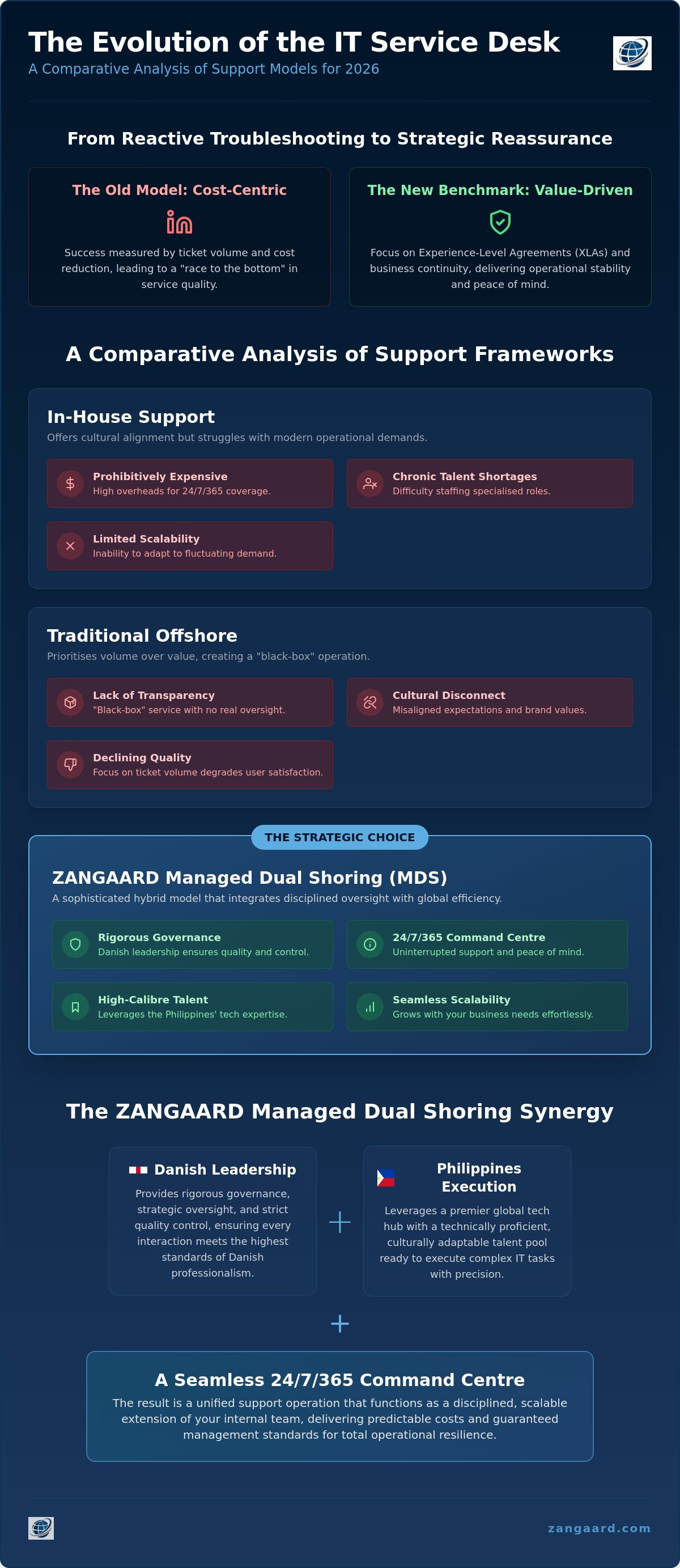
The paradigm of IT support has shifted. For decades, service desk outsourcing was viewed through a narrow lens of cost-containment, where success was measured by the volume of tickets closed rather than the quality of the user experience. This "ticket-counting" era prioritised volume over value, often leaving enterprises with support teams that understood the technical steps but failed to grasp the business impact of a system outage. By 2026, the "race to the bottom" in pricing has reached its logical conclusion: a crisis in service quality. Minimising costs has stripped many providers of the talent required to manage modern, complex IT environments, resulting in fragmented communication and declining user satisfaction.
Modern enterprises now recognise that operational stability is a far more valuable asset than a marginal reduction in monthly spend. The new benchmark for success is "Strategic Reassurance." This concept moves beyond traditional Service-Level Agreements (SLAs) to focus on Experience-Level Agreements (XLAs) and business continuity. It isn't enough to resolve an issue within a four-hour window; the objective is to ensure the user feels supported and the operation remains steady. ZANGAARD addresses this by shifting the burden of management from the client to the expert, providing a disciplined framework that ensures high-stakes operations are handled with precision. You can explore how these methodologies are applied through our Scalable Service Desk offerings.
The Limitations of Traditional Single-Shore Models
The "Onshore" model often hits a bottleneck. Whilst it offers cultural alignment, the high overheads and chronic talent shortages in local markets make 24/7/365 coverage prohibitively expensive. You often find yourself paying a premium for basic support, with limited room for scalability when demand spikes. Conversely, the traditional "Offshore" model often creates a void. These "black-box" operations frequently suffer from a lack of accountability and a deep cultural disconnect. Without rigorous oversight, the distance between strategy and execution grows, leading to misaligned expectations and a support experience that feels detached from your brand’s values. This lack of transparency is exactly what modern governance frameworks, such as the EU Digital Operational Resilience Act (DORA), seek to eliminate.
A Comparative Analysis: In-house, Traditional Offshore, and Managed Dual Shoring
Choosing the right framework for service desk outsourcing requires a cold-eyed assessment of three core variables: operational control, cost-efficiency, and long-term scalability. In-house support offers familiar cultural alignment but often fails to scale effectively, as the recruitment headache of staffing a 24/7 operation becomes a significant executive burden. Conversely, traditional offshore models frequently prioritise volume over quality, leaving you with a "black-box" service that lacks transparency and accountability. The gap between these two extremes is where many modern enterprises find their support standards begin to slip.
The ZANGAARD MDS model provides a sophisticated alternative to this binary choice. It bridges the gap by maintaining Danish leadership at the helm whilst leveraging the high-calibre technical talent available in the Philippines. This synergy ensures that your support operation isn't just a cost centre; it's a disciplined asset that scales alongside your business needs. By 2026, the Philippines has solidified its position as a premier global tech hub, offering a talent pool that is both technically proficient and culturally adaptable. This allows you to regain control over your support outcomes without the overheads of a local team.
Why Managed Dual Shoring is the Strategic Choice for 2026
MDS succeeds where others fail by integrating local oversight with offshore execution. Danish management brings a rigorous approach to governance and process frameworks, ensuring that every interaction meets strict quality benchmarks. This oversight is paired with a 24/7/365 Command Centre, creating a support environment that operates with the same precision as your internal departments. It's about industrialising quality rather than just moving tickets. If you're ready to move beyond the limitations of traditional support, you might consider discussing your specific operational requirements with our consulting team to see how a hybrid model could fit your architecture.
Implementing a Scalable Service Desk: Ensuring Governance and Peace of Mind
Transitioning your operations to a modern service desk outsourcing model requires more than a simple handover of credentials. It demands a rigorous roadmap that ensures governance remains intact whilst the burden of daily management shifts to an expert partner. This transition is anchored by a 24/7/365 Command Centre, which provides the industrialised precision necessary for true business continuity. Rather than merely reacting to incidents, this proactive environment allows for the identification of systemic issues before they impact your organisational productivity. It's a shift from fire-fighting to disciplined oversight.
A core component of this methodology is the commitment to Continual Improvement. In a high-stakes enterprise environment, your support model shouldn't remain static; it must evolve through regular performance audits and process optimisations. This ensures that the value provided by your service desk grows in tandem with your organisational complexity. By embedding these feedback loops into the service delivery, the support desk becomes a driver of efficiency rather than a stagnant cost centre. To see how these elements integrate into a wider operational strategy, you can explore the full ZANGAARD service portfolio for comprehensive implementation support.
The Critical Factor: Local Accountability
The primary risk in traditional models is the "accountability gap," where offshore technical teams operate without local leadership. ZANGAARD eliminates this risk by providing a dedicated Danish point of contact who maintains "composed authority" over global operations. This local oversight ensures that your strategic objectives are translated into daily execution without the friction of cultural or geographical distance. It provides the strategic reassurance that whilst the technical work happens globally, the responsibility remains anchored in a culture of high standards and unwavering reliability. This bridge between high-level strategy and daily execution is what allows for a scalable support model that feels like a natural extension of your internal team.
Beyond IT, this need for seamless integration extends to specialised sectors; for example, care providers looking for dedicated out-of-hours management can check out Contesto for comprehensive operational support.
Securing Operational Stability Through Strategic Integration
The shift in 2026 is definitive. The most resilient enterprises have moved beyond the simple cost-per-ticket model. They now prioritise a support architecture that offers both global scalability and the rigorous oversight of local leadership. By choosing a framework that applies Danish management standards to global technical teams, you ensure your support operation remains a strategic asset rather than a source of executive friction.
Our analysis confirms that Managed Dual Shoring is the most dependable path forward for modern organisations. It provides the 24/7/365 operational reliability your users expect whilst maintaining transparent accountability through local oversight. This approach removes the typical risks associated with service desk outsourcing and replaces them with a disciplined methodology for continual improvement. It's about building a bridge between high-level strategy and daily execution.
You don't have to compromise between cost-efficiency and high-level governance. With a disciplined global architect at your side, you can achieve both and regain total peace of mind over your IT operations. It's time to transition to a support model that grows at the pace of your ambition.
Frequently Asked Questions
What are the main risks of service desk outsourcing and how can they be mitigated?
Cultural misalignment and a lack of accountability represent the primary risks in these operations. You can mitigate these by embedding a local management layer that enforces strict governance over global execution. ZANGAARD’s methodology ensures that Danish leadership maintains direct oversight, preventing the common "black-box" issues often associated with service desk outsourcing. This approach provides the transparency needed to maintain high standards whilst leveraging global cost-efficiency.
How does Managed Dual Shoring differ from traditional IT offshoring?
Managed Dual Shoring provides a structured management layer that traditional offshoring lacks. In a traditional model, you're often left to bridge the cultural and operational gap yourself. MDS removes this burden by placing Danish architects in charge of Philippines-based technical teams. This ensures that every interaction meets European quality standards whilst providing the scalability of a global workforce. It's a partnership built on synergy rather than just simple labour arbitrage.
Is service desk outsourcing suitable for small to medium-sized enterprises (SMEs)?
Outsourcing is often the most strategic choice for SMEs that require 24/7 support without the recruitment headache of an in-house team. It grants smaller organisations access to sophisticated Command Centres and enterprise-grade governance that would be impossible to fund internally. By utilising service desk outsourcing, you can ensure your support infrastructure scales seamlessly with your business, providing a stable foundation for growth without the fixed costs of a local desk.
How do you measure the success and quality of an outsourced service desk?
You measure success by tracking Experience-Level Agreements (XLAs) alongside traditional performance metrics. Whilst technical resolution speed is a baseline, the true indicator of quality is how well the support model maintains your operational continuity. ZANGAARD focuses on continual improvement and proactive monitoring to ensure the service desk isn't just reactive. High-performing desks are defined by their ability to feel like a seamless extension of your internal culture and business goals.
Disclaimer
The purpose of this article is to generate inspiration, reflection and to start a debate across markets, industries and organizations. We do not recommend any actions soly based on the article statements, claims or opinions, but recommend you to reach out directly to ZANGAARD for a qualified review, dialogue and/or consultation. Reach out at [email protected] or visit our website www.zangaard.com


