

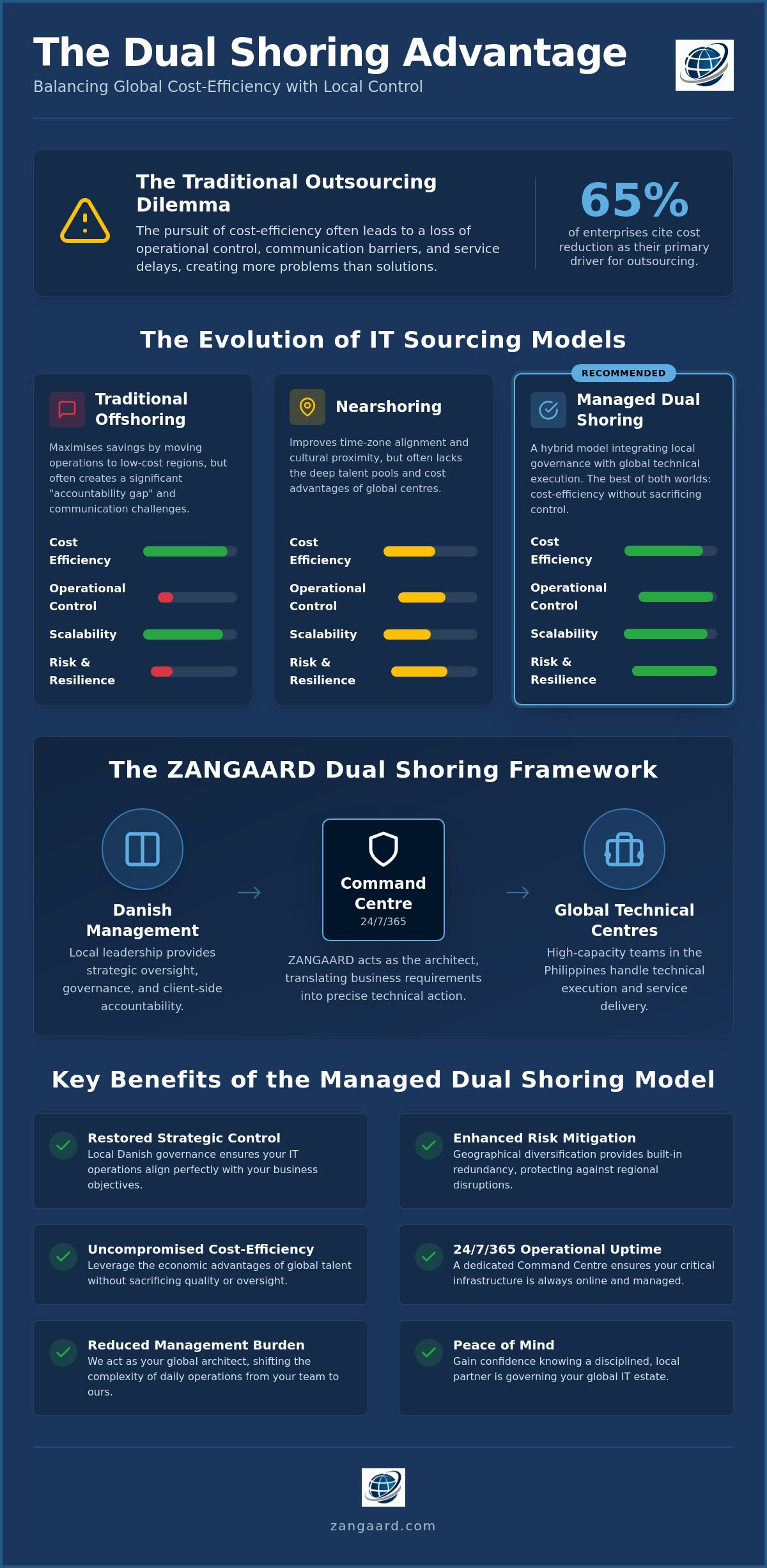
Why does the pursuit of global cost-efficiency so often result in a total loss of operational control? With 65% of enterprises citing cost reduction as their primary driver for outsourcing, it is no surprise that many leaders find themselves trapped in a cycle of communication barriers and service delays. You likely recognise the frustration of managing remote vendors where the lack of local accountability creates more problems than the offshore team solves. The strategic benefits of dual shoring offer a way to break this cycle by aligning global talent with local governance.
This model ensures your IT operations remain both scalable and predictable by integrating Danish management standards with high-capacity technical centres in the Philippines. At ZANGAARD, we act as the architect of this hybrid approach, shifting the burden of management from your internal teams to our disciplined command centre. In this article, we will explore how dual shoring eliminates the risks of traditional offshoring whilst maintaining the cost-efficiency required for modern IT operations. You will discover how to secure a 24/7 service desk that provides Danish-standard quality with the geographical diversification needed to reduce operational risk.
Key Takeaways
- Learn how to define a hybrid operational model that integrates Danish leadership with offshore technical centres to restore strategic control over your IT estate.
- Understand the primary benefits of dual shoring, specifically how to maintain high-level accountability whilst leveraging global cost-efficiencies for technical execution.
- Discover a methodology for mitigating operational risks through geographical diversification and a 24/7/365 Command Centre setup.
- Follow a practical framework for identifying critical IT infrastructure requirements and bridging the cultural gap between local stakeholders and remote teams.
- Explore the shift from traditional vendor management to a partnership model where the burden of daily operations is transferred to disciplined global architects.
Beyond Traditional Offshoring: Defining the Dual Shoring Model for IT
Traditional offshoring has historically forced leaders into a compromise between cost and quality. Dual shoring represents a more sophisticated evolution; it is a hybrid operational model that integrates local governance with offshore technical execution. Unlike traditional 'single-shore' models that often leave clients struggling with an 'accountability gap,' dual shoring places strategic oversight in the client's home region. This ensures that the benefits of dual shoring are realised through a disciplined framework of Managed IT Operations, where the local architect handles the complexity of global delivery.
Many businesses are moving away from unmanaged offshoring because the lack of direct oversight leads to service delays and hidden management costs. Whilst nearshoring offers better time-zone alignment, it frequently lacks the scalability and cost-efficiency required for large-scale IT estates. Managed Dual Shoring (MDS) bridges this gap, providing a strategic framework for IT Infrastructure Management that combines the economic advantages of global talent with the reliability of local leadership.
The Evolution of Sourcing: Why Single-Source Models Fail
Relying on a single location for IT support creates a fragile 'single point of failure.' Regional disruptions, geopolitical instability, or sudden talent shortages in one country can instantly paralyse a 24/7 service desk. Dual shoring mitigates these risks by providing built-in redundancy through geographical diversification. This strategy ensures that your operations remain resilient, as the workload can be balanced across different regions without losing the thread of local accountability.
Danish Management Meets Global Scalability
True scalability requires more than just adding headcount; it requires cultural alignment and rigorous standards. By employing local leadership to oversee technical centres in regions like the Philippines, we ensure that every ticket and process adheres to strict quality benchmarks. Danish management standards act as a quality filter that translates high-level business requirements into precise offshore technical output. This synergy creates a seamless experience where the client enjoys peace of mind, knowing their operations are governed by a steady, local hand.
The Strategic Benefits of Dual Shoring for Modern IT Operations
The primary benefits of dual shoring lie in its ability to resolve the tension between fiscal responsibility and operational excellence. By utilising technical centres in the Philippines for execution whilst maintaining Danish leadership for oversight, organisations access a high-capacity workforce without sacrificing quality. This model creates a robust cost-benefit ratio that traditional models struggle to match. It isn't just about lower hourly rates; it's about the precision and maturity that local accountability brings to global delivery. For executives, this translates to "peace of mind," knowing that a disciplined architect is managing the inherent complexities of a global team.
Comparing IT Delivery Models: Offshoring vs. Nearshoring vs. Dual Shoring
While offshoring offers maximum savings and nearshoring provides proximity, neither fully solves the accountability gap. Recent trends in dual-shoring highlight its role as a strategic tool for risk mitigation and stability. For growing Danish enterprises, this approach offers a scalable framework that protects against regional disruptions and local talent shortages. It provides the "best of both worlds" by ensuring that critical infrastructure stays online 24/7, managed by experts who understand the nuances of your business culture. This geographical diversification acts as a safeguard, ensuring that a crisis in one region doesn't lead to a total service blackout.
Improving IT Service Quality Through Managed Governance
True service excellence requires more than just reactive support; it demands a commitment to continual improvement. A managed dual-shore approach ensures that IT Service Management (ITSM) is embedded into the daily workflow. By integrating Managed IT Operations, businesses can shift from a "break-fix" mentality to a state of strategic governance. This synergy between local service delivery and global technical support fosters long-term growth and operational stability. Our 24/7/365 Command Centre setup ensures that technical execution never sleeps, while local consultants ensure that service quality never falters. If you're ready to stabilise your infrastructure, you might consider how to optimise your service delivery model.
Implementing Managed Dual Shoring: A Framework for Success
Transitioning to a hybrid model requires more than just a contract; it demands a structured methodology that prioritises governance over mere headcount. To fully capture the benefits of dual shoring, organisations must follow a deliberate path from initial assessment to industrialised execution. This process begins with a rigorous audit of critical IT infrastructure and service desk requirements that necessitate 24/7 coverage. Once these needs are mapped, the focus shifts to establishing local oversight. This is the crucial bridge that closes the cultural and operational gaps often found in traditional offshoring, ensuring that the offshore team functions as a seamless extension of your own office.
A successful implementation relies on a few core pillars of operational discipline:
- Command Centre Integration: Leverage a 24/7/365 Command Centre for real-time monitoring and incident response to ensure that technical issues are resolved before they impact the business.
- Governance Frameworks: Establish continuous optimisation through embedded ITSM consultation to keep the operation aligned with evolving business goals.
- Strategic Design: Designing an Effective Dual-shore Delivery Model requires balancing the proximity of leadership with the scale of offshore technical talent.
The ZANGAARD Approach: Managed Dual Shoring in Practice
We believe that accountability cannot be outsourced. Our Managed Dual Shoring (MDS) model integrates Danish leadership directly into the operational fabric. This approach replaces the "unmanaged chaos" of traditional vendor relationships with "industrialised precision." By positioning a Danish management layer over our technical centres in the Philippines, we provide a single point of contact that speaks your language and understands your quality standards. It's a partnership where we take the burden of daily management, allowing your internal teams to focus on high-level strategy rather than remote vendor troubleshooting.
Scaling Your Service Desk Without Increasing Management Burden
The primary advantage of this model is its inherent scalability. You can rapidly expand your technical resources in response to growth whilst keeping your management layer local and lean. This prevents the management bloat that often accompanies internal expansion or poorly structured outsourcing. We invite you to explore the full ZANGAARD service portfolio to see how this model functions in real-world scenarios. By decoupling technical execution from management location, you gain the agility of a global operation with the reliability of a seasoned, local partner.
Securing Operational Excellence Through Strategic Governance
The transition from fragmented outsourcing to a managed hybrid model marks the difference between constant firefighting and industrialised precision. We've explored how the benefits of dual shoring extend far beyond mere cost-savings; they provide a foundation for scalable growth and geographical resilience. By anchoring global technical execution in the Philippines with local Danish management standards, you ensure that every incident is handled with the same rigour you expect from an in-house team.
It's time to shift the burden of daily management to a partner who prioritises transparency and peace of mind. With our 24/7/365 Command Centre capabilities and a commitment to continual improvement, your IT infrastructure can finally become the stable asset your business requires. Discover how Managed Dual Shoring can stabilise your IT operations and provide the local accountability your executive team deserves. We look forward to helping you architect a more resilient future.
Frequently Asked Questions
What is the main difference between dual shoring and traditional offshoring?
Dual shoring differs from traditional offshoring by integrating a local management layer to bridge the accountability gap. Traditional models often leave clients to navigate cultural and communication barriers alone. In contrast, dual shoring ensures that technical execution in centres like the Philippines is governed by local leadership, maintaining consistency and quality across all global operations.
Is dual shoring more expensive than using a single offshore provider?
Total costs are often more predictable because the model eliminates the hidden expenses of unmanaged remote vendors. While a single offshore provider might seem cheaper initially, the lack of oversight often leads to service delays and rework. The benefits of dual shoring include a reduced management burden and higher service reliability, which protects your bottom line over the long term.
How does dual shoring improve IT service quality for Danish companies?
Service quality is enhanced by applying Danish management standards to a global technical workforce. This local oversight acts as a quality filter, ensuring that offshore output aligns with your organisational culture and quality expectations. It shifts the focus from simple task completion to strategic governance and continual improvement, which is essential for modern IT Infrastructure Management.
Can dual shoring help with 24/7 service desk requirements?
This model is perfectly suited for 24/7/365 Command Centre requirements. It allows businesses to maintain a scalable service desk that operates across all time zones without sacrificing local accountability. The benefits of dual shoring ensure that whilst technical support is available at any hour, the standards of delivery remain governed by a disciplined and steady local hand.
Disclaimer
The purpose of this article is to generate inspiration, reflection and to start a debate across markets, industries and organizations. We do not recommend any actions soly based on the article statements, claims or opinions, but recommend you to reach out directly to ZANGAARD for a qualified review, dialogue and/or consultation. Reach out at [email protected] or visit our website www.zangaard.com


