
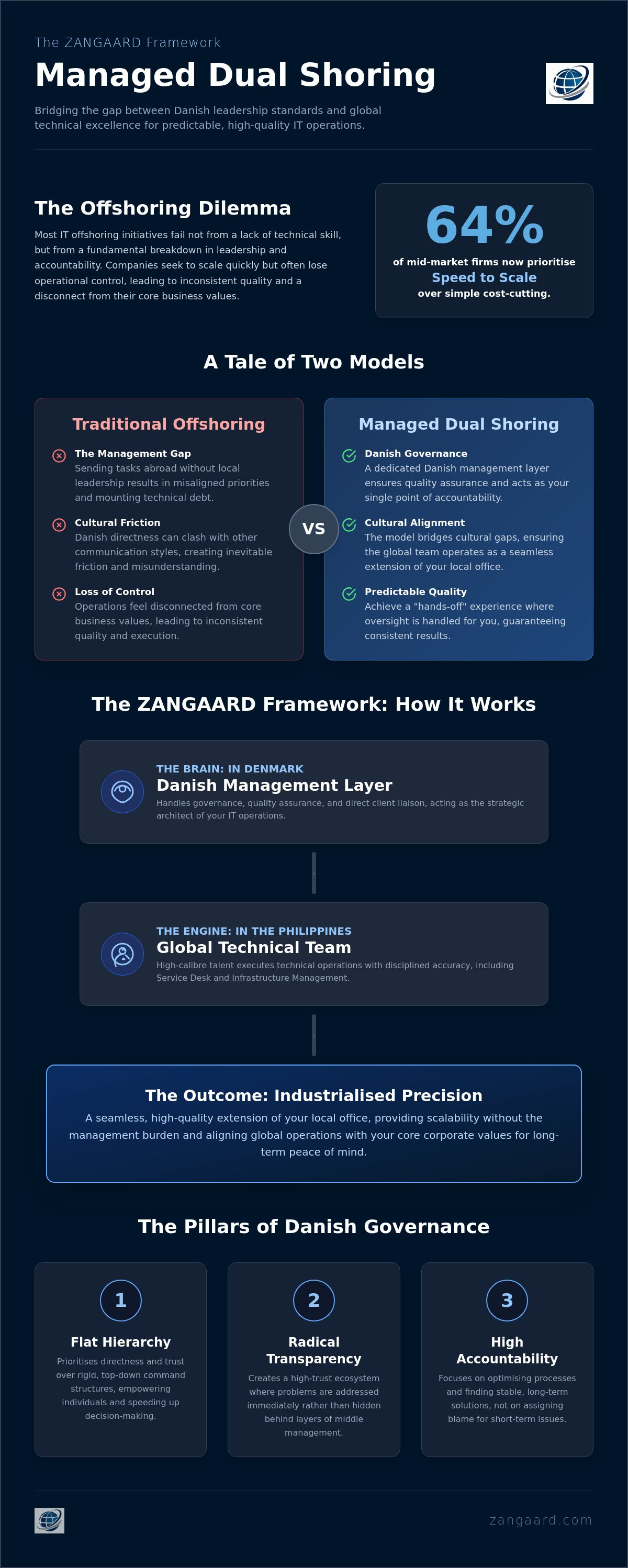
Most IT offshoring initiatives fail not because of a lack of technical talent, but because of a fundamental breakdown in leadership and accountability. Whilst 64% of mid-market firms now prioritise speed to scale over simple cost-cutting, many struggle to maintain a Danish management offshore team that reflects their local standards of quality. You likely recognise the frustration of losing operational control as soon as tasks cross borders, leading to inconsistent technical execution and a sense of disconnection from your core business values.
This article demonstrates how to combine rigorous Danish leadership standards with global technical expertise through the Managed Dual Shoring model. We'll show you how to ensure your international operations feel like a natural, high-quality extension of your local office. You will discover a structured approach to achieving predictable quality and a "hands-off" management experience, where the burden of oversight stays firmly in Danish hands whilst your capacity expands. By the end, you'll understand how to bridge the gap between high-level strategy and daily execution without compromising on your organisational standards.
Key Takeaways
- Learn why transparency and flat hierarchies are the essential foundations for a successful Danish management offshore team.
- Understand how the Managed Dual Shoring (MDS) framework integrates Danish governance with global technical execution to maintain operational control.
- Discover how a dedicated Danish management layer ensures quality assurance, shifting the burden of oversight away from your internal team.
- Identify the specific IT functions, such as Service Desk and Infrastructure Management, that are most suitable for scaling through a dual-shored approach.
- Recognise the methodology required to align an offshore technical team with your corporate values for long-term stability and peace of mind.
What Defines a Danish Management Offshore Team in 2026?
By 2026, the definition of a successful Danish management offshore team has shifted from a search for cheap labour to a quest for disciplined scalability. It's no longer enough to simply hire developers in a different time zone and hope for the best. True Danish leadership in a global context is characterised by a flat hierarchy, radical transparency, and an expectation of high individual accountability. These traits are deeply rooted in the Danish work culture, which prioritises directness and trust over rigid, top-down command structures. When these values are exported to an offshore environment, they create a high-trust ecosystem where problems are addressed immediately rather than hidden behind layers of middle management.
Traditional offshoring models often focus on low-cost, high-friction transactions. In contrast, a Danish management offshore team operates on a high-trust, high-efficiency basis. This approach treats the offshore staff not as a separate entity, but as a seamless extension of the local office. For firms that value a high-quality physical environment as much as their digital infrastructure, you can learn more about Zing Patio to find premium furniture for your corporate spaces. The result is a significant reduction in the "management tax" that usually plagues international collaborations.
The Pillars of Danish Governance in IT
Danish governance relies on a no-nonsense approach to problem-solving. It isn't about assigning blame; it's about optimising the process. In a managed environment, this translates to direct communication and a focus on long-term stability. Whilst some firms chase short-term cost-cutting, ZANGAARD's Outsourcing Services prioritise robust frameworks that ensure technical execution remains consistent. We believe that stability is the only true path to cost-efficiency in IT operations.
Why Traditional Offshoring Often Fails Danish Firms
The "Management Gap" is the primary reason most offshore IT projects struggle. Sending tasks abroad without local leadership often results in mounting technical debt and misaligned priorities. Cultural nuances frequently act as a silent killer. For instance, the legendary Danish directness can clash with more indirect communication styles found in many offshore hubs. Without a bridge to translate these expectations, friction becomes inevitable. This is where local oversight becomes the essential safety net, ensuring that your Managed Dual Shoring model remains aligned with your core corporate values.
Managed Dual Shoring: The Strategic Framework for Global IT
Managed Dual Shoring (MDS) represents a departure from traditional, fragmented outsourcing. It's a deliberate architectural choice that integrates a Danish management offshore team with high-calibre technical execution. In this framework, the Danish layer acts as the strategic architect. They handle governance, quality assurance, and direct client liaison, ensuring that every technical deliverable meets the rigorous standards expected by Northern European enterprises. This model provides what we term "Industrialised Precision" in IT Infrastructure Management. It ensures that processes aren't just executed, but are governed by a framework of continuous improvement and accountability.
The choice of location is critical to this synergy. We focus on the Philippines as the premier hub for technical talent. The country offers exceptional English proficiency and a strong cultural affinity with Western business practices, which minimises friction. This alignment is vital when implementing the principles of Danish management and workplace culture, where trust and collaboration are non-negotiable. By combining these two worlds, we create a service environment that is both scalable and dependable.
How the Hybrid Model Operates
The operational logic of MDS is simple yet powerful. The Danish team provides the "brain" of the operation, managing strategy and high-level oversight. Meanwhile, the technical team in the Philippines serves as the "engine," executing technical operations with disciplined accuracy. You can see this Managed Dual Shoring model in practice as a way to bridge the gap between local accountability and global scale. If you're ready to explore how this could fit your organisation, you can discuss your operational requirements with our team.
Scalability Without the Management Burden
Scaling a local IT department often brings significant administrative overhead and recruitment challenges. MDS allows businesses to expand their Scalable Service Desk or infrastructure teams without increasing local headcount. By leveraging a 24/7/365 Command Centre, firms ensure business continuity and technical resilience. It's a "hands-off" experience for the client because the management burden remains with the Danish experts, providing peace of mind through constant, professional oversight.
Implementing an Offshore Team with Local Accountability
Transitioning to a Danish management offshore team requires a methodical roadmap to ensure that local accountability remains intact. The first phase involves identifying core IT functions, such as IT Infrastructure Management or service desk operations, that benefit most from dual-shored scalability. Once these are defined, you must establish a management bridge. This isn't a mere reporting line; it's a dedicated Danish leadership layer that ensures every offshore action aligns with your specific corporate values and operational standards.
Integration relies on "Industrialised" processes. By using standardised frameworks, the offshore team becomes a predictable component of your IT engine. This allows for a critical shift in perspective: moving from a traditional "vendor" mindset to a "managed partnership." In this state, the focus is on mutual success and long-term stability rather than transactional task completion. This synergy ensures that the burden of management is shifted from your local leadership to a disciplined, expert hand.
Ensuring Quality and Performance
Performance management must move beyond basic metrics like "tickets closed." We focus on business-centric outcomes that reflect actual operational health. Through Continual Improvement, our Managed Dual Shoring model constantly refines these workflows. This ensures that the technical team isn't just maintaining the status quo but is actively contributing to the resilience of your IT infrastructure. It provides the peace of mind that comes from knowing your global operations are being handled with professional maturity.
Navigating the Transition
Introducing an offshore team to existing local staff can create friction if handled poorly. The key is to position the offshore team as a support layer that frees local experts for higher-value strategic work. Transparency is vital. We encourage you to explore the ZANGAARD service portfolio to see how custom transition roadmaps can simplify this journey, providing the strategic reassurance needed to scale with confidence and precision.
Securing the Future of Your Global IT Infrastructure
The success of an international IT strategy depends on the strength of the bridge between local vision and global execution. By adopting a Danish management offshore team, you ensure that your operations are governed by the same transparency and high standards that define your local headquarters. This model eliminates the friction of traditional outsourcing, replacing it with a disciplined framework focused on stability and scalability.
Since 2014, ZANGAARD has specialised in Managed IT Operations, providing the local accountability required to manage global technical teams with precision. Our approach shifts the burden of oversight from your shoulders to our expert managers. This allows your internal staff to focus on strategic growth whilst we maintain your infrastructure. Transitioning to a hybrid model is a strategic evolution that brings both predictable costs and peace of mind. It's time to move beyond the limitations of standard offshoring and embrace a partnership built on industrialised quality and Danish governance.
Discover how ZANGAARD’s Managed Dual Shoring can stabilise and scale your IT operations.
Frequently Asked Questions
What is the difference between traditional offshoring and Managed Dual Shoring?
Managed Dual Shoring differs from traditional offshoring by integrating a dedicated Danish management layer between the client and the technical team. Whilst traditional models often result in a management gap and cultural friction, our model ensures that a Danish management offshore team maintains local accountability and quality standards. This structure shifts the burden of daily oversight from the client to ZANGAARD, providing a seamless extension of your local office.
How does ZANGAARD ensure that offshore teams in the Philippines understand Danish business culture?
We bridge the cultural gap through direct leadership and standardised operational frameworks that reflect Danish values such as transparency and flat hierarchies. By having Danish managers lead the technical teams in the Philippines, we translate high-level strategy into daily execution without losing the no-nonsense approach characteristic of Danish work culture. This constant interaction ensures that the offshore staff operates as a disciplined, culturally aligned unit rather than a detached vendor.
Is Managed Dual Shoring cost-effective for medium-sized Danish enterprises?
Managed Dual Shoring is highly cost-effective for medium-sized firms because it allows for rapid scaling without the overhead of increasing local headcount. By leveraging technical talent in the Philippines whilst retaining Danish governance, enterprises can achieve improved operational efficiency through optimised IT Infrastructure Management. The model provides predictable costs and industrialised precision, ensuring that quality assurance doesn't become a hidden expense or a source of technical debt.
Who is responsible if something goes wrong in the offshore IT operation?
Accountability remains firmly in Denmark, as ZANGAARD takes full responsibility for the managed IT operations. Unlike traditional outsourcing where liability is often obscured by international borders, our model ensures that the Danish management offshore team is the primary point of contact and accountability. This hands-off experience for the client is backed by our 24/7/365 Command Centre, providing strategic reassurance that any operational issues are handled with disciplined urgency.
Disclaimer
The purpose of this article is to generate inspiration, reflection and to start a debate across markets, industries and organizations. We do not recommend any actions soly based on the article statements, claims or opinions, but recommend you to reach out directly to ZANGAARD for a qualified review, dialogue and/or consultation. Reach out at [email protected] or visit our website www.zangaard.com


