

Most IT departments spend millions each year only to find themselves standing perfectly still. It's a frustrating paradox where high expenditure fails to prevent service stagnation, often because technical metrics from offshore teams remain disconnected from your actual business goals. You likely recognise the friction of managing complex operations where "green" reports don't reflect the reality of the user experience or the needs of your stakeholders.
This article shows you how to break that cycle by implementing a disciplined framework for continual service improvement ITSM. You'll discover how to transform your IT environment from a reactive cost centre into a proactive value driver that evolves alongside your organisation. We'll explore how ZANGAARD’s Managed IT Operations and Dual Shoring model bridge the oversight gap, providing the transparent governance and Danish management standards necessary for true operational excellence. We will move from the broad strategy of organisational optimisation down to the granular details of how a 24/7 Command Centre ensures your infrastructure remains resilient, scalable, and aligned with your long-term vision.
Key Takeaways
- Understand the core philosophy of the ITIL lifecycle where static services represent operational decay, and learn to align your technical roadmap with shifting business requirements.
- Master the transition from data collection to strategic execution by identifying the Critical Success Factors that make continual service improvement ITSM a scalable reality rather than a reporting burden.
- Identify how ZANGAARD’s Managed Dual Shoring model provides the disciplined oversight needed to bridge the gap between technical metrics and high-level business goals.
- Discover how to industrialise your improvement processes through Danish management standards, ensuring that every operational adjustment contributes to long-term stability and reduced friction.
Understanding the Foundations of Continual Service Improvement (CSI)
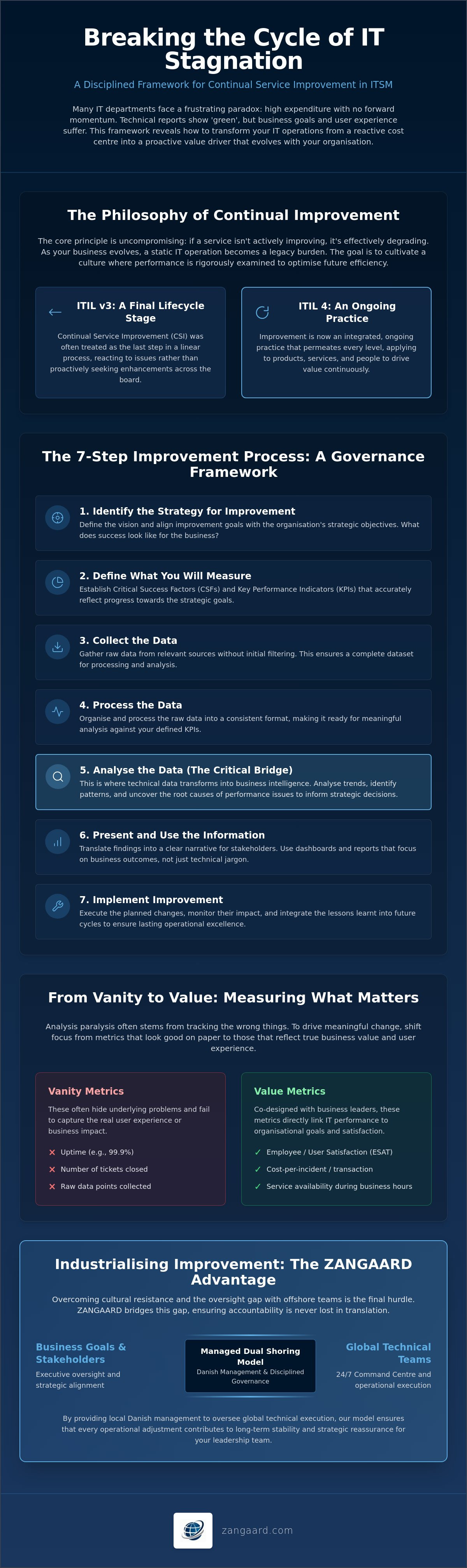
Continual service improvement is often misunderstood as a reactive fix for broken processes. In reality, it's the strategic heart of IT Service Management, designed to ensure that technical delivery remains perfectly synchronised with evolving business objectives. The core philosophy is uncompromising: if a service isn't actively getting better, it's effectively getting worse. As your business scales and market demands shift, a static IT operation quickly becomes a legacy burden that hinders growth. The primary objective of continual service improvement ITSM is to cultivate a culture where past successes and failures are rigorously examined to optimise future efficiency. At ZANGAARD, we view this through the lens of Danish management. This perspective provides the composed authority needed to move beyond mere data collection and into disciplined, strategic action.
The Evolution from ITIL v3 CSI to ITIL 4 Continual Improvement
The transition from ITIL v3 to ITIL 4 in 2019 represented a fundamental shift in how modern organisations approach optimisation. By dropping "Service" from the title, the framework acknowledged that improvement must apply to products, practices, and people with equal vigour. It moved from being a final lifecycle stage to an ongoing practice that permeates every level of the organisation. This ensures that every team member, from the service desk to the executive suite, is accountable for driving value at every touchpoint.
The Seven-Step Improvement Process as a Governance Tool
To achieve repeatable results, we utilise a structured seven-step process that transforms raw operational data into strategic assets. These steps include:
- Identify the strategy for improvement
- Define what you will measure
- Collect the data
- Process the data
- Analyse the data
- Present and use the information
- Implement improvement
The Analyse step serves as the critical bridge where technical data transforms into actionable business intelligence. Without this disciplined interpretation, organisations often suffer from analysis paralysis, where they possess vast amounts of data but lack the clarity to execute meaningful change. By applying Danish oversight to technical execution, ZANGAARD ensures these steps lead to tangible outcomes rather than just static reports.
This commitment to technical excellence and routine maintenance is a hallmark of operational success across all industries, from IT infrastructure to the specialised dispensing system maintenance provided by GTH - Getränke Technik Honesz.
Bridging the Gap: From Data Collection to Strategic Execution
Analysis paralysis is the primary reason most improvement programmes fail. Technical teams often collect every conceivable data point without a clear strategic objective, leading to a state where reports are generated but never read. To break this cycle, you must define Critical Success Factors (CSFs) before a single metric is tracked. These factors act as the North Star for your continual service improvement ITSM efforts, ensuring every adjustment serves a purpose. Once established, raw data should be organised into a narrative that resonates with stakeholders, shifting the focus from technical jargon to business outcomes. High-level transparency through clear dashboards creates strategic reassurance, allowing the executive team to feel that the burden of management has been successfully shifted to a disciplined partner.
Defining Meaningful Metrics: KPIs That Drive Change
Meaningful metrics require a shift from vanity to value. Whilst uptime is often cited as a key performance indicator, it's frequently a vanity metric that fails to capture the true user experience. According to the industry perspective on Continual Service Improvement (CSI) in ITIL, value is co-created. This means metrics like cost-per-incident or employee satisfaction (ESAT) must be co-designed with business leaders to ensure IT remains a value driver rather than a drain on resources.
Overcoming Cultural Resistance to Improvement
Cultural resistance is often the silent killer of operational excellence. Teams naturally tend to hide mistakes to avoid blame, yet improvement requires the opposite behaviour. You need a culture that surfaces opportunities for growth. This is particularly challenging with offshore technical teams where the oversight gap can lead to stagnation. ZANGAARD’s model addresses this by providing local Danish management to oversee technical execution, ensuring accountability is never lost in translation. If you're struggling to move past static reporting, you might consider how professional ITSM consultation can reset your trajectory and bring peace of mind to your operations.
Industrialising Improvement: The Managed Dual Shoring Advantage
Most organisations treat continual service improvement ITSM as a theoretical exercise, often relegated to a secondary task that technical teams address only when time permits. To move beyond this stagnation, you need a structural solution that makes optimisation an inherent part of daily delivery. ZANGAARD’s Managed Dual Shoring model provides this framework by pairing Danish management oversight with high-level technical execution in the Philippines. This model creates the composed authority needed to govern global teams effectively. It ensures that improvement isn't a mere monthly meeting, but a daily habit driven by our 24/7/365 Command Centre. By industrialising the way updates and optimisations are handled, we help you transform your Managed IT Operations into a source of strategic reassurance.
Recent insights from Forrester on proactive service management suggest that rethinkng your strategy to move away from legacy, reactive models is essential for modern excellence. ZANGAARD facilitates this transition by embedding accountability into the core of your service structure, bridging the oversight gap that often leads to offshore service decay.
Local Accountability for Global Technical Excellence
Having a local Danish point of contact is vital for translating complex business strategy into specific technical tasks. This bridge eliminates the "lost in translation" issues common in traditional offshoring, where technical metrics often fail to align with executive expectations. You receive the benefits of global scalability whilst maintaining the high standards and cultural intelligence required for seamless integration. It's a disciplined approach that ensures your technical roadmap is always moving in the right direction.
The ZANGAARD Approach: Peace of Mind Through Governance
True peace of mind is achieved when you no longer have to worry about the granular details of daily support. Our embedded ITSM consultation helps organisations build a rigorous roadmap for long-term scalability and reduced operational friction. We invite you to explore the ZANGAARD service portfolio to see how these disciplined frameworks are applied in practice to create resilient, value-driven IT environments.
Securing Your Path to Operational Excellence
Implementing a framework for continual service improvement ITSM is no longer just a technical requirement; it's a strategic necessity for any organisation aiming to scale without increasing operational friction. You've seen how the transition from reactive data collection to disciplined, value-driven execution requires more than just tools. It demands a governance structure that bridges the gap between high-level business goals and daily technical performance. By shifting the burden of management to a partner who understands the nuances of global delivery, you regain the clarity needed to lead.
ZANGAARD provides this stability through our unique Dual Shoring model. We combine rigorous Danish management standards with the constant oversight of our 24/7/365 Command Centre to ensure your IT operations remain proactive and resilient. This approach delivers scalable IT operations tailored for growth, giving you the peace of mind that comes from knowing your infrastructure is in a state of constant, controlled evolution. Explore our Managed Dual Shoring solutions to see how we drive continual improvement for your business. We're ready to help you turn your IT department into a powerful engine for organisational value.
Frequently Asked Questions
What is the difference between CSI and Continual Improvement in ITIL 4?
The primary difference lies in the scope and application within the organisation. Whilst CSI was a specific stage of the ITIL v3 lifecycle, ITIL 4 introduces Continual Improvement as a universal practice that applies to people, processes, and products. This shift ensures that continual service improvement ITSM principles aren't confined to a single phase but are embedded into every activity to co-create value across the entire enterprise.
How do we start a continual service improvement programme without disrupting daily operations?
You begin by identifying high-impact "quick wins" that require minimal resource allocation but provide visible value. This incremental approach allows you to demonstrate the benefits of a continual service improvement ITSM framework without overhauling your existing workflows. By focusing on one specific process, such as incident categorisation or first-call resolution, you build the momentum needed for a wider rollout whilst maintaining operational stability and stakeholder trust.
Why is local management important when using an offshore IT service desk?
Local management provides the essential layer of accountability and cultural alignment that traditional offshoring lacks. At ZANGAARD, our Danish management team acts as a bridge between your business strategy and technical execution in the Philippines. This composed authority ensures that technical metrics are translated into business intelligence, preventing the "lost in translation" issues that frequently lead to service stagnation and a lack of transparency for the executive team.
Can continual improvement help reduce the cost of my IT infrastructure management?
Disclaimer
The purpose of this article is to generate inspiration, reflection and to start a debate across markets, industries and organizations. We do not recommend any actions soly based on the article statements, claims or opinions, but recommend you to reach out directly to ZANGAARD for a qualified review, dialogue and/or consultation. Reach out at [email protected] or visit our website www.zangaard.com


