Most IT leaders believe that physical proximity is the only way to ensure operational discipline, yet the most resilient global architectures are built on a foundation of remote governance rather than office-based oversight. It's understandable to feel a sense of unease when considering remote infrastructure management as a replacement for local teams, especially whilst facing the rising costs of domestic talent and the pressure of 24/7 uptime. With the global market for these services reaching USD 16.26 billion in 2026, you likely recognise that the shift is necessary, yet you worry that moving operations offshore means losing the transparency you've spent years cultivating.
This guide demonstrates how to achieve a scalable IT model that doesn't sacrifice the rigorous Danish management standards your organisation demands. By leveraging a dual-shore framework, you can bridge the gap between high-level strategy and daily execution. You'll discover how ZANGAARD delivers peace of mind through local accountability, ensuring your Managed IT Operations remain secure and compliant with frameworks like NIST 2.0. We will examine how our service portfolio, including our 24/7 Service Desk and Digital Transformation Consulting, transforms global IT governance from a risk into a distinct competitive advantage.
Key Takeaways
- Understand how remote-first architectures centralise the governance of servers and networks to provide your organisation with enhanced operational flexibility.
- Learn to decouple technical execution from high-cost local real estate through remote infrastructure management, enabling 24/7 availability without the burden of local night-shift premiums.
- Discover how the Managed Dual-Shore framework bridges the accountability gap by aligning global technical scale with the disciplined oversight of ZANGAARD’s Managed IT Operations.
- Identify the essential auditing protocols required to transition your legacy systems into a high-performance IT Infrastructure Management model.
- Master the strategic governance needed to maintain Danish management standards whilst expanding your global reach through our Digital Transformation Consulting.
What is Remote Infrastructure Management? Defining the Modern IT Landscape
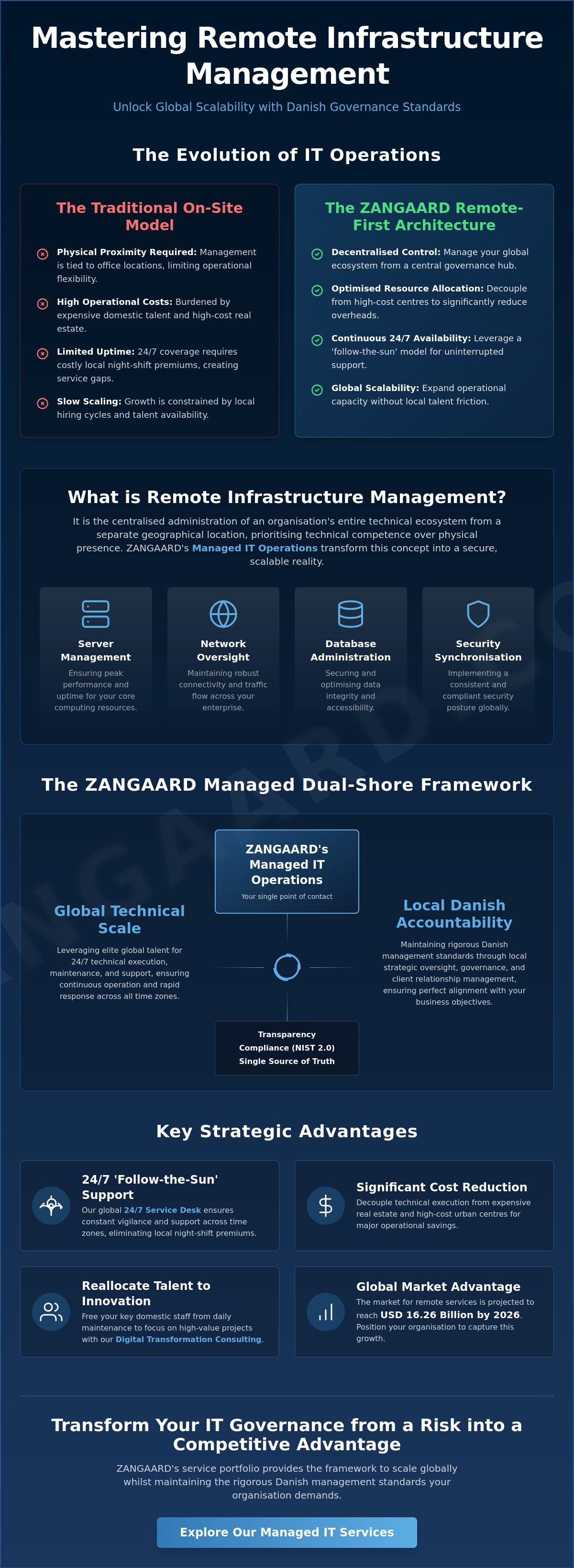
The traditional model of IT support once relied on physical presence, yet modern resilience is now defined by decentralised control. At its core, Remote infrastructure management (RIM) involves the centralised administration of an organisation's technical ecosystem, including servers, networks, and databases, from a separate geographical location. This transition from on-site intervention to remote-first architectures provides the flexibility required to manage complex workloads across different borders. It's a shift that prioritises technical competence over physical proximity, ensuring that network oversight, database administration, and security synchronisation are handled with industrialised precision.
Remote infrastructure management serves as a primary strategic lever for organisational scalability in 2026. It allows business leaders to expand their operational capacity without the friction of local talent shortages or the overhead of regional office expansion.
The Building Blocks of a Remote Framework
Effective governance requires constant vigilance. Continuous 24/7 monitoring is essential to ensure business continuity across disparate time zones, preventing minor anomalies from escalating into systemic failures. Modern enterprise environments also demand a cloud-agnostic approach, allowing for seamless management across public, private, and hybrid platforms whilst maintaining a consistent security posture.
There is a distinct difference between traditional outsourcing and the integrated oversight provided by ZANGAARD's Managed IT Operations. While basic outsourcing often results in fragmented silos, our model ensures that every remote component is harmonised with your broader corporate strategy and Danish management standards.
Why Geography no Longer Limits Infrastructure Performance
High-speed connectivity and sophisticated VPN protocols have rendered physical presence secondary to technical expertise. Performance is no longer dictated by where a technician sits, but by the robustness of the frameworks they employ to maintain system health. Secure, encrypted tunnels allow for the same level of control over a server ten thousand miles away as one located in the next room.
Centralised dashboards are vital in this distributed environment. They maintain a single source of truth amongst teams and ensure that every stakeholder has real-time visibility into operational performance. This disciplined approach to transparency is a cornerstone of our service portfolio, where we bridge the gap between global scale and local accountability.
The Strategic Advantages of Remote Infrastructure Oversight
Hiring local talent in high-cost urban centres is increasingly unsustainable for organisations seeking to maintain a competitive edge. Decoupling technical execution from expensive real estate allows for significant operational savings without compromising on quality. Remote infrastructure management has evolved into a strategic asset for organizations that value fiscal discipline alongside technical excellence. By shifting the burden of daily maintenance to a globalised model, you eliminate the overhead of local office space whilst maintaining high standards of governance.
A common fear amongst executives is that remote teams lack the necessary supervision to maintain peak performance. We counter this through industrialised precision. This isn't 'outsourcing' in the traditional, hands-off sense; it's a governed extension of your organisation. Ensuring 24/7 uptime no longer requires paying local night-shift premiums. A 'follow-the-sun' model provides a constant 24/7 Service Desk presence, moving the workload across time zones to ensure support is always awake even when your local office is closed.
When experts handle the granular details of infrastructure, your internal leaders gain the bandwidth to pursue high-level Digital Transformation Consulting. This allows your best people to focus on revenue-generating innovation rather than resetting passwords or patching servers. It's about reallocating your most expensive resources to where they can provide the most strategic value.
Scalability and Resource Optimisation
Scaling shouldn't be slowed down by local hiring cycles or regional talent shortages. Accessing global talent pools, such as those in the Philippines, provides specialised technical skills that are often scarce in domestic markets. This model allows you to scale resources up or down with minimal friction, ensuring your infrastructure grows in lockstep with your business objectives. It's a flexible approach that replaces the rigidity of traditional staffing with a dynamic, performance-led structure.
Enhancing Security Through Centralised Governance
Centralisation is the enemy of the cyber-attacker. Implementing standardised security behaviours and centralised patching across all endpoints significantly reduces your attack surface. When every remote node adheres to a single, disciplined security policy, you eliminate the vulnerabilities created by fragmented local management. This rigorous oversight is a core component of our service portfolio, ensuring that your global IT governance remains unshakeable regardless of where the technical work is performed.
Navigating the Transition: Implementing a Managed Dual-Shore Framework
Transitioning to a globalised model often fails when businesses prioritise software tools over management frameworks. The Managed Dual-Shore model solves the accountability gap by maintaining a local leadership layer that understands your corporate culture and quality expectations. This isn't a simple hand-off to an offshore entity; it's a disciplined integration of resources that bridges the distance between strategy and execution. Success in remote infrastructure management requires a methodical, four-step approach to ensure stability.
- Audit and Identification: We begin with a rigorous assessment of your existing environment to identify which components are operationally ready for remote transition.
- Governance Bridge: We establish a clear line of command; Danish management provides the strategic oversight while Philippines-based technical teams handle the execution.
- Protocol Integration: We embed 24/7 monitoring and service desk protocols into your workflow to ensure seamless handovers across time zones.
- Continuous Optimisation: We use data-driven reporting and transparent performance metrics to refine system health and cost-efficiency.
The Power of Danish Management in Remote Operations
Local oversight is critical for maintaining the quality standards that Danish enterprises demand. Without a cultural and linguistic bridge, technical execution can quickly drift away from business objectives. ZANGAARD integrates seasoned Danish leadership with highly skilled technical teams in the Philippines to provide the best of both worlds. This structure ensures that your Managed IT Operations are handled with the same care and precision you'd expect from an on-site team, but with the scalability of a global workforce.
Ensuring Peace of Mind and Accountability
Trust is built through transparency rather than proximity. We provide detailed, real-time reporting that gives you full visibility into your infrastructure's performance and security posture. This data-driven approach ensures that you're never left wondering about the state of your systems. ZANGAARD's service portfolio is specifically designed to address the needs of organisations that require global efficiency without sacrificing local reliability. By combining our 24/7 Service Desk with expert IT Infrastructure Management, we deliver the peace of mind that comes from knowing your most critical assets are in disciplined hands.
Securing the Future of Global IT Governance
Transitioning your IT environment to a remote-first architecture is no longer just a cost-saving measure; it's a strategic necessity for global scalability. By decoupling technical execution from local real estate and leveraging a "follow-the-sun" model, organisations can maintain continuous uptime whilst reallocating internal leaders to high-value digital transformation. The key to success lies in replacing the traditional "outsourcing" mindset with a disciplined governance framework that bridges the gap between headquarters and remote teams.
Achieving this balance requires a partner who understands the nuances of Danish management standards and the complexities of international operations. Our specialised Managed Dual Shoring model provides the industrialised precision needed to manage your systems with unwavering reliability. Through Danish-led oversight and 24/7 global service desk availability, we ensure your remote infrastructure management strategy remains a stable foundation for growth.
Take the next step in optimising your operational landscape. Explore ZANGAARD’s Managed IT Operations and Service Portfolio to discover how we can deliver peace of mind through local accountability and global technical scale. It's time to transform your IT governance into a resilient, future-ready asset.
Frequently Asked Questions
What is the difference between RIM and traditional IT outsourcing?
Remote infrastructure management differs from traditional outsourcing through its focus on disciplined governance and integrated oversight of specific system components. While traditional models often result in fragmented service silos and a total loss of control, our approach ensures that remote technical execution is harmonised with your organisation's strategic goals. It's about maintaining a continuous management bridge between local leadership and global technical resources to ensure operational consistency.
Is remote infrastructure management secure for sensitive enterprise data?
Security is maintained through centralised configuration management and rigorous adherence to international standards like the NIST Cybersecurity Framework 2.0. By standardising security behaviours across all endpoints, we reduce the attack surface and eliminate the risks associated with fragmented local management. Our service portfolio prioritises transparency and accountability to ensure your sensitive data remains protected regardless of the geographical location of the technical team.
How does the 'follow-the-sun' model work in a remote IT environment?
The 'follow-the-sun' model ensures continuous operational availability by shifting technical responsibilities across different time zones throughout the day. As one region ends its business day, another begins, allowing for a seamless transition of monitoring and support tasks without any service interruption. This method provides your organisation with a 24/7 Service Desk presence, ensuring that expert assistance is always available without the excessive cost of local night-shift premiums.
Can RIM be integrated with my existing in-house IT team?
Integration is achieved through a co-managed framework where remote experts handle daily maintenance and monitoring whilst your in-house team focuses on high-level digital strategy. This synergy allows for a more efficient allocation of internal resources and ensures that complex technical tasks are managed with industrialised precision. By incorporating our IT Infrastructure Management into your existing workflow, you gain the benefits of global scale without sacrificing local accountability or cultural alignment.
Disclaimer
The purpose of this article is to generate inspiration, reflection and to start a debate across markets, industries and organizations. We do not recommend any actions soly based on the article statements, claims or opinions, but recommend you to reach out directly to ZANGAARD for a qualified review, dialogue and/or consultation. Reach out at [email protected] or visit our website www.zangaard.com


