

What if the persistent inconsistency in your global support isn't a technical failure, but a fundamental gap in your governance model? Many enterprise leaders recognise the frustration of service levels that fluctuate across time zones, often accompanied by a lack of accountability from traditional outsourcing partners. You've likely dealt with high technical debt caused by poor documentation, feeling that the control of your infrastructure is slipping away. Improving IT service quality requires more than just better tools; it's about a shift towards a disciplined, industrialised approach to management.
At ZANGAARD, we address these challenges through our comprehensive ZANGAARD Services and a robust service portfolio designed for the modern enterprise. You'll discover a structured roadmap for elevating standards through proactive governance and the strategic accountability of a dual-shore model, aligning with the latest ITIL 5 frameworks released in 2026. We'll preview how integrating Managed IT Operations and IT Infrastructure Management with a 24/7 Service Desk can reduce IT costs by up to 30% whilst restoring the peace of mind your leadership team requires. This guide outlines how to bridge the gap between high-level strategy and daily operational excellence.
Key Takeaways
- Understand why the "Accountability Gap" is the root cause of service failure and how to bridge it by aligning technical performance with your strategic business expectations.
- Learn the specific steps for improving IT service quality by implementing standardised, ITIL-based governance frameworks that maintain consistency across international borders.
- Discover how to transition from fragmented, "hero-based" support to a robust, centralised solution library that eliminates technical debt and ensures operational continuity.
- Explore the "Danish Management" advantage within a Managed IT Operations model, providing the local accountability and strategic oversight often missing in traditional offshore arrangements.
- See how our service portfolio integrates global technical talent with disciplined leadership to create a scalable, high-performance IT environment.
Defining the Pillars of IT Service Quality
True IT service quality represents the precise intersection where technical performance meets business expectations. It isn't enough for a server to be active if the service it provides doesn't support the user's ultimate objective. This alignment is the foundation of IT Service Management (ITSM). Improving IT service quality requires a shift from viewing IT as a reactive cost centre to treating it as a governed, industrialised asset. By establishing rigorous governance, "quality" ceases to be a subjective feeling and becomes a transparent, measurable metric.
The "Accountability Gap" is the primary reason traditional outsourcing models fail as they scale. This gap describes the disconnect between high-level strategic goals and the daily execution of offshore teams. Without local oversight, standards inevitably slip. Danish management standards are globally recognised for their precision and reliability, offering a "no-nonsense" approach to oversight. This disciplined framework ensures that every operational task aligns with the client's broader business strategy, bridging the distance between intent and action.
The Cost of Poor Service Quality
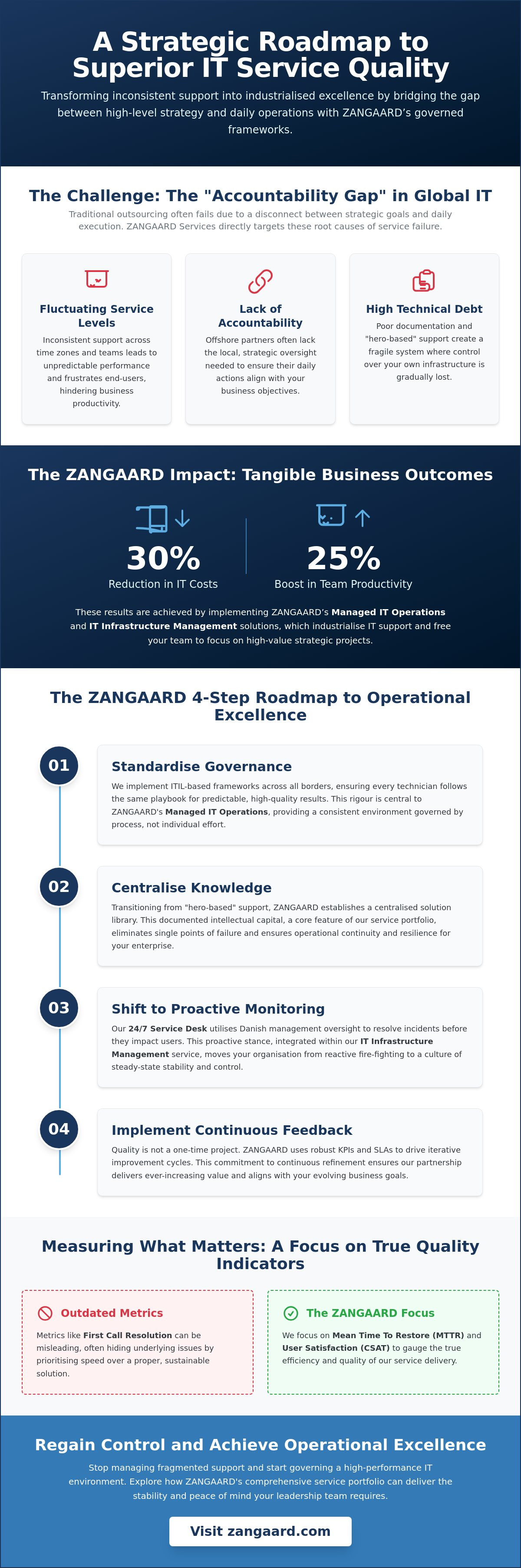
Poor service quality creates a hidden financial burden that extends far beyond the immediate impact of downtime. Industry data suggests that businesses using structured managed services can reduce IT costs by 20-30% whilst boosting productivity by up to 25%. When IT teams are trapped in a "reactive loop," digital transformation effectively stalls. If your staff are constantly resolving legacy incidents, they can't focus on the high-value projects found in our service portfolio.
Governance vs. Execution: The Critical Balance
Strategy often fails to influence daily service desk behaviour because there's no bridge between the boardroom and the technician. Managed Dual Shoring provides this bridge. By integrating Danish leadership with global technical talent, our Managed IT Operations ensures that high-level governance translates into reliable execution. This structure provides the steady hand required to manage complex, high-stakes environments whilst maintaining absolute transparency for the enterprise leader.
A 4-Step Roadmap for Improving IT Service Quality
Elevating service standards requires a transition from fragmented execution to a unified operational model. It's about building a system where accountability is baked into every layer of the infrastructure. This roadmap provides the structure required to regain control and ensure that IT supports, rather than hinders, your strategic objectives.
- Step 1: Standardise Governance. Implementing ITIL-based frameworks across borders ensures that every technician follows the same playbook. This rigour delivers value in today's emerging digital enterprise by providing a predictable environment where results are governed by process rather than individual effort.
- Step 2: Centralise Knowledge. Move away from "hero-based" support where critical information lives in one person's head. Intellectual capital must be documented in a centralised solution library to ensure continuity. As of 2026, 40% of enterprise applications include task-specific AI agents; leveraging these within your Managed IT Operations creates a smarter, more resilient knowledge base.
- Step 3: Shift to Proactive Monitoring. Utilise oversight to resolve incidents before they reach the user. A 24/7 Service Desk proves its worth by moving the organisation from a reactive fire-fighting stance to one of steady-state stability.
- Step 4: Continuous Feedback Loops. Use KPIs and SLAs to drive iterative improvement cycles. This ensures that the roadmap for improving IT service quality isn't a one-time project but a permanent shift in operational culture.
Standardising Your Operational Framework
Organising service desk tiers ensures that specific expertise is applied to the appropriate problem level. An L1 technician shouldn't be handling complex L3 infrastructure changes; clear escalation paths prevent bottlenecks. A unified Service Catalogue defines exactly what users can expect, providing transparency and setting clear boundaries for service delivery across the enterprise.
Measuring What Matters: KPIs for Quality
Traditional metrics like First Call Resolution often hide underlying issues. Focus instead on Mean Time to Restore (MTTR) and User Satisfaction Scores (CSAT) to gauge true efficiency. The Quality Index is a weighted average of technical and perceptual metrics. You can see how we apply these standards in our service portfolio. If you're looking for a partner to guide this transition, exploring our IT Infrastructure Management solutions is a logical next step.
Sustaining Quality Through Managed Dual Shoring
Scaling an enterprise often leads to a dilution of standards, particularly when offshore teams operate without direct, local oversight. ZANGAARD’s Managed IT Operations solve this by integrating disciplined Danish leadership with high-tier global technical talent. This model ensures that the accountability gap identified earlier is permanently closed. By maintaining a Danish management layer, we provide the strategic reassurance that high-stakes operations are handled with the same rigour as your internal team would apply. It’s a partnership where the burden of management shifts from your shoulders to our steady hand.
The "Danish Management" advantage isn't merely about cultural alignment; it's about a no-nonsense commitment to doing things right. Traditional offshore providers often struggle with synergy because they lack a bridge between strategy and execution. Our service portfolio serves as a framework for organisations looking to expand their technical capabilities whilst maintaining absolute control over their environment. It’s a disciplined approach to improving IT service quality that leverages global scale without sacrificing the precision of local standards.
Local Oversight, Global Scale
Operating a 24/7 centre of excellence in the Philippines provides the business continuity required for modern enterprises, but it's our Danish oversight that prevents quality drop-off. This dual-shore approach ensures that technical tasks are performed around the clock whilst remaining under the steady hand of managers who understand your specific business requirements. It eliminates the frustration of inconsistent service levels across time zones. We replace complexity with a predictable, industrialised flow of support that maintains high standards regardless of the hour.
Integrating ZANGAARD into Your Strategy
Our IT Infrastructure Management services act as the primary engine for improving IT service quality within your organisation. We don't just manage hardware; we manage the outcome of your entire technical ecosystem. This strategic partnership allows your leadership team to focus on high-level digital transformation whilst we handle the granular details of daily support and infrastructure stability. Discover how ZANGAARD’s Managed Dual Shoring can transform your IT service quality and bring lasting stability to your operations.
Securing the Future of Your IT Operations
Achieving a state of operational excellence requires more than just technical proficiency; it demands a disciplined framework that bridges the gap between strategy and execution. We've explored how standardising governance and centralising knowledge can eliminate the "Accountability Gap" that often plagues traditional outsourcing. Improving IT service quality is a continuous journey that relies on the synergy between local leadership and global technical expertise. By adopting a Managed Dual Shoring model, you ensure that business continuity is maintained whilst standards remain uncompromised.
ZANGAARD provides the steady hand your enterprise needs to navigate these complexities. Our Danish-led management team, supported by a 24/7 Global Service Desk and a proven Dual Shoring methodology, is ready to help you regain control and achieve peace of mind. Explore ZANGAARD’s Service Portfolio for High-Quality IT Operations and discover how our comprehensive service portfolio can support your long-term growth. It's time to move beyond reactive fire-fighting and towards a future of strategic stability and industrialised precision.
Frequently Asked Questions
What are the most important KPIs for improving IT service quality?
Mean Time to Restore (MTTR) and User Satisfaction Scores (CSAT) are the most critical metrics because they measure both technical efficiency and business alignment. Whilst traditional metrics like ticket volume provide raw data, they don't capture the actual impact on your organisation's productivity. Our Managed IT Operations utilise a weighted Quality Index to ensure that technical performance consistently meets executive expectations and operational requirements.
How does documentation impact the speed and quality of IT support?
Robust documentation reduces technical debt and eliminates the risks associated with "hero-based" support environments where knowledge is siloed. When solutions are centralised in a solution library, resolution times decrease because technicians don't have to reinvent the wheel for repetitive issues. We demonstrate this disciplined approach in our service portfolio, where documented processes ensure that service standards remain high during scaling or staff transitions.
Can offshore IT support truly match the quality of local teams?
Offshore support matches and often exceeds local quality when it's governed by a local centre of excellence and disciplined leadership. The common drop-off in quality usually stems from an accountability gap rather than a lack of technical skill. By integrating Danish management with our 24/7 Service Desk, we maintain a steady hand over global operations, ensuring that cultural alignment and rigorous standards are never compromised.
What is the difference between IT service quality and IT service management (ITSM)?
IT service management refers to the structured frameworks and processes, such as ITIL 5, used to design and deliver services, whereas IT service quality is the measurable outcome of those processes. ITSM provides the roadmap, but quality is the destination where technical performance aligns perfectly with business needs. Our service portfolio exemplifies how we use advanced ITSM principles as the foundation for improving IT service quality across the digital enterprise.
Disclaimer
The purpose of this article is to generate inspiration, reflection and to start a debate across markets, industries and organizations. We do not recommend any actions soly based on the article statements, claims or opinions, but recommend you to reach out directly to ZANGAARD for a qualified review, dialogue and/or consultation. Reach out at [email protected] or visit our website www.zangaard.com


