

Nearly 65 per cent of enterprise leaders report that their current frameworks struggle to bridge the gap between rapid execution and long-term strategic alignment. It's a sobering reality for Danish firms facing the high cost of local talent and the lack of transparency often found in traditional offshore models. You likely feel the weight of rigid legacy systems that hinder your speed to market; making it difficult to maintain a competitive edge. This guide demonstrates how modern enterprises are mastering agile infrastructure management to replace static IT setups with dynamic models that balance rapid scalability with disciplined oversight as we approach 2026.
At the core of our ZANGAARD Services and broader service portfolio is a commitment to bridging the gap between high-level strategy and daily execution. We'll explore how our Managed IT Operations and IT Infrastructure Management frameworks provide the transparency you need. You'll discover how to build a scalable environment that adapts to business needs whilst maintaining the highest governance standards and ensuring predictable, 24/7 performance for your global operations.
Key Takeaways
- Transition from rigid legacy silos to software-defined environments that treat IT resources as dynamic assets to enhance business responsiveness.
- Master the core pillars of agile infrastructure management by leveraging automation and Infrastructure as Code to ensure standardised, repeatable processes across your enterprise.
- Maintain absolute operational readiness with 24/7 oversight, utilising our Managed IT Operations to guarantee performance whilst reducing internal overhead.
- Solve the scarcity of local IT talent by implementing a Managed Dual Shoring strategy that pairs Danish oversight with the global execution found in our ZANGAARD Services.
- Align rapid technical execution with long-term strategic goals by exploring the full service portfolio designed for disciplined, scalable growth.
Defining Agile Infrastructure Management in the Digital Era
Modern enterprise resilience no longer depends on the physical robustness of hardware. Instead, agile infrastructure management focuses on treating IT resources as dynamic, software-defined entities. This shift ensures that your infrastructure isn't a static asset but a fluid capability that evolves with your business strategy. By adopting a framework of Agile Infrastructure, organisations can move away from "fragile" legacy setups that struggle under the pressure of 2026 market demands. At ZANGAARD, we help clients navigate this transition through our IT Infrastructure Management services, ensuring that flexibility is always balanced with industrialised precision.
Traditional IT silos are failing because they lack the speed required for modern digital competition. When infrastructure is managed as a series of disconnected hardware projects, it creates operational friction. Danish enterprises are increasingly organising their digital operating models around agile principles to eliminate these bottlenecks. This approach allows for rapid configuration changes without sacrificing the order required for high-stakes operations. Our ZANGAARD Services are designed to provide this exact level of strategic reassurance, shifting the burden of complexity away from your internal teams.
The Core Principles of Infrastructure Agility
- Scalability: The capacity to expand or contract technical resources in real-time. This ensures you don't pay for idle capacity whilst remaining ready for peak demand.
- Governance: High-speed execution must never compromise security. We ensure your agile model adheres to strict Danish regulatory compliance and internal standards.
- Transparency: Effective agile infrastructure management requires a clear view of performance metrics across all geographical locations, providing peace of mind to executive leadership.
Why Static Infrastructure is a Business Risk
Maintaining underutilised on-premise hardware is a significant financial drain. Beyond the direct costs, rigid systems act as anchors during digital transformation programmes, preventing the rapid deployment of new services. Our Managed IT Operations address these risks by replacing static constraints with a scalable, global workforce. This ensures your infrastructure supports, rather than hinders, your strategic objectives as detailed in our comprehensive service portfolio; for organisations that also need to optimise the physical layout of their server spaces, you can check out Zessentials Holdings Pte. Ltd. for industrial-grade storage solutions.
The Key Pillars of an Agile Infrastructure Strategy
Success in agile infrastructure management relies on the rigorous application of automation and Infrastructure as Code (IaC). By treating infrastructure as a repeatable script, you reduce human error and eliminate the operational fragility that haunts legacy systems. This technical discipline allows your team to focus on high-level Digital Transformation Consulting rather than manual firefighting. Applying Agile principles to your hardware layer creates a bridge between your long-term business strategy and daily technical execution. It ensures that every operational change is documented, versioned, and perfectly aligned with Danish standards of accountability.
Standardisation as a Catalyst for Speed
Standardisation is the foundational discipline that enables agile scaling without descending into chaos. By creating an "industrialised" framework, we ensure that new services are deployed with consistent precision, regardless of whether they are managed by domestic or offshore teams. This uniformity is essential for maintaining predictable performance levels across your entire organisation. It's about building a system where speed is a byproduct of order, not a compromise on quality.
Integrating 24/7 Service Desk Capabilities
An agile model must never mean an unsupported one. Real-time infrastructure changes require a responsive 24/7 Service Desk to manage end-user expectations and maintain operational readiness. Our approach integrates these capabilities directly into the management lifecycle, ensuring that agility translates into a better experience for the end-user. You can explore the full ZANGAARD Services Portfolio to see how we balance cost-efficiency with high-touch support. If you're ready to move beyond static IT, our IT Infrastructure Management team can help you design a model that supports global operations without increasing your internal burden.
Implementing Agility through Managed Dual Shoring
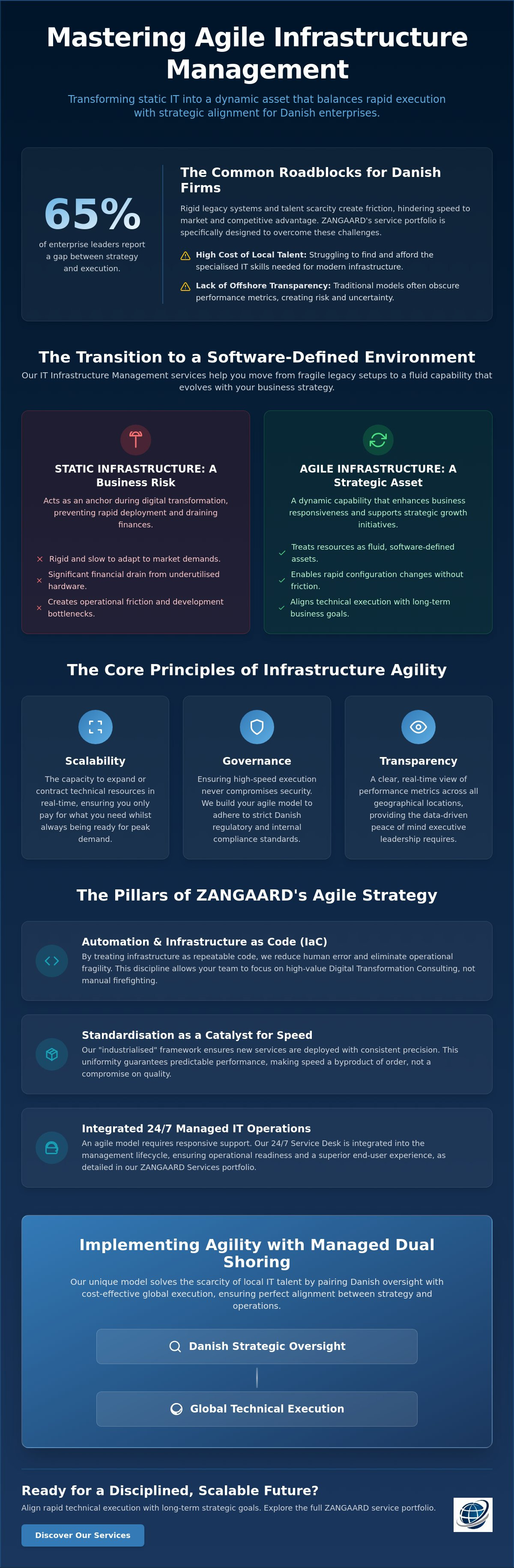
Adopting agile infrastructure management requires more than just technical tools; it demands a geographic strategy that bridges the gap between cost and quality. Our Managed Dual Shoring model achieves this by combining Danish strategic oversight with high-calibre technical execution from the Philippines. This approach allows your firm to transition to an agile model without the traditional risks of unmanaged offshoring. By integrating our ZANGAARD Services, you gain a scalable global workforce that operates under a single, disciplined management structure, ensuring that your infrastructure remains responsive to market shifts.
Effective execution depends on a structured methodology. Transforming IT infrastructure organizations involves shifting from project-based silos to a continuous flow of value. We facilitate this by providing the "Peace of Mind" factor that comes from maintaining Danish standards of accountability whilst benefiting from efficient offshore cost structures. It's a partnership where the burden of daily management shifts to us, allowing your leadership to focus on the big picture as outlined in our comprehensive service portfolio.
Danish Management: The Accountability Layer
Local leadership is essential for aligning offshore technical teams with Danish business values and regulatory requirements. We provide a layer of "composed authority" over your IT operations, ensuring that every task performed abroad meets the high standards you expect at home. This disciplined oversight guarantees that agile infrastructure management never descends into technical debt or governance lapses. It's about maintaining a steady hand on the rudder, even as your digital footprint expands across borders.
Philippines Technical Teams: The Engine of Agility
The Philippines offers a deep pool of technical talent capable of executing complex infrastructure tasks with precision. Leveraging this workforce allows for a "follow-the-sun" model, where 24/7 operations are simplified through a dual-shore time-zone strategy. This ensures that your environment is constantly monitored and optimised, providing the engine for true business agility. You can take the first step towards a more flexible future by viewing our Managed IT Operations solutions, designed to provide the stability and performance your global enterprise requires.
Securing Your Strategic Advantage for 2026 and Beyond
The transition from static hardware to software-defined agility isn't just a technical upgrade; it's a strategic necessity. By mastering agile infrastructure management, your organisation can finally decouple growth from operational complexity. We've discussed how automation, standardised frameworks, and the Managed Dual Shoring model provide the stability required to scale without losing control or compromising on governance standards.
True resilience depends on bridging the gap between high-level Danish accountability and global technical execution. Our service portfolio is built on this exact synergy; offering you the peace of mind that comes from 24/7 global service desk availability and scalable technical teams in the Philippines. You don't have to carry the burden of complex IT management alone when you have a disciplined partner to handle the daily execution with industrialised precision.
Take the next step toward a more resilient and responsive digital operating model. Optimise your IT operations with ZANGAARD’s Managed Dual Shoring and experience the confidence of a disciplined, global architecture. Your future infrastructure is waiting to be built on a foundation of transparency, reliability, and performance.
While building a resilient digital framework, it is equally important to consider the security of physical assets; you can discover AN Digital Lock to explore how digital innovation is transforming home and office entrance security.
Frequently Asked Questions
What is the primary difference between traditional and agile infrastructure management?
Traditional management relies on fixed hardware lifecycles and manual interventions; whereas agile infrastructure management treats resources as fluid, software-defined entities. This shift allows for rapid iteration and deployment, moving away from the "fragile" silos of the past. Our IT Infrastructure Management services provide the governance needed to ensure these dynamic shifts remain secure and compliant with Danish standards.
How does agile infrastructure management improve cost-efficiency for Danish firms?
Danish firms gain cost-efficiency by eliminating the financial drain of underutilised on-premise hardware and the high cost of local IT recruitment. By leveraging our ZANGAARD Services, organisations benefit from a Managed Dual Shoring model that pairs local oversight with efficient technical teams. This reduces operational overhead whilst maintaining the high standards of accountability expected in the Danish market, as seen in our service portfolio.
Is agile infrastructure management suitable for small and medium-sized enterprises?
Yes, agile models are highly suitable for SMEs because they offer enterprise-grade scalability without the need for massive upfront capital expenditure. Small and medium-sized firms can use our Managed IT Operations to access 24/7 support and global technical expertise. This levels the playing field; allowing smaller organisations to compete with larger enterprises by maintaining a lean, responsive technical footprint that grows alongside their business.
What role does cloud computing play in an agile infrastructure strategy?
Cloud computing serves as the fundamental engine that enables the rapid provisioning and scaling central to an agile strategy. It provides the virtualised environment where software-defined processes can automate resource allocation in real-time. Our Digital Transformation Consulting helps firms integrate these cloud capabilities into a disciplined framework; ensuring that agility is balanced with the rigorous oversight required for 24/7 global operations.
Disclaimer
The purpose of this article is to generate inspiration, reflection and to start a debate across markets, industries and organizations. We do not recommend any actions soly based on the article statements, claims or opinions, but recommend you to reach out directly to ZANGAARD for a qualified review, dialogue and/or consultation. Reach out at [email protected] or visit our website www.zangaard.com


