

Hiring more contractors to solve a delivery bottleneck often creates a new, more exhausting problem: the management debt of overseeing them. Whilst the debate of it staff augmentation vs managed services usually focuses on hourly rates, the real cost lies in the mental load of your internal leadership. You likely recognise the frustration of escalating talent costs in the UK and Europe, compounded by a lack of accountability from traditional offshore models that require constant micro-management to ensure quality.
This comparison provides the clarity needed to determine which model secures your operational stability and scalability for 2026. We examine how shifting the burden of governance from your team to a disciplined partner can yield predictable costs and higher output. By aligning these strategies with the ZANGAARD Services suite, including our service portfolio in Managed IT Operations and 24/7 Service Desk support, we demonstrate how to regain strategic control whilst maintaining industrialised precision in your daily execution. You will discover a roadmap for transitioning from fragmented oversight to a streamlined, outcome-based architecture.
Key Takeaways
- Identify the core distinctions between it staff augmentation vs managed services to ensure your choice supports long-term operational stability rather than short-term fixes.
- Evaluate the true cost of management overhead by comparing the internal resources required to lead contractors versus the accountability-driven results of a managed team.
- Gain insight into how Managed Dual Shoring bridges the gap between high-level strategy and daily execution through a blend of Danish oversight and global technical talent.
- See how ZANGAARD Services, particularly our Managed IT Operations, provide a disciplined approach to reducing complexity whilst securing predictable costs.
- Consult our service portfolio to understand how a 24/7 Service Desk and IT Infrastructure Management can be integrated to deliver peace of mind without micro-management.
Defining the Models: IT Staff Augmentation vs Managed Services
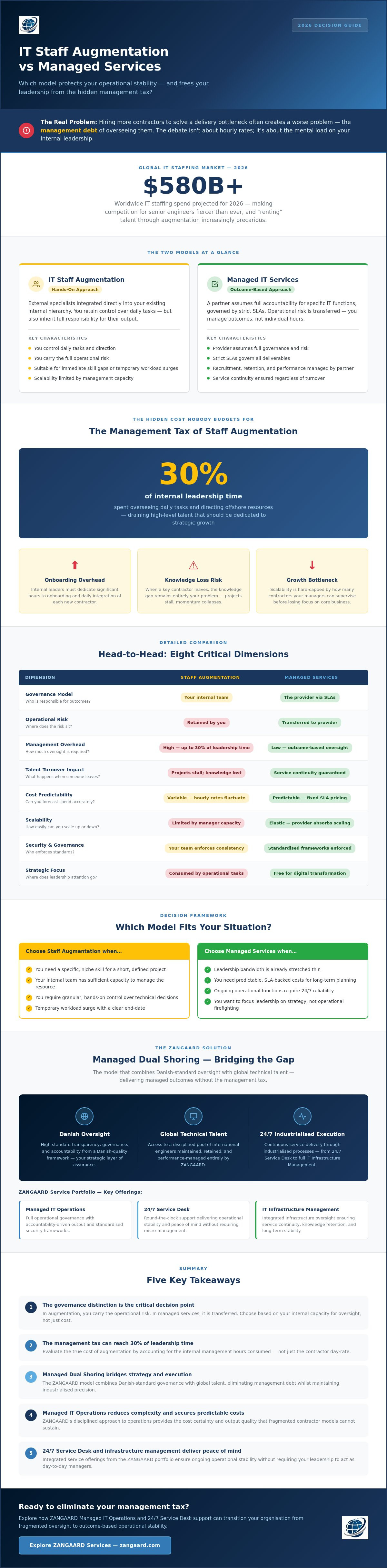
The choice between it staff augmentation vs managed services hinges on a fundamental question of governance. Staff augmentation involves integrating external specialists directly into your existing internal hierarchy. You retain control over their daily tasks, but you also inherit the responsibility for their output. Conversely, Managed services represent a model where a partner assumes full accountability for specific IT functions, governed by strict Service Level Agreements (SLAs). This distinction is critical; in augmentation, you carry the operational risk, whereas in a managed model, that risk is transferred to the provider.
In 2026, the market context has shifted dramatically. With worldwide IT staffing spending projected to exceed $580 billion this year, the competition for senior engineers is fierce. Simply "renting" talent through augmentation has become precarious. When a key contractor leaves, the knowledge gap remains your problem. Managed models mitigate this by ensuring service continuity, shifting the entire burden of recruitment, retention, and performance management to the partner. This provides a level of strategic reassurance that is difficult to achieve with a fragmented team of contractors.
IT Staff Augmentation: The Hands-On Approach
This model is often selected to fill immediate skill gaps or manage temporary workload surges whilst maintaining direct control. However, it introduces a "management tax." Your internal leaders must dedicate significant hours to onboarding, technical oversight, and daily integration. This often leads to management exhaustion, where the internal capacity to oversee contractors becomes a hard bottleneck for growth. Scalability is limited by how many people your managers can effectively supervise without losing focus on core business objectives.
Managed IT Services: The Outcome-Based Approach
Evaluating Risk, Control, and Management Overhead
Quantifying the management burden is the first step in a mature evaluation of it staff augmentation vs managed services. Whilst augmentation offers direct control, it often necessitates a "management tax" where internal leaders spend up to 30% of their time overseeing daily tasks and directing offshore resources. This micro-management drains high-level talent that should be dedicated to strategic growth. In contrast, managed services move the focus from individual activity to organisational outcomes.
Turnover presents another significant risk in 2026. In an augmented model, the departure of a single contractor can stall a project and erase critical institutional knowledge. Managed services eliminate this vulnerability by ensuring service continuity; the provider is responsible for maintaining the talent pool and internal documentation. This shift is a cornerstone of effective IT outsourcing risk management, where accountability for the final result rests with the partner rather than your internal management team.
The Hidden Costs of Micro-Management
Shifting from "body shopping" to managed operations provides the strategic reassurance business leaders require. Instead of chasing freelancers for updates, you gain a disciplined architect who ensures operational reliability. This transition allows your team to stop managing tickets and start driving innovation. Expert providers like Gradius IT Solutions illustrate how Managed IT Operations offer a sustainable path to reclaiming internal leadership capacity whilst ensuring 24/7 support.
Security and Governance Amongst Distributed Teams
Maintaining high standards across international borders requires more than just skilled individuals; it requires industrialised processes. Managed providers implement standardised security frameworks and ensure long-term knowledge retention within the service organisation. By choosing a partner that adheres to Danish standards of transparency, you secure your infrastructure whilst leveraging global talent. Our service portfolio illustrates how 24/7 Service Desk and IT Infrastructure Management can be integrated to provide 24/7 coverage that is simply impossible to replicate through traditional staff augmentation. This ensures that even as individual technicians change, your governance remains steady and your data remains protected.
The Managed Dual Shoring Solution: Bridging the Gap
Many leaders view the choice between it staff augmentation vs managed services as a binary trade-off between cost and control. This perception often ignores the potential for a hybrid architecture that captures the benefits of both. Managed Dual Shoring eliminates the traditional 'offshore risk' by placing a disciplined Danish management layer over a scalable technical workforce in the Philippines. This ensures that whilst you benefit from global cost-efficiencies, the accountability for delivery remains local and transparent. ZANGAARD integrates this local accountability with technical execution to move your operations from a state of potential complexity to one of streamlined simplicity.
Danish Management, Global Execution
Maintaining high standards requires a local point of contact who understands your business culture and operational requirements. This structure eliminates communication barriers through structured governance and Danish leadership, ensuring that every task aligns with your broader strategy. Managed Dual Shoring is the synthesis of local oversight and offshore cost-efficiency, providing a steady hand to guide complex technical execution. By shifting the management burden to us, you gain the strategic reassurance that your high-stakes operations are handled with industrialised precision.
Transitioning to Managed IT Operations
Moving from a fragmented staffing mindset to an integrated operational model requires a shift in strategic focus. You can begin this journey by reviewing the ZANGAARD service portfolio to identify which functions are best suited for a managed transition. Whether your needs involve Managed IT Operations or IT Infrastructure Management, the goal is to shift the burden of daily execution to a partner who prioritises your stability. The next step involves auditing your current IT infrastructure to prepare for this shift, ensuring that your organisation is ready to scale without increasing management debt. This methodical approach ensures that your transition to a managed model is both logical and steady.
Securing Your Operational Future with Managed Dual Shoring
Choosing between it staff augmentation vs managed services is ultimately a decision about where you want the burden of governance to reside. Whilst augmentation provides immediate hands on deck, it leaves the weight of oversight and the risk of turnover squarely on your shoulders. Managed services, particularly when delivered through a disciplined framework, allow you to reclaim your leadership’s time by focusing on Service Level Agreements rather than individual contractor hours. It's a vital shift for maintaining scalability in an increasingly competitive talent market.
ZANGAARD provides the strategic reassurance needed to navigate this transition with confidence. By combining Danish management standards with 24/7 global service desk availability, we ensure your infrastructure remains resilient whilst you focus on high-level growth. Our proven Managed Dual Shoring methodology bridges the gap between cost-efficiency and operational excellence, offering a steady hand to manage your most complex technical requirements. This approach is reflected across our ZANGAARD Services and our wider service portfolio.
We invite you to Explore ZANGAARD's Managed IT Operations and Dual Shoring Portfolio to discover how a partner-led model can secure your operational peace of mind. Regaining control of your digital operations starts with choosing a partner committed to unwavering accountability.
Frequently Asked Questions
Is IT staff augmentation cheaper than managed services?
Staff augmentation often appears more cost-effective on a per-hour basis, yet it frequently carries a higher Total Cost of Ownership (TCO) due to the hidden "management tax." When you factor in the internal resources required to onboard, direct, and oversee contractors, the financial gap in it staff augmentation vs managed services narrows significantly. Managed services provide a predictable monthly fee that includes the cost of governance, recruitment, and service continuity, which often results in better long-term value.
Can I combine staff augmentation with managed IT services?
You can certainly adopt a hybrid approach that utilises both models to address different organisational needs. Many businesses choose ZANGAARD Services to handle core Managed IT Operations whilst using staff augmentation for short-term, niche project surges. This strategy allows you to maintain a stable, disciplined foundation for your primary infrastructure whilst retaining the flexibility to scale specific development teams for temporary requirements.
What are the biggest risks of IT staff augmentation?
The primary risks involve knowledge loss and management exhaustion. When an augmented contractor leaves, they often take critical institutional knowledge with them, leaving your internal team to fill the gap. Additionally, the burden of daily oversight remains with your managers, which can lead to a bottleneck in strategic decision-making. Managed services mitigate these risks by placing the accountability for documentation and staff retention on the partner rather than the client.
How do I ensure quality when using offshore managed services?
Quality is maintained through a structured governance framework that includes local management oversight. By utilising our Managed Dual Shoring methodology, we ensure that Danish standards of transparency and quality are applied to global technical execution. You can review our service portfolio to see how this disciplined approach ensures that operational reliability is never compromised by geographical distance or cultural differences.
What is the typical transition time to a managed services model?
A transition to a managed model typically requires between four to twelve weeks, depending on the complexity of your environment. This timeframe allows for a methodical audit of your existing IT infrastructure and a steady transfer of knowledge to the service team. It's a deliberate process designed to ensure that the handover is seamless and that your operational stability is maintained throughout the shift.
Does managed services mean I lose control over my IT strategy?
No, you actually gain greater control over your IT strategy by offloading the burden of daily operational execution. Managed services allow your internal leadership to stop focusing on routine maintenance and start focusing on high-level digital transformation. You continue to define the strategic direction and business goals, whilst we provide the steady, expert hand required to manage the underlying technical complexities.
Disclaimer
The purpose of this article is to generate inspiration, reflection and to start a debate across markets, industries and organizations. We do not recommend any actions soly based on the article statements, claims or opinions, but recommend you to reach out directly to ZANGAARD for a qualified review, dialogue and/or consultation. Reach out at [email protected] or visit our website www.zangaard.com


