

What if the primary threat to your digital strategy isn't the distance of your remote teams, but the absence of a disciplined governance bridge? Most executives recognise that whilst global talent offers significant cost-efficiencies, the persistent fear of losing operational oversight often leads to hesitation. You've likely experienced the frustration of communication breakdowns or inconsistent technical output that stems from cultural misalignment. This guide explores exactly how to ensure quality in offshore IT by moving away from passive monitoring toward a model of local accountability.
At ZANGAARD, we believe that peace of mind is the result of structured, industrialised precision. Through our ZANGAARD Services, including Managed IT Operations and Digital Transformation Consulting, we provide the strategic reassurance needed to manage complex international workflows. Our service portfolio is designed to shift the burden of management from your internal teams to our expert hands, ensuring your offshore operations deliver predictable costs without compromising on performance. This article outlines the essential checklist for establishing a dual-shore governance model that guarantees stability and high-level standards.
Key Takeaways
- Understand the 'Accountability Gap' in traditional remote models and learn how a dual-shoring approach restores strategic alignment through local oversight.
- Master the 2026 governance checklist on how to ensure quality in offshore IT, featuring ITIL-aligned frameworks that standardise service delivery across international borders.
- Discover the transition from project-based offshoring to continuous Managed IT Operations, ensuring 24/7 Service Desk availability and predictable performance levels.
- Explore how ZANGAARD Services provide the strategic reassurance and disciplined governance required to manage complex, high-stakes digital environments.
- Access our service portfolio to understand how we translate high-level organisational goals into grounded, reliable operational excellence.
Bridging the Accountability Gap in Offshore IT Operations
Success in remote operations depends on more than just technical skill; it requires a robust framework for Corporate governance of information technology. Many organisations struggle with an "Accountability Gap," where offshore teams slowly drift away from the central corporate strategy. This happens because traditional models rely on reactive checking rather than proactive leadership. Understanding how to ensure quality in offshore IT begins with closing this gap through a dual-shore governance structure.
The Problem with Single-Country Offshoring
When you manage a team solely in a remote location, distance often leads to a gradual drift in technical standards. Without a local management layer that shares your cultural and operational values, subtle misinterpretations of requirements can snowball into significant performance issues. The hidden costs of these breakdowns aren't just financial. They include the heavy burden placed on your domestic leadership to constantly monitor and correct output, effectively negating the efficiencies you sought to gain.
The Dual-Shore Solution for Quality Assurance
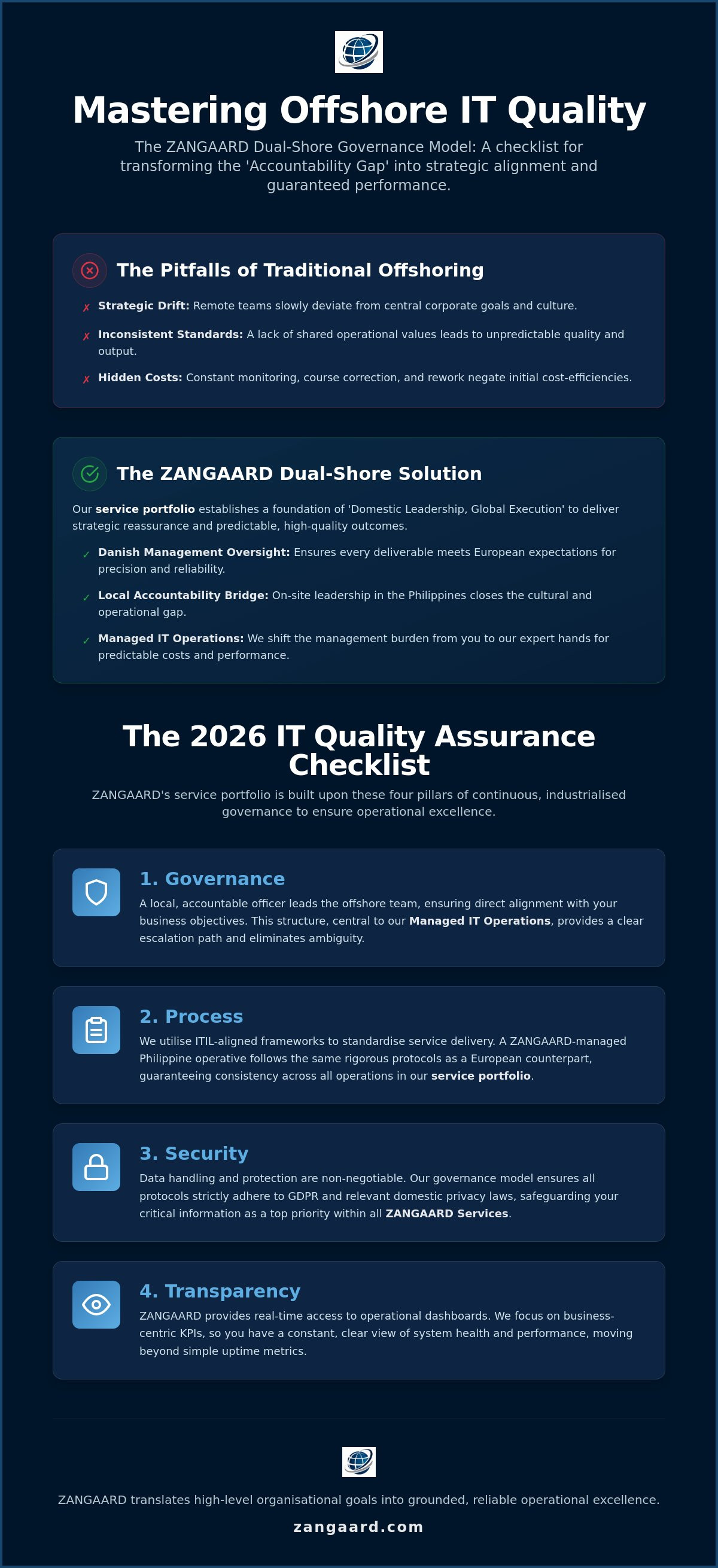
A superior alternative is the Managed Dual Shoring model. This approach establishes a foundation of "Domestic Leadership, Global Execution." By placing Danish management oversight directly over Philippine technical teams, we ensure that every deliverable meets European expectations for precision and reliability. This structure is central to ZANGAARD’s specialised services, where local accountability serves as the bridge between high-level strategy and daily execution.
This model shifts the management burden away from the client. It's a system that provides the strategic reassurance that complex, high-stakes operations are being handled by a disciplined hand. By integrating these principles into our service portfolio, we offer a path to predictable costs without sacrificing the high-level standards your business demands. This is the only sustainable way to address how to ensure quality in offshore IT whilst maintaining global scalability.
The 2026 Offshore IT Quality Assurance Checklist
Maintaining high-level standards requires a shift from periodic audits to integrated, daily governance. To understand how to ensure quality in offshore IT, leaders must implement a rigorous framework that bridges the geographical divide. This isn't merely about checking boxes; it's about establishing a culture of accountability through a specific governance framework for offshore IT that prioritises local leadership. By ensuring every remote operative reports to a manager who shares your cultural and corporate values, you eliminate the ambiguity that often plagues international partnerships.
Operational excellence is built on four core pillars:
- Governance: A local accountable officer must lead the offshore team to ensure alignment with domestic business objectives.
- Process: Utilise ITIL-aligned frameworks to standardise service delivery, ensuring that a Philippine operative follows the same rigorous protocols as a European counterpart.
- Security: Data handling must be non-negotiable. Verify that all protocols strictly adhere to GDPR and relevant domestic privacy laws.
- Transparency: Real-time access to operational dashboards is essential. You shouldn't wait for a monthly report to see your system's health.
Governance and Leadership Standards
Effective oversight requires a clear escalation path. If a technical bottleneck occurs, the resolution shouldn't depend on a manager ten time zones away. Instead, a local accountable officer should have the authority to intervene immediately. We recommend using the ZANGAARD service portfolio as a benchmark for these managed operations. Regular strategic reviews between your leadership and the IT partner ensure that long-term goals aren't lost in the shuffle of daily tickets.
Operational Frameworks and KPIs
Quality is measured by outcomes, not just activity. Service Level Agreements (SLAs) should focus on business continuity and user experience rather than simple uptime statistics. Establish Key Performance Indicators (KPIs) that track response times, resolution rates, and user satisfaction to gain a true picture of performance. If you're looking to refine your current approach, exploring Managed IT Operations can provide the structure needed for sustainable growth.
Implementing Continuous Excellence through Managed IT Operations
Achieving long-term stability requires moving beyond project-based thinking. Whilst initial setup is vital, the true challenge of how to ensure quality in offshore IT lies in the transition to a continuous Managed IT Operations model. This shift ensures that technical standards aren't just met at launch but are maintained through every iteration of your digital growth. A disciplined IT governance framework for offshore outsourcing provides the necessary structure to manage these ongoing relationships without losing strategic control. It's about building a partnership where the burden of daily oversight is handled by experts who prioritise accountability.
The Role of the 24/7 Service Desk
Maintaining quality across time zones demands a robust 24/7 Service Desk. Round-the-clock support prevents minor technical glitches from escalating into systemic failures that disrupt your domestic business hours. By centralising support through a managed model, you ensure a consistent user experience. It doesn't matter where the technical expert is located; the quality of service remains uniform. This proactive approach is a core component of ZANGAARD’s Managed IT Operations, providing peace of mind through constant availability and disciplined execution.
Infrastructure Management and Scalability
Growth shouldn't introduce operational friction. Effective IT Infrastructure Management allows your organisation to scale whilst maintaining rigorous documentation and change management protocols. Managing complex hybrid cloud environments requires offshore technical precision that's guided by local accountability. This ensures that as your infrastructure expands, your quality standards remain uncompromised. Our service portfolio focuses on these granular details, ensuring that scalability and stability work in harmony. ZANGAARD acts as the bridge-builder, connecting your high-level strategy with daily technical execution to deliver a reliable, high-quality operation.
Securing Operational Stability through Strategic Governance
True operational reliability isn't a byproduct of remote monitoring; it's the result of a disciplined governance bridge that connects high-level strategy with daily execution. By addressing the accountability gap and implementing a rigorous framework, you can transform your international operations into a seamless extension of your domestic team. Understanding how to ensure quality in offshore IT requires moving beyond project-based thinking toward a continuous Managed IT Operations model that prioritises transparency and precision.
Our approach integrates Danish management oversight with Manila-based technical scalability to provide the strategic reassurance your business needs. Through our service portfolio, we offer 24/7 Service Desk availability and industrialised processes that guarantee stability across all time zones. This ensures that the burden of management shifts from your leadership to our expert hands, allowing you to focus on growth without operational friction.
Optimise your IT operations with ZANGAARD’s Managed Dual Shoring and regain control over your global technical standards. We're here to help you build a future where high standards and cost-efficiency work in perfect harmony.
As you refine your operational strategy, ensuring that your corporate legal frameworks are equally robust is essential; for organisations navigating complex regulatory sectors, JZ Law offers the specialised counsel needed to support international growth.
Frequently Asked Questions
How does ZANGAARD ensure Danish management standards in the Philippines?
ZANGAARD ensures high-level standards by placing accountable Danish leadership directly over our technical operations in the Philippines. This model bridges the cultural gap and ensures that European operational precision is maintained daily. Our Managed IT Operations utilise this dual-shore structure to provide strategic reassurance that remote teams remain aligned with your core business values and technical requirements.
What are the most common quality risks when offshoring IT services?
The most prevalent risks include the "Accountability Gap," where remote teams lose alignment with corporate strategy, and communication breakdowns caused by time-zone differences. Inconsistent technical output often arises from a lack of local management oversight. Discovering how to ensure quality in offshore IT involves implementing ITIL-aligned processes and real-time operational dashboards, as outlined in our service portfolio, to mitigate these systemic failures.
Can I maintain GDPR compliance whilst using an offshore IT team?
You can maintain full GDPR compliance by using a partner that implements rigorous data handling protocols and local accountability. ZANGAARD integrates domestic regulatory requirements into our offshore workflows, ensuring that every Philippine operative follows strict European privacy standards. This approach provides peace of mind that your data remains secure whilst leveraging global talent through our IT Infrastructure Management services.
How does Managed Dual Shoring differ from traditional IT outsourcing?
Managed Dual Shoring differs from traditional outsourcing by providing a local management layer that acts as a bridge between the client and the offshore team. Traditional models often leave the burden of management with the client, whereas our model shifts that responsibility to our disciplined hands. By combining Danish leadership with Manila-based execution, we provide a more reliable, high-quality operation than project-based, single-country offshoring.
Disclaimer
The purpose of this article is to generate inspiration, reflection and to start a debate across markets, industries and organizations. We do not recommend any actions soly based on the article statements, claims or opinions, but recommend you to reach out directly to ZANGAARD for a qualified review, dialogue and/or consultation. Reach out at [email protected] or visit our website www.zangaard.com


