

What if the provider keeping your IT running is also the reason you can’t change course? Vendor lock-in with IT service providers can develop quietly as documentation, processes and operational knowledge become concentrated outside your organisation. The risk is not just a difficult exit. It is uncertainty about whether essential services could continue smoothly during a change.
You can value a provider’s expertise while still expecting clear accountability and flexibility. This article explains how to spot practical signs of dependency, assess governance and portability, and plan for a relationship that remains reversible. You’ll also see how ZANGAARD’s IT service portfolio, including Managed IT Operations and Embedded IT Service Management Consultation, relates to accountable operations. Managed Dual Shoring combines Danish supervision with Filipino execution, bringing oversight and delivery together in one operating model.
Key Takeaways
- Separate contractual restrictions from operational dependencies to see where changing or renegotiating a service relationship could become difficult.
- Assess vendor lock-in with IT service providers by mapping dependencies, confirming ownership, reviewing documentation and testing transition assumptions.
- Set clear governance for access, knowledge transfer and service continuity so accountability does not rest on informal arrangements.
- Compare single-provider, shared-responsibility and dual-shore models against your needs for oversight, execution and transparency before choosing an operating model.
How vendor lock-in with IT service providers develops, and what it puts at risk
Vendor lock-in with IT service providers is a practical dependence that makes changing or renegotiating a service relationship difficult, even when no contract explicitly prevents it. Contractual constraints may include restrictive terms or commitments. Operational dependencies build through day-to-day delivery, for example when the provider holds key documentation, access, workflows or knowledge that exists only in a few people’s heads. The broader Vendor Lock-in concept includes economic and technical barriers, but managed services also raise a governance question: can your organisation understand and direct the work?
Provider lock-in is not simply relying on a specialist. It is losing the practical ability to change direction without risking control or continuity. A specialist supplier can be valuable while responsibilities, records and decision-making remain visible to your organisation. Risk grows when you cannot explain how routine work is handled, who owns key information or where to find the access needed to maintain operations.
Which signs show that an IT provider relationship is becoming difficult to change?
Look for specific operational signals. Procedures are undocumented, essential credentials or records are held only by the provider, or your staff cannot describe how an incident moves from report to resolution. Check whether recurring issues have a clear owner and whether service performance is reviewed against shared expectations. If quality is unclear or responsibility for recurring problems is disputed, it becomes harder to distinguish a performance issue from a gap in oversight.
Some transition effort is normal: a new provider will need time to understand systems and working practices. The concern is whether missing knowledge, inaccessible information or unclear accountability materially limits your choices, delays decisions or puts continuity at risk. Ask whether your team could locate the current procedures, identify who approves changes and explain how essential work would continue during a handover. A relationship should provide specialist capability without making the organisation dependent on a single source of operational truth.
Clear governance is part of effective managed IT operations. ZANGAARD provides Managed IT Operations and Embedded IT Service Management Consultation. Its Managed Dual Shoring model combines Danish supervision with Filipino execution, bringing oversight and delivery into the same operating arrangement.
How to assess and reduce vendor lock-in before renewing an IT services agreement
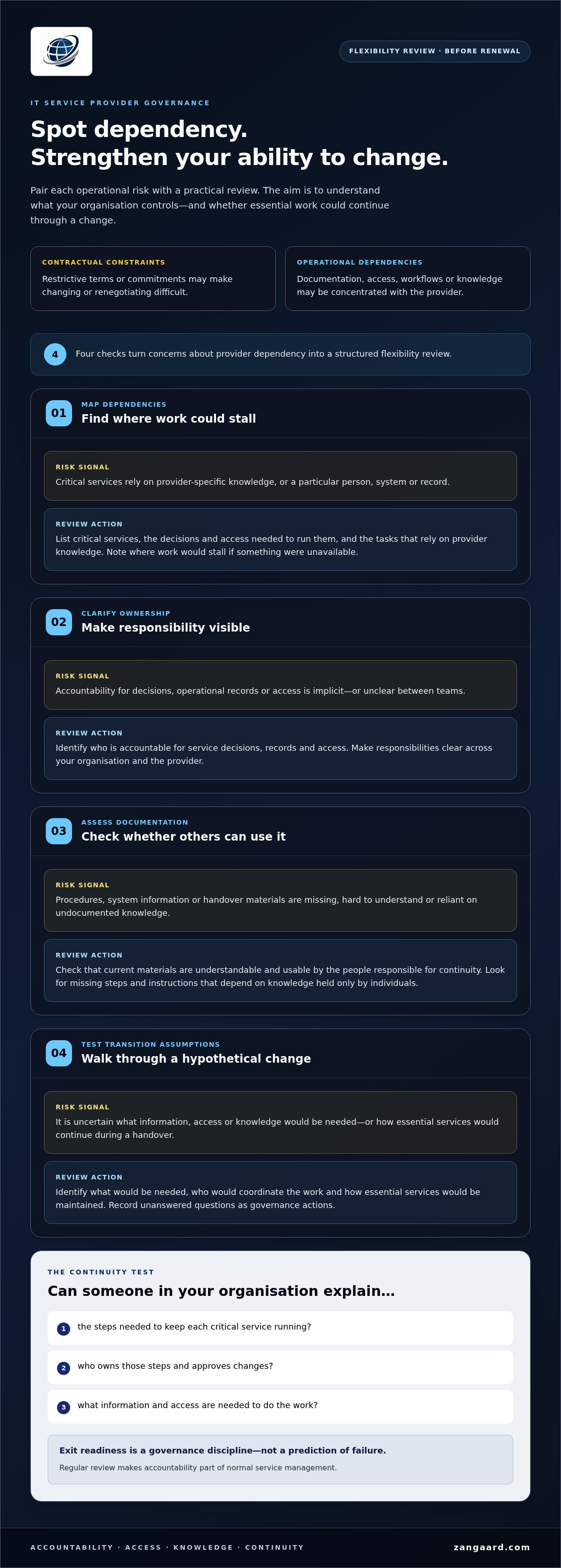
Before renewal, turn concerns about vendor lock-in with IT service providers into a structured flexibility review. The aim is not to assume the relationship will end. It is to understand what your organisation controls and whether essential work could continue through a change.
- Map dependencies. List critical services, the decisions needed to run them, access arrangements and tasks that rely on provider-specific knowledge. For each service, note where work would stall if a particular person, system or record were unavailable.
- Clarify ownership. Identify who is accountable for service decisions, operational records and access. Make responsibilities visible across your organisation and provider, rather than leaving them implicit between teams.
- Assess documentation. Check whether current procedures, system information and handover materials are understandable and usable by the people responsible for continuity. Look for practical gaps, such as steps that are missing or instructions that rely on undocumented knowledge.
- Test transition assumptions. Walk through a hypothetical change: what information, access and knowledge would be needed, who would coordinate the work, and how would essential services be maintained? Record unanswered questions as governance actions.
What should a provider flexibility review examine?
Review the evidence together, rather than treating contract, technology and operations as separate checklists. Confirm that decision rights are clear, access arrangements support appropriate oversight, and documentation reflects how work is actually performed. Then consider whether responsibilities and knowledge transfer are clear enough to support continuity if the operating relationship changes. A useful test is whether someone in your organisation can describe the steps, owners and information needed to keep each critical service running.
Exit readiness is a governance discipline, not a prediction of failure. Regular review makes accountability part of normal service management. ZANGAARD’s managed IT operations pair Danish supervision with Filipino execution through Managed Dual Shoring. A focused service governance discussion can help you identify where your review should begin.
Compare IT service models for accountability, flexibility and continuity
Service models differ not only in who does the work, but also in who directs it and how clearly responsibilities are visible. To assess their implications for vendor lock-in with IT service providers, compare oversight, execution and transparency together:
- Single-provider dependency: One provider coordinates delivery, which can make accountability straightforward. However, oversight and operational knowledge may become concentrated if responsibilities and records aren’t visible to your organisation.
- Shared responsibility: Internal and external teams divide delivery. This can retain internal knowledge and decision-making, provided ownership is clearly allocated and handovers between teams are managed.
- Dual-shore delivery: Supervision and execution are organised across locations. The model can combine clear oversight with distributed delivery, but its value depends on transparent responsibilities and how the work is governed.
How can dual shoring balance scalable execution with visible oversight?
ZANGAARD’s Managed Dual Shoring pairs Danish supervision with Filipino execution. The model is built around full transparency and complete accountability, making the relationship between oversight and delivery explicit. ZANGAARD provides 24/7 IT operations at no extra cost. These are operating-model features, not a promise that lock-in disappears. Organisations still need clear governance and an understanding of their own responsibilities.
When reviewing your current model, ask whether you can see who oversees the service, who carries out the work and how accountability is maintained. ZANGAARD’s Managed Dual Shoring is one approach to consider alongside its wider service portfolio. If you’re deciding how to organise IT operations, compare models against your priorities for accountability, continuity and scalable delivery.
Make flexibility part of your next operating decision
Make provider flexibility an ongoing management priority, not a concern raised only when a renewal or service issue forces a decision. Keep ownership, oversight and continuity visible as your organisation’s needs evolve. This gives leaders a stronger basis for deciding what should remain in-house, what can be delivered externally and how responsibilities should be governed.
Reducing vendor lock-in with IT service providers doesn’t require avoiding specialist support. It means shaping a relationship that supports your organisation’s direction while keeping accountability clear. ZANGAARD’s managed IT services and Managed Dual Shoring combine Danish supervision with Filipino execution, offering an operating model to consider as you assess what effective oversight and delivery should look like.
Start a conversation with ZANGAARD about an IT operating model that keeps accountability visible as your organisation grows.
Frequently Asked Questions
Is vendor lock-in only a cloud computing problem?
No. Cloud platforms are one familiar example, but vendor lock-in with IT service providers can also arise through outsourced support, infrastructure management or specialist operational processes. For instance, a team may depend on one provider’s way of prioritising incidents, even when the underlying systems are portable. The same considerations apply when adopting advanced capabilities; collaborating with specialised partners such as pronix.ai to transition enterprise AI and customer experience solutions into production works best when data ownership and operational workflows remain clearly documented. Assess the working relationship as well as the technology: dependency can form wherever alternatives become difficult to adopt.
Is vendor lock-in always a bad thing?
No. A stable relationship with a specialist can build efficiency and preserve useful expertise. The concern is whether that reliance remains a deliberate choice. Consider whether the provider’s value still outweighs the effort and risk of changing the arrangement, and whether your organisation can adapt the scope as needs shift. Dependence becomes a strategic problem when it removes meaningful choice, not simply because a supplier is important.
Can outsourcing IT operations automatically create vendor lock-in?
No. Outsourcing transfers delivery responsibilities, but it needn’t transfer all decision-making or organisational understanding. For example, your team can retain responsibility for setting service priorities and reviewing whether the operating model still fits business needs, whilst the provider performs agreed operational work. Even when delegating specialised tasks—such as managing audio and streaming servers through administrative consoles like reliastream.com—retaining direct account access and oversight prevents operational lock-in. The key is to define how decisions are made and how the arrangement can evolve, rather than treating outsourcing itself as the source of lock-in.
Does a contract alone prevent vendor lock-in with an IT provider?
No. Contract wording can describe responsibilities and transition expectations, but it can’t by itself ensure that daily practice supports flexibility. Governance must connect written arrangements to real operational habits, such as reviewing service boundaries and decision-making. ZANGAARD’s Managed IT Operations services provide a relevant framework for considering how managed delivery and organisational oversight fit together.

Disclaimer
The purpose of this article is to generate inspiration, reflection and to start a debate across markets, industries and organizations. We do not recommend any actions soly based on the article statements, claims or opinions, but recommend you to reach out directly to ZANGAARD for a qualified review, dialogue and/or consultation. Reach out at [email protected] or visit our website www.zangaard.com


