

Could offshore execution expand IT coverage without putting accountability at a distance? Unclear ownership, slow handovers and limited visibility are valid concerns when teams work across locations. Effective dual-shore IT operations do more than split work between countries: they connect leadership and execution through clear responsibilities, shared information and reliable communication.
ZANGAARD’s Managed Dual Shoring combines Danish supervision with Filipino execution, with 24/7 IT operations provided at no extra cost. Explore Managed Dual Shoring and ZANGAARD’s wider service portfolio to see how this model connects leadership and delivery in day-to-day operations.
This article sets out practical steps for assigning ownership, improving handovers and maintaining visibility as coverage grows. Use the framework to assess whether your operating model keeps decisions and delivery aligned across locations.
Key Takeaways
- Structure dual-shore IT operations around distinct oversight and execution responsibilities so ownership is easy to follow.
- Set out who owns each task, what a handover must record and where teams can find current status information.
- Review whether communication and visibility still work as delivery scales across locations.
- Explore ZANGAARD’s Managed Dual Shoring and wider service portfolio, including 24/7 IT operations at no extra cost.
Dual-shore IT operations: how Danish supervision and Filipino execution fit together
Scaling IT execution can extend operational capacity, but it also raises a leadership question: how do you retain clear oversight and accountability when work happens across locations? The answer is to connect governance to delivery, rather than letting distance turn teams into separate operating units.
Dual-shore IT operations coordinate oversight in one location with technical execution in another, within a shared operating model. Supervision sets direction and maintains accountability; execution carries out the operational work. These responsibilities are distinct, but they need to remain connected. Priorities, ownership and relevant service information must flow between teams so decisions reflect what is happening in day-to-day operations.
What does dual-shore mean in an IT operations context?
In ZANGAARD’s model, Danish supervision is combined with Filipino execution. If an IT issue recurs, for example, clear roles help the execution team understand its assigned work and help supervision retain visibility of the issue’s operational significance. The teams should also be clear about when an issue needs attention and who owns the next decision. This is more than moving tasks offshore: Offshoring describes the broader practice, whilst dual-shore operations depend on coordination between oversight and delivery.
That coordination is central to ZANGAARD’s Managed Dual Shoring, which connects leadership with managed IT operations. For a wider explanation of the model’s strategic context, see What is Dual Shoring? A Strategic Guide to the Hybrid Operational Model. The distinction matters: execution can scale whilst supervision keeps a clear view of responsibilities and delivery.
How to organise dual-shore IT operations around ownership, handovers and transparency
A workable operating model makes responsibility visible before a task crosses a team boundary. Use these steps to establish a shared way of working:
- Define ownership. For each service area, record who provides supervision, who carries out the technical work and who makes decisions when priorities conflict. Avoid assigning shared ownership without naming who is accountable for the next decision.
- Set a handover standard. Agree what information must travel with an open task, such as its current status, actions already taken, outstanding work and the next responsible owner.
- Choose a source of truth. Decide where teams record progress, decisions and issue status. Make sure everyone involved knows where to find the latest information, rather than relying on scattered messages or individual memory.
- Review operational fit. Revisit the arrangements when responsibilities, service scope or coverage change. Look for unclear ownership, repeated information gaps and decisions that regularly stall at a team boundary.
Transparent ownership gives each team a clear view of who is responsible, what has happened and where the next decision belongs. For example, a team receiving an open issue should be able to understand its context and next action without having to reconstruct the history from separate messages. Treat this as a governance practice, not a promise that every handover will be complete or never need follow-up.
Which operating questions clarify ownership across locations?
Start with four questions: Who supervises the work? Who carries out the technical execution? What information must accompany a handover? Who owns escalation at each stage? Record the answers somewhere accessible and agree how they will be updated. This makes responsibility less dependent on informal assumptions. For broader governance context, see Managed IT Operations: A Strategic Guide to Scalable Governance. Models for global delivery and follow-the-sun operations also show why location, coverage and coordination need to be considered together.
ZANGAARD’s Managed IT Operations connects structured oversight with operational delivery. If you are refining accountability across locations, explore ZANGAARD’s service portfolio and consider how Managed Dual Shoring can support your operating model.
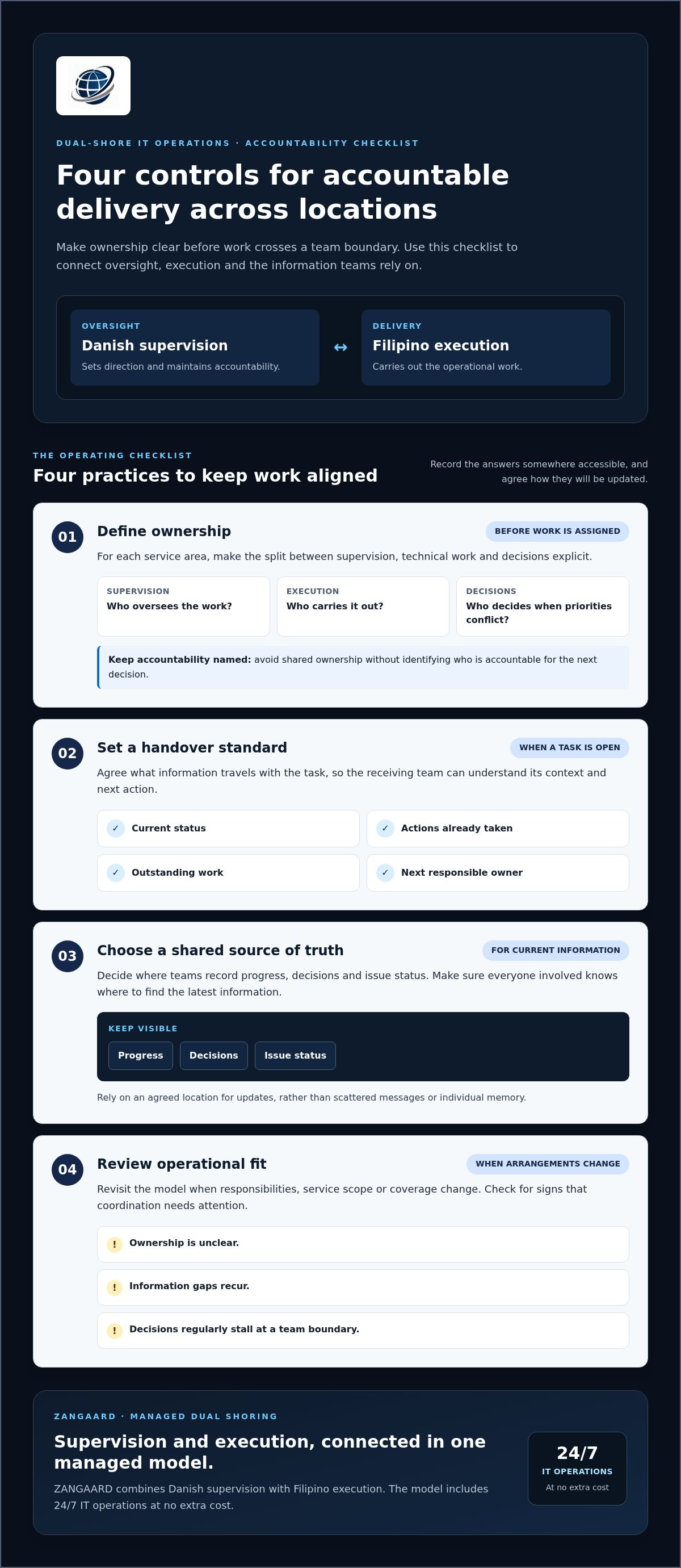
How ZANGAARD’s Managed Dual Shoring connects oversight to 24/7 IT operations
Scalable execution is most useful when it stays aligned with business priorities. ZANGAARD’s Managed Dual Shoring brings Danish supervision and Filipino execution together in a managed IT operations model. It provides businesses with a structured way to scale operational delivery while maintaining oversight, transparency and accountability. The model includes 24/7 IT operations at no extra cost.
What does ZANGAARD’s managed model bring together?
The model combines Danish supervision with Filipino execution, supported by transparency and accountability. This gives businesses a clear framework for connecting operational delivery to management oversight as their needs evolve. For a practical assessment, consider which responsibilities need ongoing supervision, what work requires execution capacity and how the status of that work should remain visible.
For organisations considering how to extend their IT operations, the key question is whether a managed structure can meet their requirements without obscuring responsibility. ZANGAARD’s approach connects supervision and delivery, alongside its wider service portfolio. Readers exploring round-the-clock service desk considerations can also refer to The Strategic Guide to the 24/7 IT Service Desk: Ensuring Global Business Continuity.
Explore ZANGAARD’s Managed Dual Shoring service to see how the model connects oversight with managed IT delivery. To discuss how it could align with your organisation’s priorities, contact ZANGAARD at [email protected].
Shape your operating model for what comes next
Growth is a useful time to check whether your operating model still reflects the business’s priorities. Treat dual-shore IT operations as a design decision, not simply a staffing arrangement. Consider how governance, service scope and future demand should align as technology and organisational needs change.
Before adjusting the model, identify which decisions should stay close to leadership and which capabilities need room to scale. Then assess whether responsibilities, handovers and status reporting support that split. This gives you a more deliberate basis for change than waiting until operational pressure exposes gaps.
ZANGAARD’s Managed Dual Shoring connects Danish supervision with Filipino execution, helping businesses align operational delivery with oversight.
Take the next step by discussing how the model could fit your operational priorities.
Frequently Asked Questions
How does dual-shore IT operations differ from nearshoring?
Dual-shore IT operations describe how oversight and execution are coordinated across locations; nearshoring describes sourcing work from a geographically closer location. The terms cover different aspects of delivery, so a model can be dual-shore without relying on nearshore delivery. For example, a business might retain governance with its Danish leadership whilst technical work is carried out offshore.
Can dual-shore IT operations work alongside an in-house IT team?
Yes. The model can complement an in-house team when each group has a defined remit. Internal specialists might retain responsibility for business priorities and technology decisions, whilst a managed service partner handles an agreed operational scope. ZANGAARD’s IT service portfolio gives businesses services to consider when defining that scope.
Is dual-shore IT operations only suitable for large enterprises?
No. Suitability depends more on operational requirements than company size. A business with a small IT function may value additional execution capacity, whilst a larger organisation may need a defined way to coordinate distributed work. The key is to choose a scope that matches actual demand and can be governed clearly, rather than adopting a model simply because it appears scalable.
What should a business clarify before adopting dual-shore IT operations?
Clarify which services and systems are in scope, who can approve changes and how performance will be assessed. Decide what information teams need to share, how access is governed and which decisions remain with the business. For example, agree how a proposed change affecting a critical business application will be reviewed before work proceeds, so decision-making authority is clear from the outset.

Disclaimer
The purpose of this article is to generate inspiration, reflection and to start a debate across markets, industries and organizations. We do not recommend any actions soly based on the article statements, claims or opinions, but recommend you to reach out directly to ZANGAARD for a qualified review, dialogue and/or consultation. Reach out at [email protected] or visit our website www.zangaard.com


