

What if the real weakness in your IT service management isn’t the plan, but what happens after it’s approved? Unclear ownership and inconsistent processes can leave even sensible improvements disconnected from daily operations. Effective ITSM consulting services connect service design to accountable, continuous delivery, so change takes hold in the work teams do every day.
ITSM improvement needs more than recommendations. It needs clear priorities, defined responsibilities and a practical route into operations. This guide explains how to identify outcomes that matter, scope consulting around operational needs and sustain progress through continual improvement. At ZANGAARD, embedded IT Service Management Consultation works alongside Managed IT Operations. Its Managed Dual Shoring model combines Danish supervision with technical execution in the Philippines, including 24/7 operations at no extra cost. Explore how these services fit together in the ZANGAARD Services portfolio.
Key Takeaways
- Use ITSM consulting services to connect service-management challenges with clear operational outcomes and ownership.
- Scope improvement work by defining the service problem, desired results, responsibilities and review points before selecting tools.
- Connect embedded ITSM consultation with Managed IT Operations and continual improvement to carry plans into ongoing delivery.
- Explore the ZANGAARD Services portfolio to see how Danish supervision and Filipino execution support transparent, accountable operations, with 24/7 operation at no extra cost.
What ITSM Consulting Services Should Improve in Your Organisation
ITSM consulting provides expert support to improve how an organisation designs, governs and delivers IT services. Grounded in the principles of IT service management (ITSM), it connects service practices with operational needs, rather than treating processes as paperwork or tools as the solution in themselves. The purpose is practical: clarify what needs to work better, who is accountable and how improvement will become part of daily delivery.
Start with observable symptoms. If teams disagree about who owns a service, decisions or escalations may stall between groups. If a request follows different steps depending on who receives it, the process may be inconsistent. If a change is introduced but routine work soon returns to old habits, the improvement may lack ownership or follow-through. Turn each symptom into a specific focus: clarify service accountability, remove avoidable process friction, or establish practices that can be maintained as demand grows.
Which ITSM challenges are suitable for consulting?
Describe challenges in terms that can be observed: “staff cannot identify the owner for this service”, “requests are handled differently across teams”, or “agreed process changes aren’t reflected in day-to-day work”. Each statement identifies a condition to investigate and an outcome to pursue. This helps distinguish a recurring operational issue from a proposed solution, such as buying a new platform.
Consulting can set direction, map responsibilities and design practical governance. Implementation puts agreed changes into practice, while ongoing operations apply and maintain them through everyday service delivery. These responsibilities are distinct, but should not become disconnected hand-offs. ZANGAARD’s embedded IT Service Management Consultation sits alongside Managed IT Operations and continual improvement, connecting service-management priorities with operational delivery. Advice informs the work, agreed ownership guides execution, and operational experience helps identify what to improve next.
How to Scope ITSM Consulting Services Around Practical Outcomes
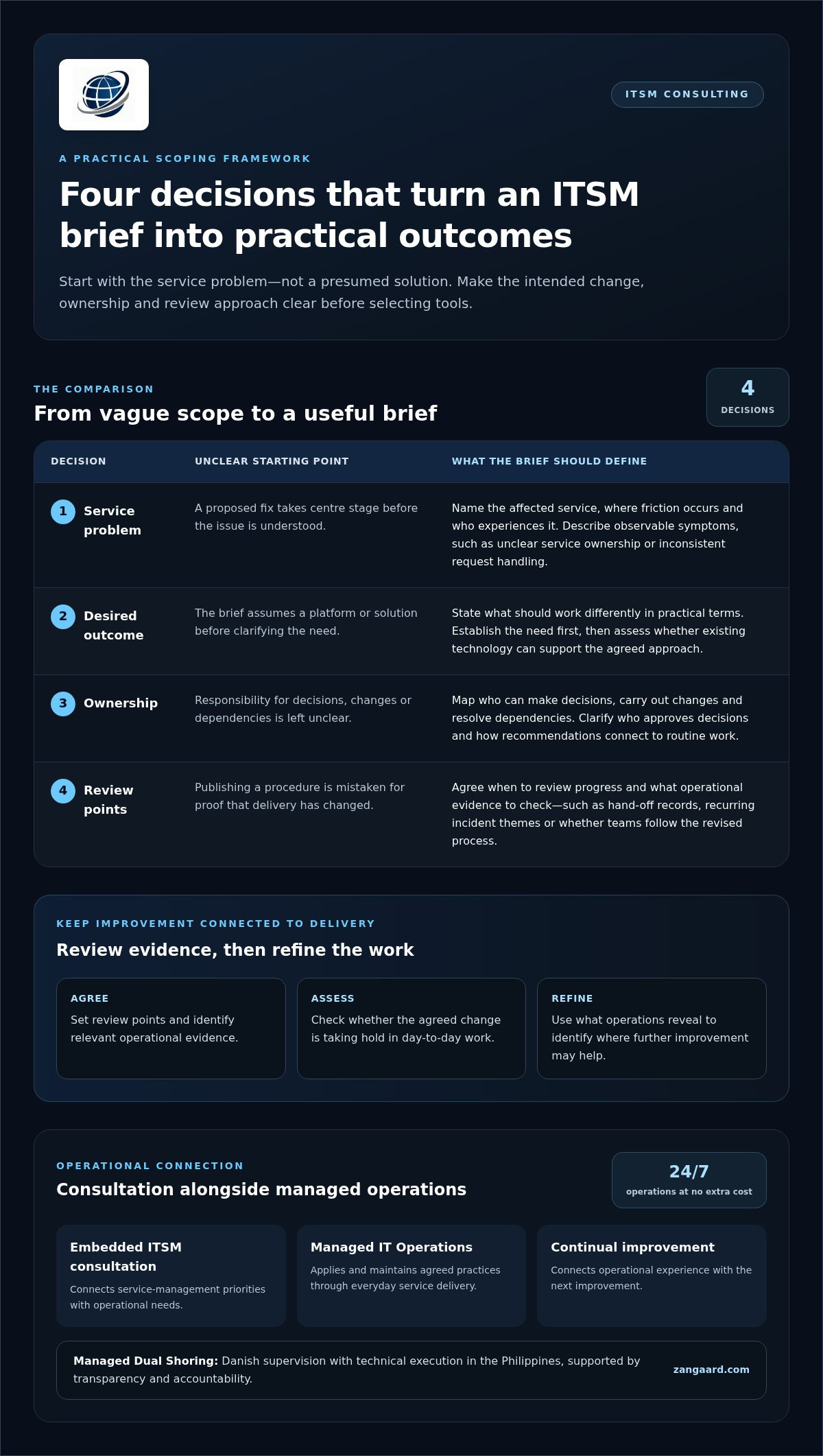
A useful brief focuses on the service problem, not a presumed solution. Scope ITSM consulting services around four decisions: what is happening, what should improve, who owns the change, and how progress will be reviewed.
- Identify the service problem. Describe the affected service, where friction occurs and who experiences it.
- Define the desired outcome. State what should work differently in practical terms, without setting unsupported targets.
- Map ownership. Identify who can make decisions, carry out changes and resolve dependencies.
- Agree review points. Decide when to assess progress and what operational evidence will show whether the change is taking hold.
A practical scoping framework is simple: identify the service problem, define the outcome, map ownership and agree how progress will be reviewed.
What should an ITSM consulting brief include?
Set out the affected services, stakeholders, current friction and business impact in plain language. Clarify what falls within scope, who approves decisions, and how recommendations will connect to routine work. Keep process and governance questions separate from tool selection: first establish the need, then assess whether existing technology can support the agreed approach. The GOV.UK Service Standard offers a public reference for considering services in terms of users and their needs, rather than starting with a platform.
Choose evidence that reflects the problem, such as hand-off records, recurring incident themes or whether teams follow the revised process. Review it at agreed points and use the findings to refine the work. Publishing a procedure is an activity, not proof that daily delivery has changed. ZANGAARD’s embedded consultation and continual improvement connect this review with managed operations. The ZANGAARD Services portfolio shows how consultation and operational services fit together.
How ZANGAARD Connects ITSM Consultation to Managed Operations
Consulting has greater operational value when service priorities carry through into delivery and continued improvement. ZANGAARD provides embedded IT Service Management Consultation alongside Managed IT Operations and continual improvement, linking advisory work with the environment where service practices are applied. This keeps governance and operational responsibility connected as needs evolve.
When should consulting connect with ongoing IT operations?
Make that connection when recommendations need consistent ownership, when new practices must become part of routine delivery, or when operational experience should inform the next improvement. A plan clarifies what needs to change. Ongoing operations provide the setting to apply the agreed approach, observe how it works and identify where further refinement may help.
ZANGAARD’s Managed Dual Shoring model combines Danish supervision in Denmark and the Philippines with technical execution in the Philippines. Full transparency and accountability make responsibilities and delivery visible, while 24/7 operations are provided at no extra cost. This brings oversight and execution together while keeping responsibility clear.
For organisations considering how advice can connect to delivery, the ZANGAARD Services portfolio brings related service areas into view. A conversation can focus on your service priorities, operational ownership and the support needed to sustain improvement. Visit the ZANGAARD contact page to start that discussion.
Turn service priorities into your next step
Better IT operations begin with a deliberate choice: decide which service experience your organisation wants to make more dependable, and keep that ambition visible as priorities evolve. The value of ITSM consulting services lies not only in resolving today’s friction, but in helping leaders make considered decisions about what their services should enable next.
Bring one important service challenge to your planning discussion. A focused conversation can turn it into a clear direction for your organisation’s IT priorities.
With embedded ITSM consultation, Managed IT Operations and continual improvement, ZANGAARD connects service priorities to ongoing delivery. Explore the ZANGAARD Services portfolio to see how Managed Dual Shoring combines Danish supervision and Filipino execution.
Frequently Asked Questions
What do ITSM consulting services include?
Depending on the agreed scope, ITSM consulting services may examine how staff find support, how requests move between teams, or where service information is hard to locate. A useful engagement gives decision-makers prioritised observations and options for action. For example, a review might identify that employees use different routes to request the same type of help.
When should a business use ITSM consulting services?
Consider consulting when organisational change exposes gaps in how IT services are arranged, such as introducing a new business application or combining teams with different support practices. Start by recording where staff encounter difficulty and how it affects their work. This keeps the discussion grounded in business needs.
Do ITSM consultants implement the recommendations they make?
Not necessarily. The agreed engagement should distinguish analysis and advice from responsibility for carrying out changes, communicating them to affected teams and maintaining them afterwards. Clarifying those boundaries early helps prevent recommendations from becoming unowned tasks. ZANGAARD’s Services portfolio shows how its service offerings relate to ITSM needs.
Can ITSM consulting support 24/7 IT operations?
Yes. Consulting can help an organisation plan how round-the-clock operations should be governed, including how responsibilities, escalation paths and handovers are defined. For example, teams can map which decisions need clear ownership across shifts and what information must be passed on. ZANGAARD’s Managed Dual Shoring provides 24/7 IT operations at no extra cost, combining Danish supervision with Filipino execution.
Disclaimer
The purpose of this article is to generate inspiration, reflection and to start a debate across markets, industries and organizations. We do not recommend any actions soly based on the article statements, claims or opinions, but recommend you to reach out directly to ZANGAARD for a qualified review, dialogue and/or consultation. Reach out at [email protected] or visit our website www.zangaard.com


