

What if the lowest IT rate leads to the highest operating cost? An IT outsourcing cost analysis based on headline fees alone can miss the work required to manage delivery, maintain continuity and keep accountability clear. Scope, coverage and oversight can vary significantly between operating models, so a low quote may not tell the whole story.
This guide shows how to build a transparent, like-for-like comparison by accounting for service scope, transition, internal management and other assumptions that shape total cost. You’ll also learn how to weigh cost efficiency against continuity and operational control. ZANGAARD’s Services include Managed Dual Shoring, which combines Danish supervision with Filipino execution. Its 24/7 operation is provided at no extra cost. The aim is to give you a clearer basis for choosing an operating model that balances efficiency with accountable oversight.
Key Takeaways
- Use an IT outsourcing cost analysis to compare defined sourcing options, including their costs and operating implications.
- Separate supplier charges from internal effort, transition work and ongoing oversight for a more complete comparison.
- Match scope, service coverage, assumptions and responsibilities before comparing delivery models.
- Assess how Danish supervision and Filipino execution can bring delivery and accountability into one managed operating model.
What belongs in a complete IT outsourcing cost analysis?
A complete IT outsourcing cost analysis compares the costs and operating implications of clearly defined sourcing options. Outsourcing changes more than who performs the work: it can also change how delivery is managed, how knowledge is transferred and where oversight sits. For a useful starting point, What is Outsourcing? explains the broader business practice.
A fair comparison uses the same scope and time horizon for every option; otherwise, the figures describe different operating models. Compare the same services, expected coverage and planning period. Make assumptions visible, and avoid filling gaps with market averages or estimates that your organisation cannot substantiate.
Which cost categories should leaders map before comparing options?
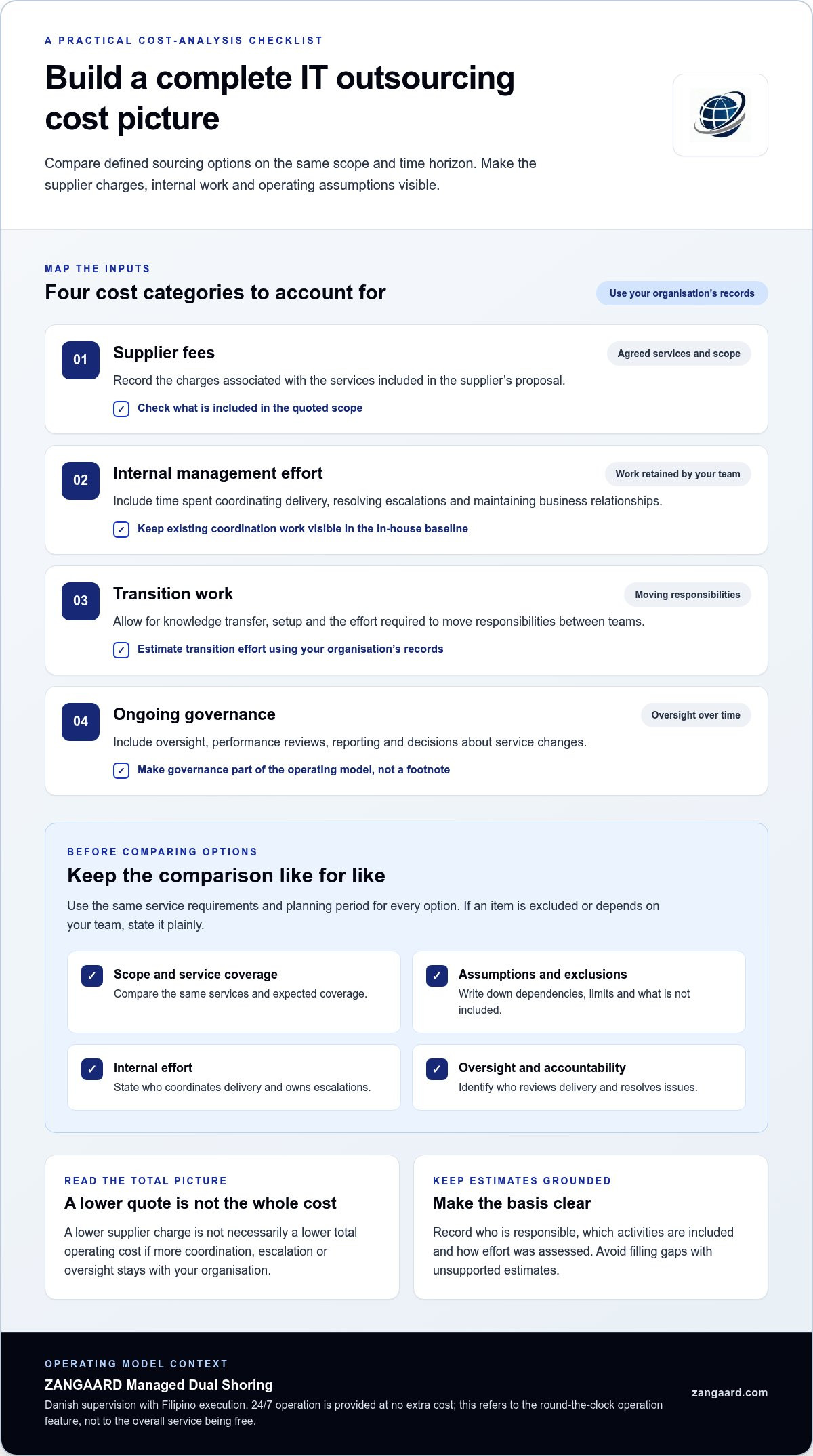
Group the inputs into four categories. Use your organisation’s records to estimate internal effort and transition work, and write down the assumptions behind each estimate.
- Supplier fees: Charges associated with the agreed services and scope.
- Internal management effort: Time spent coordinating delivery, resolving escalations and maintaining business relationships.
- Transition work: Knowledge transfer, setup and the effort needed to move responsibilities between teams.
- Ongoing governance: Oversight, performance reviews, reporting and decisions about service changes.
For each category, record who is responsible, which activities are included and how you assessed the effort. For example, if your current team spends time coordinating incidents, keep that work visible in the in-house baseline. Do not assume it disappears simply because delivery moves outside the organisation.
Governance belongs in the operating model, not in a footnote. ZANGAARD’s Managed IT Operations brings service delivery and management into the same discussion as supplier charges, helping leaders consider operational responsibilities alongside cost. The related guide, “Managed IT Operations: A Strategic Guide to Scalable Governance”, explores that governance perspective further.
How to compare IT outsourcing costs without mistaking a low rate for value
A useful IT outsourcing cost analysis puts each option through the same operational test. A lower quoted charge is not necessarily a lower total operating cost if it leaves more coordination, escalation or oversight with your organisation. A lower supplier charge and a lower total operating cost are not the same thing.
Use a comparison table to expose differences before deciding. Set the same service requirements and review period for each option, then fill in the details using your proposals and internal records. If an item is excluded or depends on your team, state that plainly rather than treating it as included.
| Comparison area | Option A | Option B |
|---|---|---|
| Scope and service coverage | Services and coverage included | Same requirements, clearly stated |
| Assumptions | Dependencies, exclusions and limits | Dependencies, exclusions and limits |
| Internal effort | Coordination and escalation ownership | Coordination and escalation ownership |
| Oversight | Who reviews delivery and resolves issues? | Who reviews delivery and resolves issues? |
How can a like-for-like comparison expose the real trade-offs?
Keep the period and service requirements consistent, then make every assumption explicit. If one option depends on your team handling more escalations, record that responsibility rather than treating it as cost-free. Revisit the comparison when the scope changes or actual internal effort differs from your estimate. This helps distinguish a more efficient model from one that simply moves work outside the supplier’s quote.
Once you have completed the comparison, weigh the findings against continuity and clear accountability, not just the supplier rate. To explore the assumptions behind your comparison, you can discuss an IT outsourcing cost analysis with ZANGAARD.
How ZANGAARD’s managed dual-shoring model connects cost efficiency with accountability
A cost comparison becomes more meaningful when supervision and execution are visible parts of the operating model. ZANGAARD’s Managed Dual Shoring pairs Danish supervision with Filipino execution, bringing delivery and oversight into one structure. In your IT outsourcing cost analysis, consider not only which tasks are performed, but also how responsibilities are managed and kept transparent.
This model gives decision-makers a way to map execution, supervision and governance alongside the service scope. Explore how Managed Dual Shoring applies this approach, or review ZANGAARD’s IT services and service portfolio to see how its offerings relate to your operational requirements.
What should decision-makers take into an outsourcing discussion?
Bring a concise view of what your organisation needs and how you expect delivery to work. This makes it easier to discuss the operating model, surface assumptions and identify where accountability sits.
- Scope: The services and responsibilities you want covered.
- Operating needs: Required service coverage and continuity expectations.
- Cost assumptions: Supplier charges and internal effort considered in your comparison.
- Governance: Oversight expectations, reporting needs and responsibility for decisions.
ZANGAARD’s 24/7 operations are provided at no extra cost. This refers to the round-the-clock operation feature, not to the overall service being free. For further context on the model and its delivery setting, see “What is Dual Shoring? A Strategic Guide to the Hybrid Operational Model” and “IT Outsourcing Philippines for European Companies: The Strategic Guide”.
Bring your assumptions and requirements into a focused discussion. Contact ZANGAARD to discuss your IT operating model.
Turn your comparison into a confident next step
The value of an IT outsourcing cost analysis lies in the decisions it helps clarify: what your organisation needs, where responsibilities should sit and how you’ll keep delivery accountable over time. Use those priorities to shape an operating model that fits your organisation, rather than letting a single figure define the choice.
As you refine your decision, consider how ZANGAARD’s IT services and service portfolio align with your operational requirements. A focused discussion can turn your assumptions into a practical path forward, with responsibilities and expectations in view from the outset.
Bring your priorities into focus and take the next step with confidence.
Frequently Asked Questions
How often should a business revisit its IT outsourcing cost analysis?
Revisit your IT outsourcing cost analysis when the scope, service requirements, operating assumptions or sourcing arrangement changes. Adding a service or shifting escalation responsibilities, for example, may alter the comparison. Use current organisational data and keep requirements consistent across options, so the review reflects the change rather than an outdated baseline. There’s no universal review interval that suits every business.
Can an IT outsourcing cost analysis account for service continuity and accountability?
Yes. Record continuity requirements, responsibility for key tasks and how oversight is arranged alongside the financial assumptions. For example, if your team needs a clear escalation owner during a service disruption, document that requirement and compare how each option addresses it. Treat these operational factors as decision criteria, not cash costs, unless your organisation has its own evidence to value them.
Does ZANGAARD charge extra for 24/7 operations?
No. ZANGAARD states that its 24/7 operation is provided at no extra cost. This refers to the round-the-clock operation feature; it does not mean the overall service is free. In your comparison, record the feature accurately while treating the service itself as a separate commercial arrangement.
What is the difference between an IT outsourcing cost analysis and a cost-benefit analysis?
An IT outsourcing cost analysis organises and compares the costs and assumptions of defined sourcing options. A cost-benefit analysis also assesses expected benefits against those costs, such as whether a proposed arrangement addresses a documented operational need. Both depend on a clearly defined scope and your organisation’s own evidence. Neither should rely on generic benchmarks or imply a guaranteed financial outcome.

Disclaimer
The purpose of this article is to generate inspiration, reflection and to start a debate across markets, industries and organizations. We do not recommend any actions soly based on the article statements, claims or opinions, but recommend you to reach out directly to ZANGAARD for a qualified review, dialogue and/or consultation. Reach out at [email protected] or visit our website www.zangaard.com


