

What if scaling IT delivery did not mean choosing between local oversight and offshore capacity? For organisations considering outsourcing, accountability, communication and day-to-day service quality matter just as much as access to technical teams. A practical answer to how to choose an IT outsourcing partner in Denmark starts with one question: how clearly does the provider connect responsibility to delivery?
This guide gives you a practical framework for comparing ownership, operational fit and service models. Use it to assess whether a partner can scale with your organisation while keeping responsibilities visible. You’ll see how Danish management and local oversight can work alongside technical teams in the Philippines, and what to examine across infrastructure management, service desk support and continual improvement. These are central to ZANGAARD’s Managed Dual Shoring approach and wider IT services portfolio.
Key Takeaways
- When considering how to choose an IT outsourcing partner in Denmark, compare ownership and oversight as carefully as delivery capacity.
- Define the service scope, map decision-making responsibilities and agree how communication will work before comparing proposals.
- Assess scalability by asking how the model can adapt to changing operational needs, then look for a clear approach to continual improvement.
- Compare in-house, offshore and dual-shore delivery by their oversight and operating structures; see how these elements connect across ZANGAARD’s services.
How to choose an IT outsourcing partner in Denmark without losing operational control
Scalable capacity creates value only when ownership and oversight stay clear. If responsibility for day-to-day IT operations is blurred, additional delivery capacity can make it harder to maintain continuity, resolve service issues and support employees. The arrangement should also give your organisation more room to focus on its core operations, rather than adding another layer to manage.
There is no single delivery model that suits every organisation. The useful question is how the model assigns work, decisions and oversight. A general overview of IT outsourcing concepts and models can help frame the options. Then test how each option would work in practice: who coordinates the work, who makes decisions and how your organisation stays informed. For a Danish organisation, Managed Dual Shoring combines Danish management and local oversight with technical teams in the Philippines.
Use this checklist to keep your comparison grounded in operational fit:
- Accountability: Identify who owns each agreed operational responsibility and how unresolved issues are escalated. Make sure there is a clear owner for work that crosses team boundaries.
- Communication: Clarify who your teams speak to, how updates are shared and how decisions reach delivery teams.
- Scope: Separate the operations covered by the partner from responsibilities retained in-house. For example, distinguish infrastructure management from decisions about business priorities.
- Scalability: Consider how the service model can adapt as needs change, without making ownership less clear.
- Improvement: Establish how recurring issues and service observations are reviewed, assigned and translated into improvement work.
What should an IT outsourcing partner be accountable for?
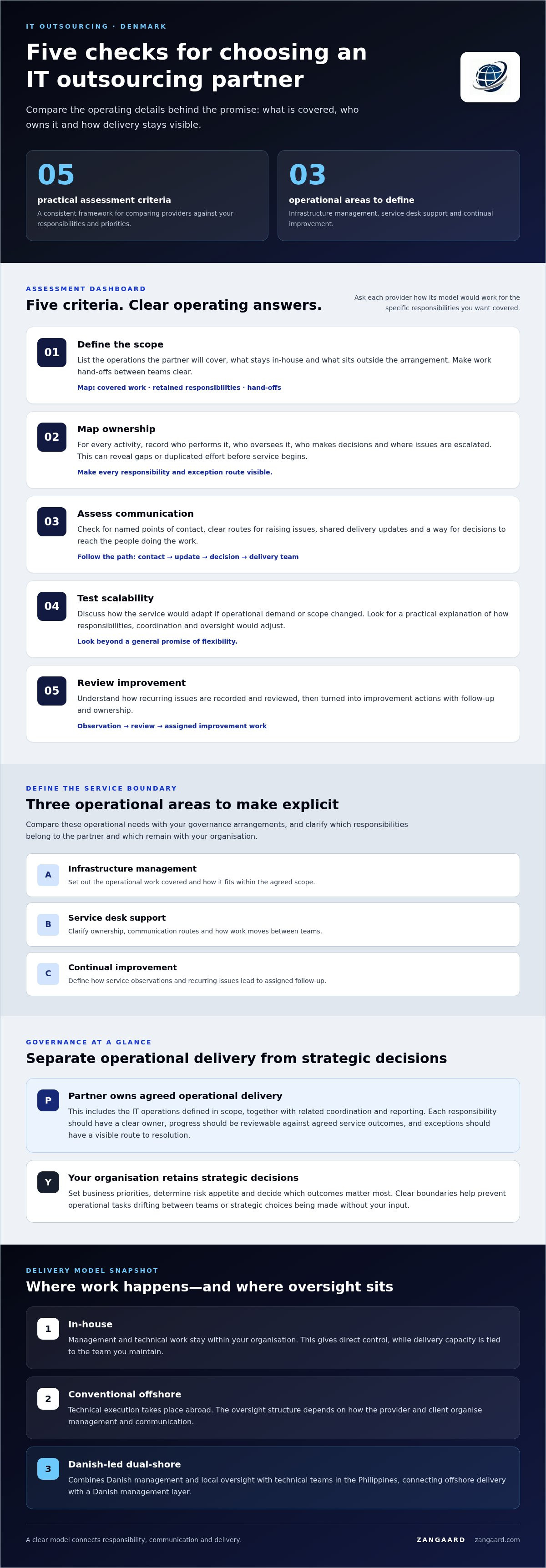
The partner should own delivery of the IT operations defined in the agreed scope, including related coordination and reporting. Your organisation retains strategic decisions, such as setting business priorities, determining risk appetite and deciding which outcomes matter most. Clear boundaries prevent operational tasks from drifting between teams or strategic choices from being made without your input.
Operational accountability means every responsibility has a clear owner, progress can be reviewed against agreed service outcomes, and exceptions have a visible route to resolution. ZANGAARD’s Danish management and local oversight provide an accountable operating layer alongside technical execution, connecting day-to-day delivery with your organisation’s direction.
How to assess an IT outsourcing partner in Denmark: five practical criteria
A consistent assessment turns broad promises into operating details you can compare. To decide how to choose an IT outsourcing partner in Denmark, work through these five criteria against your priorities. Ask each provider to explain how its model would work for the specific responsibilities you want covered.
- Define scope. List the operations you want covered, such as infrastructure management, service desk support and continual improvement. Note what remains in-house, what falls outside the arrangement and how work passes between teams.
- Map ownership. For each activity, record who performs it, who oversees it, who makes decisions and where issues are escalated. A responsibility map can expose gaps or duplicated effort before service begins.
- Assess communication. Look for a clear operating rhythm: named points of contact, routes for raising issues, how delivery updates are shared and how decisions reach the people doing the work.
- Test scalability. Discuss how the service would adapt if operational demand or scope changed. Look for a practical explanation of how responsibilities, coordination and oversight would adjust, rather than a general promise of flexibility.
- Review improvement. Understand how recurring issues are recorded, reviewed and turned into improvement actions. Look for a defined process that connects service observations to follow-up and ownership.
How can a Danish business assess service scope and governance?
Compare your operational needs against infrastructure management, service desk support and continual improvement, then establish how each area fits within governance. Embedded IT service management consultation can connect that governance with daily execution. ZANGAARD’s Managed IT Operations guide explores how operational delivery and governance can work together. Clear service boundaries make oversight more effective by showing what is covered, who owns it and where decisions sit.
A concise requirements brief can help you discuss your IT operations requirements with ZANGAARD.
When does a Danish-led dual-shore IT outsourcing model make sense?
The right delivery model depends on how much operational capacity you need and where you want oversight to sit. With an in-house team, management and technical work stay within your organisation, giving you direct control but tying delivery capacity to the team you maintain. A conventional offshore model places technical execution abroad; its oversight structure depends on how the provider and client organise management and communication. Dual-shore combines offshore delivery with a Danish management layer.
Compare the models across three practical dimensions:
- Oversight: In-house teams sit within your management structure. Offshore models need defined coordination. Dual-shore places Danish management and local oversight alongside offshore execution.
- Delivery structure: In-house work is performed internally, while offshore delivery is performed by teams abroad. Dual-shore connects Danish oversight with technical teams in the Philippines.
- Scalability: Consider how each arrangement can adjust capacity and responsibilities as operational needs change, and how those changes remain visible to your organisation.
This comparison helps clarify how to choose an IT outsourcing partner in Denmark: focus not only on where work is delivered, but on how oversight connects to daily operations. ZANGAARD’s Managed Dual Shoring model brings Danish management and local oversight together with technical teams in the Philippines, a delivery structure explored in its guide to IT outsourcing in the Philippines.
How does Danish oversight work alongside offshore IT delivery?
In a dual-shore arrangement, local management and offshore technical execution form parts of one operating model, linked through its governance and communication structure. ZANGAARD applies this approach to Managed IT Operations, including infrastructure management and a scalable service desk. This model is relevant for organisations seeking offshore technical capacity while retaining Danish oversight of operations.
For a practical discussion of how this structure could fit your operating needs, share your outsourcing requirements with ZANGAARD.
Turn your outsourcing priorities into a clear next step
Turn your evaluation into a practical operating model: define what should change, what your organisation must retain and how oversight will connect to delivery. This gives you a grounded basis for deciding how to choose an IT outsourcing partner in Denmark, without treating capacity or geography as the only measures of fit.
ZANGAARD’s approach combines Danish management and local oversight with technical teams in the Philippines. Its service portfolio includes Managed IT Operations, IT Infrastructure Management and Scalable Service Desk, connecting the delivery model to core operational needs. Start with your priorities, then make ownership clear as those needs evolve.
A considered decision now can give your organisation a clearer path to scalable IT operations.
Frequently Asked Questions
Is IT outsourcing suitable for a small or mid-sized business in Denmark?
Yes. IT outsourcing can suit a smaller organisation when it addresses a specific capacity or expertise gap. For smaller firms, how to choose an IT outsourcing partner in Denmark often starts with identifying which tasks take too much time from internal staff. For example, a business with an IT lead but limited service desk capacity could assess whether external operational support fits its needs. ZANGAARD’s IT services include operational support options such as Managed IT Operations and Scalable Service Desk.
Can a business outsource IT operations and still retain control?
Yes. Your organisation can retain authority over business priorities, budgets and decisions that affect how employees work, while an external team carries out agreed operational tasks. For example, you might set the approval process for changes to a critical system and review how support requests are handled. Decide which choices stay in-house before operational work is handed over.
How much does IT outsourcing cost in Denmark?
There is no single price for every IT outsourcing arrangement: cost depends on the scope and delivery model. To compare proposals fairly, give each provider the same description of services and responsibilities. Then check what the quoted price includes, how charges are calculated and which assumptions or exclusions apply. Consider both transition work and the ongoing service, rather than comparing headline figures alone.
What is the difference between offshoring and dual shoring for IT services?
Offshoring means delivering work from another country; dual shoring combines offshore execution with a domestic management or oversight layer. The practical distinction is where decisions are made and how delivery connects with your organisation. For example, a team may perform technical tasks offshore while local management coordinates priorities and operational communication. Compare the arrangements by their management structure, not geography alone.

Disclaimer
The purpose of this article is to generate inspiration, reflection and to start a debate across markets, industries and organizations. We do not recommend any actions soly based on the article statements, claims or opinions, but recommend you to reach out directly to ZANGAARD for a qualified review, dialogue and/or consultation. Reach out at [email protected] or visit our website www.zangaard.com


