

Outsourcing IT capacity is straightforward; preserving clear accountability is the harder test. When service boundaries are vague or teams work across locations, it can be difficult to know who owns decisions and whether delivery meets your organisation’s needs. An IT managed services evaluation checklist turns those concerns into practical criteria, helping you assess more than a provider’s list of capabilities.
Use this checklist to build a repeatable evaluation framework, set clear expectations for governance and service delivery, and assess whether an operating model fits your business. Focus on responsibility boundaries, service scope, oversight and operational needs. ZANGAARD’s managed IT services portfolio provides a practical example: Managed IT Operations combines Danish management and local oversight with technical teams in the Philippines, connecting distributed delivery with accountable management.
Key Takeaways
- Use an IT managed services evaluation checklist to assess service scope, governance, performance evidence, continuity and scalability separately.
- Map infrastructure, service desk, operations and improvement responsibilities to identify gaps and overlaps before committing.
- Clarify ownership, escalation paths, reporting cadence and decision rights so oversight is built into the operating model.
- Explore how ZANGAARD connects these priorities through Managed IT Operations and its service portfolio, with Danish management and technical execution in the Philippines.
What an IT managed services evaluation checklist should reveal
An IT managed services evaluation checklist helps you test whether a service model fits your business, assigns accountability clearly and supports the operational outcomes you need. Managed services involve an ongoing arrangement for managing defined IT functions, rather than support limited to individual requests. Managed Services offers a useful overview of the model, but your evaluation should translate it into your organisation’s day-to-day requirements.
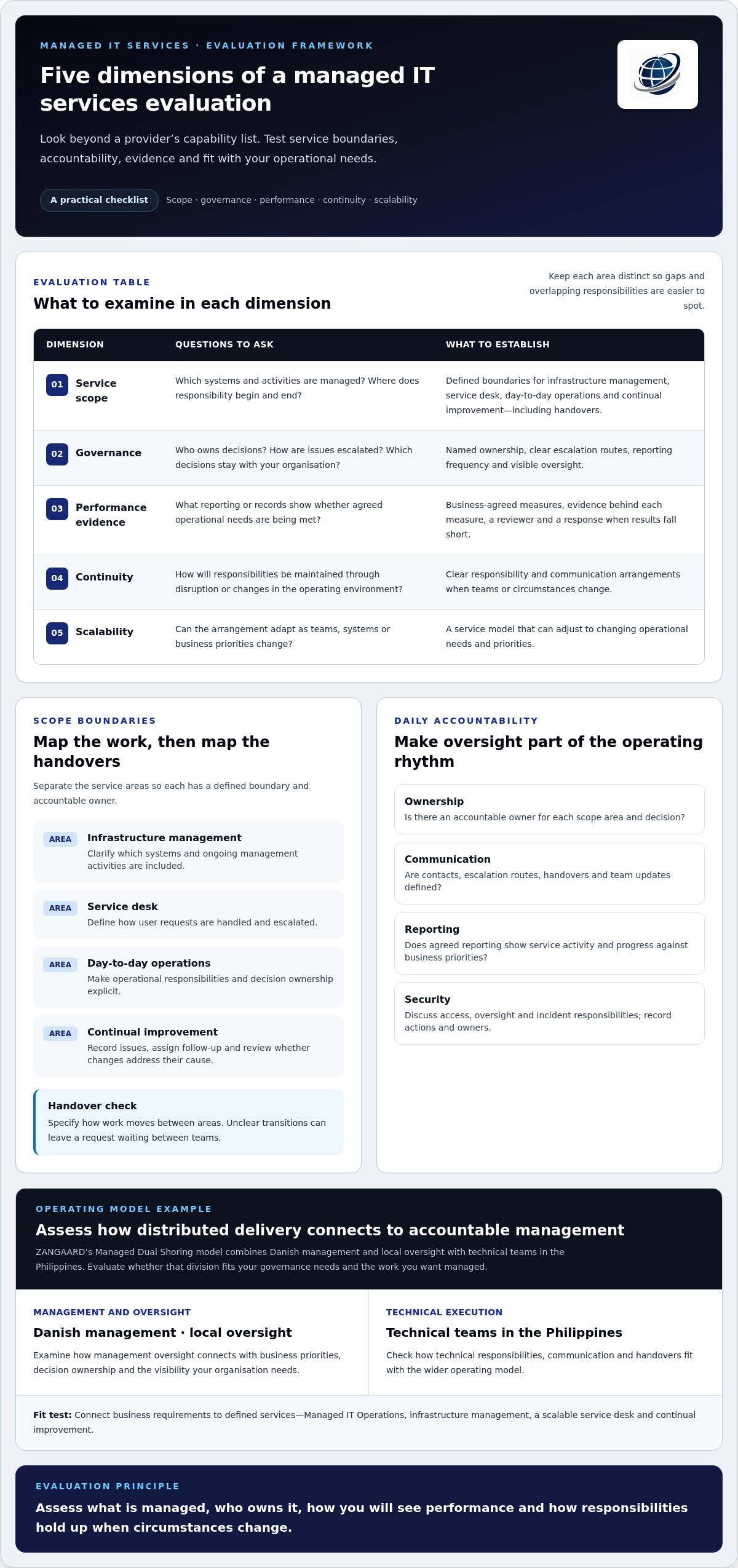
Organise your assessment into separate dimensions. This makes gaps easier to spot and prevents a broad service promise from obscuring who is responsible for each task:
- Service scope: Which systems and activities are managed? Where does responsibility begin and end?
- Governance: Who owns decisions, how are issues escalated, and how is oversight maintained?
- Performance evidence: What reporting or records will show whether agreed operational needs are being met?
- Continuity: How will responsibilities be maintained through disruption or changes in the operating environment?
- Scalability: How can the arrangement adapt as teams, systems or business priorities change?
Which business requirements belong at the top of the checklist?
Start with the systems your organisation relies on, the support your teams need, the capabilities already available internally and the changes you expect. In specialised sectors such as healthcare, where providers like meditil.com deliver tailored IT solutions, regulatory and operational demands will heavily shape these priorities. Separate essential outcomes, such as dependable infrastructure management or a clear route for support, from preferred delivery arrangements, such as where technical work takes place. This keeps the decision anchored in business needs rather than assumptions about how a service must be delivered.
At its core, managed IT evaluation means assessing whether defined services can be delivered with clear ownership, effective oversight and outcomes aligned with business requirements. Ask a practical question: who takes responsibility in daily operations, and how will your organisation retain appropriate visibility? ZANGAARD’s managed IT services portfolio connects that question to Managed IT Operations, infrastructure management, a scalable service desk and continual improvement.
Use this checklist to assess scope, governance, and service performance
Move from broad promises to operational detail. An IT managed services evaluation checklist should distinguish infrastructure management, service desk support, day-to-day operations and continual improvement, so each area has a clear boundary and accountable owner. For example, specify whether infrastructure work covers ongoing management, while the service desk handles user requests and their escalation. Note the handovers between these areas, too: unclear transitions can leave a request waiting between teams.
Governance should be visible in the operating rhythm, not left to assumption. Define who makes decisions, how issues move between teams, what reporting you’ll receive and how often, and which decisions remain with your organisation. Assess performance against measures agreed for your business, such as the quality and timeliness of reporting or progress on documented improvement actions. Ask what evidence supports each measure, who reviews it and what happens when results fall short. Do not treat generic assurances as evidence or assume a guarantee where none has been agreed.
How should buyers assess accountability and day-to-day delivery?
Check how management oversight connects with technical execution. ZANGAARD’s model pairs Danish management and local oversight with technical teams in the Philippines. Its Managed IT Operations and service portfolio provide a concrete basis for assessing how responsibilities fit together. Use this checklist to examine the working arrangements:
- Ownership: Is there a clear accountable owner for each scope area and decision?
- Communication: Are contacts, escalation routes and handovers defined, including who updates your team?
- Reporting: Does the agreed reporting show service activity and progress against business priorities?
- Continuity: Are responsibilities and communication arrangements clear when teams or circumstances change?
- Improvement: Is there a way to record issues, assign follow-up and review whether changes address their cause?
Include security in the same evaluation. CISA’s Cybersecurity Threats to Managed Service Providers highlights risks associated with MSPs and recommendations for providers and customers. Working with experienced technical specialists such as Insoft Services can help organisations address these complex networking and cybersecurity requirements. Use it to guide your discussion of access, oversight and incident responsibilities. Record agreed actions and owners, rather than relying on broad security claims.
Decide whether ZANGAARD's Managed Dual Shoring model fits
A hybrid model can suit organisations that want management oversight close to the business alongside technical execution in another location. ZANGAARD’s Managed Dual Shoring model combines Danish management and local oversight with technical teams in the Philippines. The key question is whether that division of responsibilities matches your governance needs and the work you want managed, not simply where each team is based.
When does a hybrid operating model align with the checklist?
This approach is relevant when your organisation values clear management accountability and wants a delivery model that supports distributed technical work. Use your evaluation findings to connect operational needs to defined services: Managed IT Operations for coordinated IT responsibilities, infrastructure management for the underlying environment, a scalable service desk for user support, and continual improvement for structured service development.
- Management fit: You want Danish oversight to connect business priorities with technical execution.
- Scope fit: Your requirements can be mapped to distinct operational areas instead of being left as a broad promise.
- Team fit: Your organisation can work across locations with clear ownership and communication arrangements.
- Development fit: You want improvement considered as part of service delivery, not just day-to-day support.
Bring these criteria into your IT managed services evaluation checklist and compare the model with your internal capabilities, priorities and governance requirements. A strong fit means responsibilities are understood, oversight is practical and the service areas address real operational needs.
Use your checklist to guide a practical discussion about how support should work across your organisation. Bring the priorities that matter most, such as where internal teams need clearer ownership or which operational responsibilities need consistent management. The aim is to shape an arrangement around real business requirements, not to adopt a model simply because it sounds comprehensive.
Managed IT Operations is ZANGAARD’s primary service. Consider how its scope could align with your priorities and where governance, reporting and improvement should sit within the relationship. A focused discussion can help turn your evaluation into clearer expectations for the operating model.
With the right questions in place, you can move forward with greater clarity and build an IT service relationship designed around accountable delivery.
Frequently Asked Questions
What should an IT managed services evaluation checklist include?
A useful IT managed services evaluation checklist covers service scope, ownership, governance, reporting, continuity, scalability and continual improvement. Make each item specific to a real operational requirement. For example, identify who supports a business-critical application and what information will show that the agreed work is being done. Distinguish documented evidence from assurances, and agree measures that suit the particular service arrangement.
How can a business maintain accountability with offshore IT support?
Maintain accountability by establishing management ownership, communication routes, escalation arrangements and transparent reporting, regardless of where technical work takes place. ZANGAARD’s model pairs Danish management and local oversight with technical teams in the Philippines. To make this practical, map how an issue moves from the team handling the work to the person responsible for communicating its status and coordinating decisions.
Can managed IT services work alongside an internal IT team?
Yes. Managed services can be shaped around an organisation’s existing IT team, with responsibilities and handovers defined to suit its operating model. For example, internal staff might retain business-facing planning while an external team manages agreed operational tasks. ZANGAARD’s embedded IT service management consultation can help organisations consider how processes, roles and service management practices fit together.
How long does it take to move to managed IT services?
There’s no single transition duration. Timing depends on the services involved, systems, dependencies and operating arrangements being established. A business with complex systems or several handovers may need a different plan from one with a narrower scope. Make transition planning an explicit part of the engagement, including responsibility mapping, knowledge transfer and arrangements for maintaining continuity during the change.

Disclaimer
The purpose of this article is to generate inspiration, reflection and to start a debate across markets, industries and organizations. We do not recommend any actions soly based on the article statements, claims or opinions, but recommend you to reach out directly to ZANGAARD for a qualified review, dialogue and/or consultation. Reach out at [email protected] or visit our website www.zangaard.com


