

Growth doesn’t make an IT operation accountable; clear ownership does. As teams expand, priorities can drift away from business outcomes, whilst service reliability becomes harder to oversee across internal teams and suppliers. The answer isn’t another layer of process. It’s an IT operations strategy that makes responsibility visible and performance measurable.
Leaders need dependable services without losing oversight. This guide sets out a practical framework for connecting business priorities to service measures, establishing governance and assigning ownership as complexity grows. It also shows how ZANGAARD’s Managed IT Operations model combines Danish management and local oversight with technical execution in the Philippines, supported by infrastructure management, a scalable service desk and continual improvement. You’ll see how these capabilities can support accountable delivery and a scalable operating model that improves over time.
Key Takeaways
- Shape an IT operations strategy around the services that matter most to business outcomes, not simply a list of technology projects.
- Use a clear sequence to assess demand, set priorities, assign ownership, define measures and review performance.
- Balance service reliability with user experience, resilience and cost control when deciding what good operational performance looks like.
- Connect strategic priorities to day-to-day delivery, then use performance reviews to identify where operations can improve as the organisation grows.
IT operations strategy: connect daily services to business priorities
An IT operations strategy sets the choices, governance and capabilities that guide reliable technology services towards business priorities. It clarifies which services matter, who is accountable for them and how leaders will assess performance. Without that direction, operational decisions can be made in isolation. Teams may resolve incidents, for example, without addressing the recurring issue disrupting an important business process.
A technology roadmap describes planned changes to systems and platforms. An operations strategy governs how services perform day to day, how responsibilities are shared and how operational risks are managed. The two should align, but they answer different questions: the roadmap asks what technology will change; the strategy asks how services will reliably support the organisation and how that support will be evaluated.
Frameworks can help leaders organise these decisions. The ITIL framework for IT operations strategy offers service-management practices oriented towards business needs. Use it as a reference point, not a substitute for choosing outcomes that reflect your organisation’s priorities.
What belongs in an IT operations strategy?
Start with a small set of operational outcomes, then connect each one to the services and responsibilities that can deliver it. For example, if dependable access to a core business application is a priority, identify the support and infrastructure needed to maintain the service, who owns each part, and how performance will be reviewed. ZANGAARD’s Managed IT Operations service portfolio brings together capabilities that support this connection.
- Business priorities and service scope: identify what the operation must support and which services are in scope.
- Accountability and operating model: assign clear ownership across teams and suppliers, including responsibility for decisions and hand-offs.
- Risk and performance: determine which risks matter and how service reliability, user experience and cost control will be reviewed.
These choices give daily decisions a consistent basis. When priorities compete, leaders can compare their impact on agreed outcomes instead of relying on whichever request feels most urgent. They can also see when a service has no clear owner or when its measures do not show whether the business need is being met.
Build an IT operations strategy around governance, capability and measurable outcomes
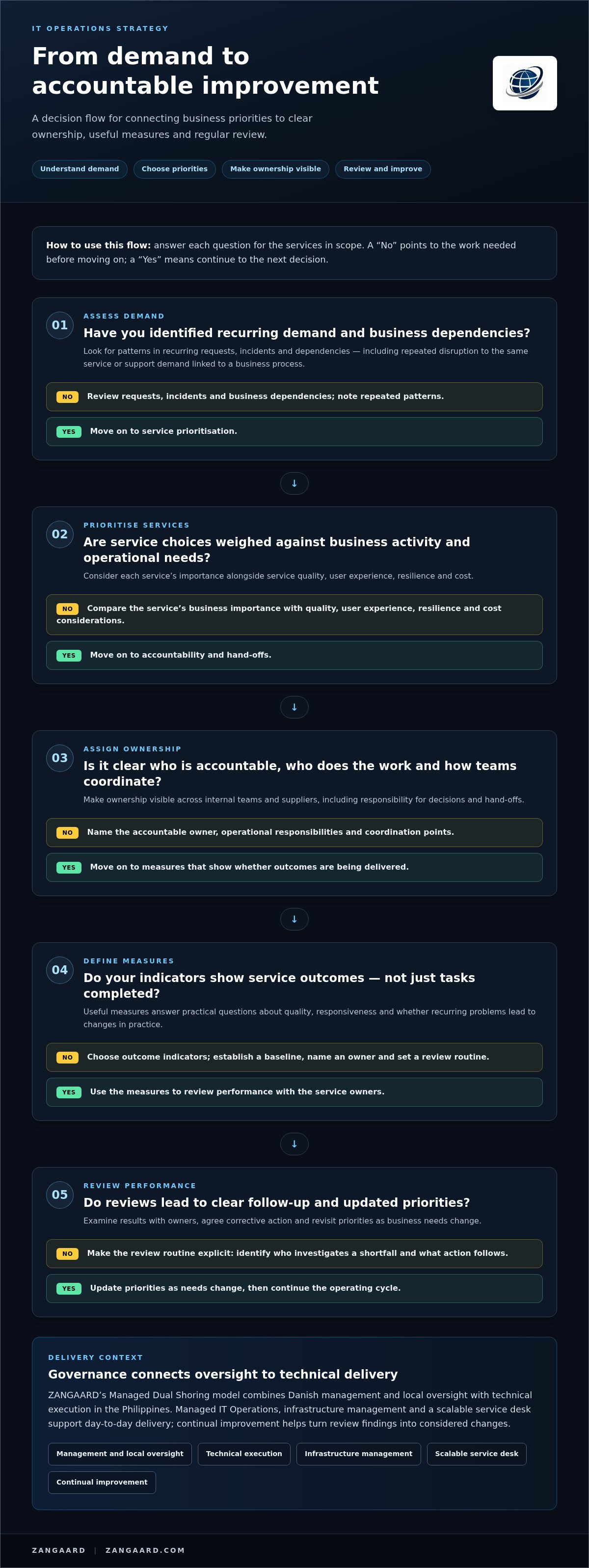
A sound IT operations strategy turns priorities into an operating cycle: understand demand, make deliberate choices, assign responsibility and review results. This keeps decisions about service levels, user experience, resilience and cost control connected to business needs, rather than treating them as separate targets.
- Assess demand: review recurring requests, incidents and business dependencies. Look for patterns, such as repeated disruption to the same service or support demand linked to a particular business process.
- Prioritise services: weigh each service’s importance to business activity against service quality, user experience, resilience and cost considerations.
- Assign ownership: identify who is accountable for each service, who handles operational work and how internal teams and suppliers coordinate hand-offs.
- Define measures: select indicators that show whether agreed service outcomes are being delivered, rather than only counting tasks completed.
- Review performance: examine results with owners, agree corrective action and update priorities as business needs change.
How can leaders measure whether the strategy is working?
Choose measures that answer a practical question. Service quality measures can show whether agreed expectations are being met; responsiveness measures can reveal how support handles demand; improvement measures can track whether recurring problems lead to changes in practice. For each measure, establish a baseline, name an owner and set a review routine. If a measure falls short, the review should make clear who will investigate and what action follows. Without ownership and follow-up, a dashboard may report activity without showing what needs to change.
Governance makes that cycle workable across teams and delivery arrangements. ZANGAARD’s Managed Dual Shoring model combines Danish management and local oversight with technical execution in the Philippines. This gives the operating model a clear relationship between management oversight and technical delivery. ZANGAARD’s Managed IT Operations, infrastructure management and scalable service desk can support the day-to-day delivery, while continual improvement helps turn review findings into considered changes.
To put these principles into practice, discuss your operational priorities with ZANGAARD.
Turn IT operations strategy into accountable execution and continual improvement
Execution becomes easier to govern when each operational activity has a clear owner, a defined hand-off and a route for raising issues. The Managed Dual Shoring model provides a structure for aligning management oversight with technical delivery. The practical test is whether teams know who makes decisions, how work is coordinated and how emerging issues are brought into view. If a service problem crosses team boundaries, for instance, the operating model should make clear who coordinates the response and who is responsible for follow-up.
Where Managed Dual Shoring fits in the operating model
Connect delivery arrangements to the responsibilities and review practices set out in your operating model. This is the distinction behind a dual-shoring hybrid model: it describes how delivery is arranged, while governance defines how ownership and oversight work across that arrangement. Clear roles and hand-offs help leaders maintain visibility without confusing management accountability with technical execution.
A scalable service desk can make support demand visible; IT infrastructure management can address the technology services that underpin business activity; continual improvement can turn operational observations into considered changes. For example, recurring incidents can be reviewed as a pattern rather than treated as unrelated tickets, helping teams identify where operational practice needs attention. Together, these capabilities connect strategic priorities with service work and help teams learn from its outcomes.
ZANGAARD’s Managed IT Operations services bring these capabilities together as part of a broader portfolio, helping organisations shape delivery around their operating requirements.
Explore how this model could fit your organisation by discussing your IT operations requirements with ZANGAARD.
Make accountability the foundation for your next stage of growth
Growth brings new demands, but it doesn’t have to mean unclear ownership or constant operational firefighting. Treat your IT operations strategy as a working management discipline: revisit it as business needs shift, and use it to guide decisions about what the organisation needs from its technology services next.
A useful next step is to bring business and IT leaders together around one emerging priority. Clarify what successful support would look like, which services contribute to it, who is responsible and how the organisation will recognise progress. This turns strategy from a document into a shared basis for action, while giving teams room to adapt as requirements develop.
With clear accountability guiding the way, your organisation can approach change with greater confidence and build a service model ready to grow. Explore ZANGAARD’s IT services or discuss your operating priorities with the team.
Frequently Asked Questions
How often should an organisation review its IT operations strategy?
Review an IT operations strategy on a regular schedule aligned with business planning, and sooner when a material change affects service demand or risk. For example, a new business application may introduce different support needs or dependencies. A scheduled review keeps the strategy current; a change-triggered review helps leaders respond before outdated assumptions shape operational decisions.
Who should be involved in creating an IT operations strategy?
Bring together the people who understand business priorities, service delivery and the impact of disruption. This can include business leaders, IT service and infrastructure owners, finance colleagues, risk stakeholders and representatives who hear directly from users. Involving these perspectives early helps expose competing needs, such as controlling operational expenditure whilst maintaining dependable access to a business-critical system.
Can an IT operations strategy adapt as a business grows?
Yes. Treat the strategy as a maintained operating guide, not a fixed plan. As the organisation adds users, services or suppliers, revisit whether existing responsibilities and service arrangements still fit. For instance, growth may increase support demand or create new technology dependencies. Updating scope and ownership in response helps the operating model develop without losing clarity or accountability.

Disclaimer
The purpose of this article is to generate inspiration, reflection and to start a debate across markets, industries and organizations. We do not recommend any actions soly based on the article statements, claims or opinions, but recommend you to reach out directly to ZANGAARD for a qualified review, dialogue and/or consultation. Reach out at [email protected] or visit our website www.zangaard.com


