

What if the real test of a managed service provider isn’t its service catalogue, but who owns an incident from first report through to resolution? Choosing a provider can look straightforward until escalation crosses teams, locations or service boundaries. The questions to ask a potential managed service provider should reveal how accountability works in practice, not just what appears in a proposal.
Look beyond service names and headline response commitments. Clear ownership, defined escalation paths and a delivery model that fits your organisation are what make support dependable. This checklist will help you assess service scope, governance, continuity and operational fit, including how response differs from resolution. ZANGAARD’s Managed Dual Shoring model connects Danish management and local oversight with technical teams in the Philippines. Explore the ZANGAARD service portfolio as you consider which questions matter most.
Key Takeaways
- Start with the business outcomes you need, then map each service and responsibility to those priorities.
- Use the ZANGAARD service portfolio to see how managed operations, infrastructure management and service desk support can align with your requirements.
- Ask how the provider defines decision rights, escalation routes and service continuity, and who remains accountable at each hand-off.
- Compare operating models by the control, ownership and flexibility your organisation needs, rather than by labels alone.
Questions to Ask a Potential Managed Service Provider About Scope and Outcomes
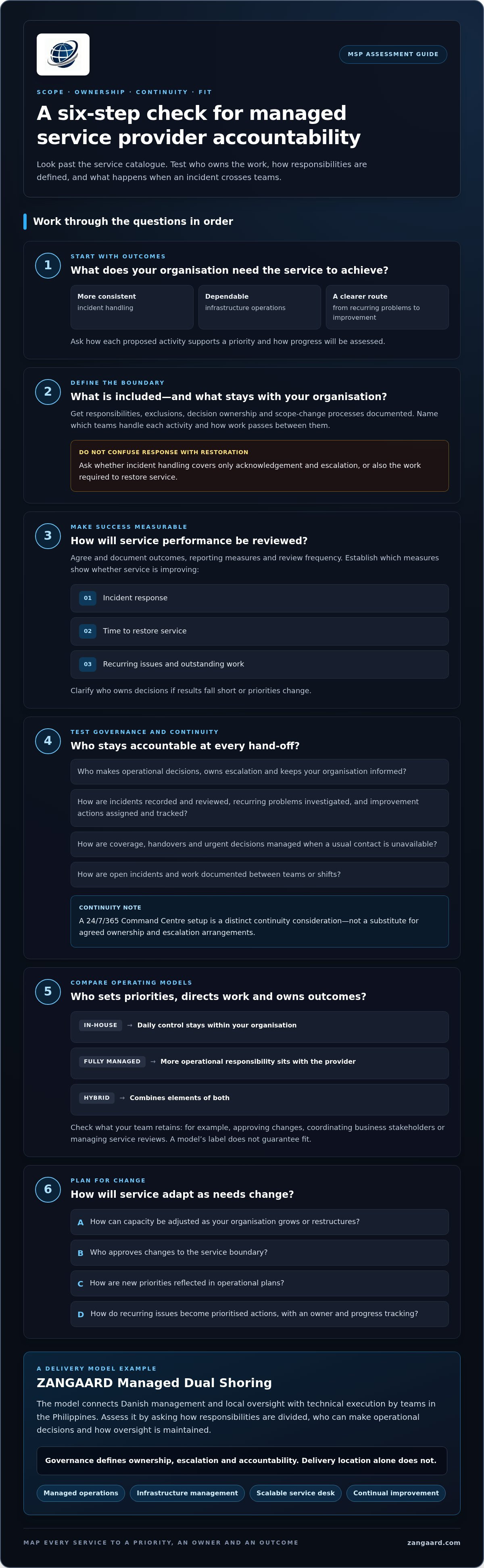
Start with the outcomes your organisation needs, not a list of technologies. Are you seeking more consistent incident handling, dependable infrastructure operations, or a clearer route from recurring problems to improvement? Your answers shape the service you need. Ask how each proposed activity supports those priorities and how progress will be assessed.
The managed services model centres on ongoing management of defined services. In practice, the questions to ask a potential managed service provider should uncover exactly what that ongoing responsibility means for your organisation.
How will the provider define success and service boundaries?
Ask how outcomes, reporting measures and review frequency will be agreed and documented. Which measures will show whether service is improving: incident response, time to restore service, recurring issues or outstanding work? Clarify who owns decisions when results fall short or priorities change. Request a clear account of which teams handle each responsibility, how work passes between them, and which activities remain with your organisation.
A useful service boundary names responsibilities, measures outcomes and assigns clear ownership of escalation.
Make the distinction between incident response, routine operations, infrastructure management and continual improvement explicit. For example, ask whether incident handling covers only acknowledgement and escalation, or also the work required to restore service. For routine operations, identify the specific activities included. For improvement, establish how recurring issues become prioritised actions, with an owner and a way to track progress, rather than informal observations.
ZANGAARD connects managed operations with governance by aligning defined responsibilities and oversight with technical execution. The managed IT service portfolio includes managed operations, infrastructure management, a scalable service desk and continual improvement. When reviewing these services, map each one to a business priority and identify who owns the work, decisions and outcomes.
Before agreeing a service, make sure the documented boundary covers included activities, exclusions, decision ownership and the process for reviewing outcomes. Ask how a change to the scope will be raised, assessed and recorded. That clarity gives both sides a practical basis for managing expectations as needs evolve.
Questions to Ask About Accountability, Governance and Service Continuity
Distributed delivery can work well when accountability is visible at every hand-off. Ask who makes operational decisions, who owns escalation when an incident crosses teams, and who keeps your organisation informed. Find out how technical updates reach the person responsible for management oversight, and what happens if a decision is needed while work is in progress. This helps expose gaps where an issue could otherwise stall between execution and decision-making.
Good IT governance connects technology decisions with business priorities and risk oversight. Ask how incidents are recorded and reviewed, how recurring problems are assigned for investigation, and how service reviews turn findings into tracked improvement actions. Establish who approves priorities, who is responsible for completing agreed actions and how progress is communicated.
What keeps distributed IT operations accountable?
Look for an operating model that makes ownership clear across locations and time zones, rather than assuming proximity guarantees control. ZANGAARD’s Managed Dual Shoring pairs Danish management and local oversight with technical execution by teams in the Philippines. Ask how responsibilities are divided, who can make operational decisions and how oversight is maintained. Governance defines ownership, escalation and accountability; delivery location alone does not.
Ask how continuity planning accounts for coverage, handovers and urgent decisions. Find out how work is documented between shifts or teams, how open incidents are handed over, and who can escalate an issue when the usual contact is unavailable. A 24/7/365 Command Center setup is a distinct consideration in continuity planning, not a substitute for agreed responsibility and escalation arrangements. ZANGAARD’s Managed Dual Shoring model provides a practical example of connecting management oversight with technical delivery.
These are among the most revealing questions to ask a potential managed service provider: who remains accountable when work passes between teams, and how can you see that ownership in practice? If you’re assessing how governance could align with your operating needs, discuss your service management requirements.
Questions to Ask About Scalability, Improvement and the Right Operating Model
As systems and demand change, service responsibilities may need to change with them. Ask how capacity can be adjusted, who approves changes to the service boundary, and how new priorities are reflected in operational plans. Scalability in information technology is about adapting resources to changing needs. For an MSP, that means discussing how service delivery can respond as your organisation grows or restructures, and how changes in demand are reflected in responsibilities and priorities.
Compare operating models by what your team needs to retain and what it wants managed. In-house delivery can keep daily control within your organisation, whilst a fully managed arrangement assigns more operational responsibility to the provider. A hybrid model combines elements of both. Ask who sets priorities, directs work and owns outcomes in each option. For example, clarify whether your internal team will approve changes, coordinate business stakeholders or manage service reviews. Don’t treat the model’s label as a guarantee of fit.
ZANGAARD’s Managed Dual Shoring model combines Danish management with technical execution by teams in the Philippines. Its managed IT service portfolio brings together services such as infrastructure management, a scalable service desk and continual improvement. Consider how those capabilities map to your changing requirements and internal responsibilities.
How can a provider make continual improvement part of operations?
Ask how recurring issues are documented, assigned an owner, prioritised and reviewed, and how agreed actions are tracked to completion. A useful process connects operational evidence to a decision, not just a report. For example, ask what happens when the same type of incident appears repeatedly: who investigates the cause, who agrees the next action and how the result is reviewed. ZANGAARD’s continual improvement and embedded IT service management consultation are relevant capabilities for building that discipline into service operations.
Use these questions to assess whether the operating model can evolve without blurring accountability. The questions to ask a potential managed service provider should reveal how change, ownership and improvement fit together. To explore how these considerations relate to your organisation, discuss your managed IT requirements.
Make Your Next IT Decision with Clarity
The right managed service arrangement should support where your organisation is going, not simply preserve how IT works today. Use the questions to ask a potential managed service provider to turn business priorities into a clear basis for discussion: what needs to change, what must remain under your control, and how you’ll recognise progress. That perspective can help you make a grounded decision as requirements evolve.
For ZANGAARD, accountable service delivery means connecting management oversight with technical work through a defined operating model. Consider how your requirements and preferred ways of working can shape the service conversation.
With clear priorities and ownership in view, you can move forward with greater confidence.
Frequently Asked Questions
Can a managed service provider work alongside an internal IT team?
Yes. An MSP can take responsibility for defined operational tasks whilst your internal team retains strategic direction, business knowledge or specialist work. For example, the provider might manage infrastructure operations while internal IT coordinates technology changes with department leads. ZANGAARD’s managed IT services support organisations considering how external delivery can fit alongside their existing capabilities.
What should an MSP proposal include?
A useful proposal should make its assumptions visible, not just describe a package. Look for a summary of your requirements, the services and responsibilities proposed, dependencies on your organisation, the operating model, and how changes or unresolved issues will be handled. Compare these points with your current environment and note any gaps or terms that could be interpreted differently by each party.
How much internal oversight does a managed service provider require?
The level depends on how much responsibility you delegate and which decisions your organisation retains. Assign an internal sponsor to set priorities and provide business context, then decide who coordinates technical changes and reviews service information. The questions to ask a potential managed service provider should clarify these retained roles, so oversight is purposeful rather than an informal stream of requests to different teams.
What happens if our requirements change after choosing an MSP?
Requirements can be reassessed through an agreed change process. For example, adding a business application or bringing a new team into the service may affect responsibilities, capacity or priorities. Record the requested change, assess its operational impact with the provider, and document the revised agreement before work proceeds. This creates a shared reference point and helps prevent assumptions from becoming service gaps.

Disclaimer
The purpose of this article is to generate inspiration, reflection and to start a debate across markets, industries and organizations. We do not recommend any actions soly based on the article statements, claims or opinions, but recommend you to reach out directly to ZANGAARD for a qualified review, dialogue and/or consultation. Reach out at [email protected] or visit our website www.zangaard.com


