

The outsourcing model with the lowest apparent cost can leave your internal team with the greatest management burden. An IT outsourcing models comparison should look beyond location and rates to ask who owns quality, governance and day-to-day outcomes. Offshore capacity can help teams scale, but limited visibility and inconsistent processes can reduce its value.
If you’re weighing staff augmentation, managed services and hybrid approaches, start by asking how much operational control your team needs and who will be accountable for delivery. This guide compares the models and their trade-offs, with practical criteria for matching an approach to your requirements. It also explains Managed Dual Shoring, which combines Danish management and oversight with technical execution in the Philippines. For organisations seeking scalable operations without taking on every layer of day-to-day coordination, that distinction matters.
Key Takeaways
- Use an IT outsourcing models comparison to distinguish temporary capacity support from outsourcing a function with defined outcome accountability.
- Before choosing staff augmentation, assess whether your managers have time to assign work, review quality and handle day-to-day coordination.
- Classify IT functions by criticality to decide where managed or co-managed support best fits your operating needs.
- Explore how ZANGAARD’s services and portfolio connect managed IT operations with a hybrid delivery model for governed, scalable support.
Comparing Relationship-Based IT Outsourcing Models: Staff Augmentation vs Managed Services
In an IT outsourcing models comparison, the key distinction is who directs the work and owns the result. Staff augmentation adds external specialists to your existing team. It can suit a defined skills gap or a workload spike when your managers have capacity to assign tasks, answer questions and review the work. Your organisation remains responsible for coordination and delivery.
Managed services transfer responsibility for an agreed function or outcome to the provider, with performance assessed against defined service levels. This can suit ongoing operations where continuity and clear governance matter more than directing each individual task. When comparing the arrangements, ask who handles work allocation, escalation, documentation and service reporting. For a neutral introduction to the range of outsourcing models, including location-based approaches, see Wikipedia’s overview.
The Governance Gap: Why Managed Services Outperform Staff Augmentation
Staff augmentation can look straightforward, but its total cost of ownership includes more than the external resource. Account for the time your team spends onboarding specialists, allocating tasks, answering operational questions, checking quality and coordinating handovers. If internal management capacity is already stretched, this work can limit the value of the extra capacity.
With managed services, team coordination and service performance sit within the provider’s remit for the agreed scope. Before work begins, define what is included, how requests are prioritised, how issues are escalated and what reporting your team needs. Standardised processes and regular performance reviews can make responsibilities clearer and help identify opportunities for continual improvement as requirements change. For organisations looking to relieve internal operational burden, a practical next step is to explore Managed IT Services delivered by an experienced external partner.
Managed IT Operations treat support as an integrated function rather than a collection of additional individuals. ZANGAARD’s Managed Dual Shoring combines Danish management and oversight with technical execution in the Philippines, connecting leadership with offshore delivery. Its IT services and portfolio include managed operations and service desk support. The right choice depends on whether you need temporary capacity or sustained responsibility for operational outcomes.
Evaluating Geographic Delivery Models: Onshoring, Offshoring, and the Dual-Shore Hybrid
Location affects access to talent and the coordination a service requires, but it does not determine quality on its own. Onshoring keeps teams closer to internal stakeholders and processes, while offshoring can provide access to technical capacity at scale. Distance can make communication, oversight and consistent ways of working more demanding. This overview of geographic delivery models explores considerations behind these approaches.
A useful IT outsourcing models comparison therefore looks beyond geography to the management structure. Ask who sets priorities, resolves competing requests, communicates changes and monitors service quality. If those responsibilities remain with your internal team, offshore delivery may add coordination work rather than remove it. Pairing offshore technical teams with engaged management offers a structured way to combine delivery capacity with clear oversight.
Mitigating Offshore Risk with Local Accountability and Danish Management
Managed Dual Shoring (MDS) combines Danish management and local oversight with technical execution in the Philippines. Rather than treating offshore work as a separate operation, the model connects strategic direction with day-to-day delivery. Clear governance and communication help establish shared expectations and quality standards, while Danish leadership provides an accountable point of oversight. Philippines-based technical teams carry out the work within that managed structure.
The distinction is practical: leadership sets direction and maintains oversight, while technical teams handle operational execution. This can help organisations pursue offshore scalability without placing the full coordination burden on internal managers. ZANGAARD applies this approach to Managed IT Operations and service desk delivery. Explore Managed Dual Shoring and ZANGAARD’s service portfolio to understand how Danish management and global technical execution fit together.
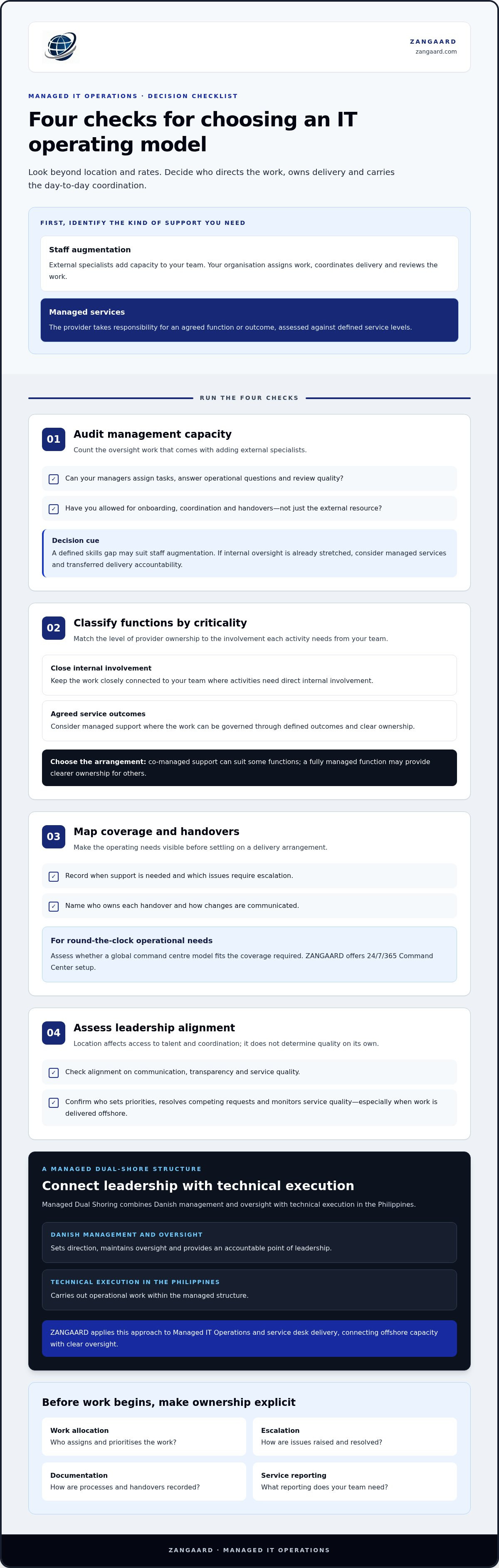
Selecting a Future-Proof Operating Model for Managed IT Operations
A sound IT outsourcing models comparison should lead to an operating decision, not just a supplier shortlist. Use these steps to connect delivery choices to the work your organisation needs done:
- Audit management capacity. If your team can assign, supervise and review external specialists, staff augmentation may fill a defined gap. If that oversight would pull managers away from core responsibilities, consider transferring delivery accountability through managed services.
- Classify functions by criticality. Identify which activities need close internal involvement and which can be governed through agreed service outcomes. This helps determine where co-managed support makes sense and where a fully managed function may provide clearer ownership.
- Map coverage requirements. Record when support is needed, which issues need escalation and who owns each handover. For round-the-clock operational needs, assess whether a global command centre model fits the required coverage. ZANGAARD offers 24/7/365 Command Center setup.
- Assess leadership alignment. Consider whether the provider’s management approach fits your expectations for communication, transparency and service quality. Clear oversight is especially important when technical work is delivered offshore.
Implementing Managed Dual Shoring to Optimise Cost and Service Quality
Moving from fragmented arrangements to a unified operation starts with connecting responsibilities, processes and infrastructure management. Managed Dual Shoring aligns technical execution in the Philippines with Danish management, while IT Infrastructure Management provides a foundation for coordinated oversight. Before changing models, map the hand-offs between teams, document who owns each operational decision and agree how issues will be escalated. This helps avoid disconnected processes and unclear accountability.
“Managed Dual Shoring is not merely a cost-saving exercise; it is a strategic realignment of accountability and execution.”
Explore ZANGAARD’s Managed IT Operations to see how a governed approach can support complex IT environments, or discuss your operating model.
Build an Operating Model That Scales with Confidence
A sound IT outsourcing models comparison looks beyond headline cost to accountability, management effort and the level of control your operations require. Staff augmentation can address a defined skills gap, while managed services place responsibility for agreed ongoing outcomes with the provider. Geography matters, but effective oversight connects distributed technical delivery to clear responsibilities and consistent working practices.
ZANGAARD’s Managed Dual Shoring brings Danish management oversight together with technical teams in the Philippines. Alongside Managed IT Operations, the portfolio includes IT Infrastructure Management, Scalable Service Desk and 24/7/365 Command Center setup. These services give organisations options for structuring operational support around their requirements. Explore the service portfolio and discuss which operating model fits your needs.
With clear governance and the right operating model, you can scale IT support with greater confidence and keep your organisation focused on what comes next.
Frequently Asked Questions
What is the main difference between staff augmentation and managed services?
The main difference is who manages the work and owns its outcomes. With staff augmentation, external specialists join your team, while your managers remain responsible for direction, performance and delivery. With managed services, the provider takes responsibility for an agreed function or outcome. An IT outsourcing models comparison should include the internal time needed to supervise augmented staff, not just the resource cost.
How does the Managed Dual Shoring model reduce the risks of traditional offshoring?
Managed Dual Shoring pairs offshore technical execution with Danish management and local oversight. This structure connects operational work with leadership, communication and accountability, helping address risks such as limited visibility and inconsistent expectations. ZANGAARD combines management in Denmark with technical teams in the Philippines. Explore its Managed Dual Shoring model to see how it supports governed delivery.
Is IT outsourcing in the Philippines suitable for European companies?
It can be suitable when offshore technical delivery is supported by a management approach that fits the organisation’s operating needs. European businesses should consider how responsibilities, communication, quality oversight and escalation will work across the delivery model. ZANGAARD combines technical teams in the Philippines with Danish management, bringing offshore execution and Danish leadership together within Managed IT Operations.
Can I maintain Danish management standards whilst using an offshore technical team?
Danish management and local oversight can guide offshore technical execution through shared expectations, clear accountability and structured operational governance. ZANGAARD’s hybrid model brings these elements together, with Danish leadership and technical teams in the Philippines. Its service portfolio includes Managed IT Operations, IT Infrastructure Management and 24/7/365 Command Center setup.
Disclaimer
The purpose of this article is to generate inspiration, reflection and to start a debate across markets, industries and organizations. We do not recommend any actions soly based on the article statements, claims or opinions, but recommend you to reach out directly to ZANGAARD for a qualified review, dialogue and/or consultation. Reach out at [email protected] or visit our website www.zangaard.com


