

Most IT strategies fail not because the vision is flawed, but because the governance never leaves the boardroom. You've likely experienced the mounting frustration of high-level policies dissolving into operational chaos at the service desk level, particularly whilst managing distributed or offshore teams. Fragmented toolsets often mask recurring incidents, leaving leadership in the dark about the true stability of their technical infrastructure. This article demonstrates how to implement IT operational governance that transforms abstract directives into disciplined, day-to-day execution. You'll discover how to establish enforceable cadences that guarantee accountability across every workflow. By exploring the ZANGAARD Services and our specialised service portfolio, we will show you how to gain unified visibility and shift your technical teams from reactive fire-fighting to a culture of composed, strategic improvement.
Key Takeaways
- Understand why IT operational governance is the critical bridge between executive vision and daily service delivery, ensuring that policies are strictly enforced on the frontline.
- Learn to implement a disciplined blueprint of operational cadences, ranging from daily standups to quarterly reviews, to secure unambiguous ownership across your entire infrastructure.
- Discover how to maintain rigorous oversight in hybrid and distributed environments by establishing clear service boundaries that prevent the common breakdowns found in traditional outsourcing.
- Explore how ZANGAARD’s specialised managed IT operations and dual-shoring model transform reactive fire-fighting into a steady state of continual improvement and business stability.
What is IT Operational Governance and Why Do Frameworks Fail?
True IT operational governance isn't a static manual on a shelf; it's the active, systemic control over every interaction within your service delivery chain. Whilst the corporate governance of information technology focuses on high-level alignment and risk management, operational governance lives in the trenches. It is the mechanism that ensures executive intent translates into specific, repeatable behaviours. Static frameworks often fail because they lack the management hierarchy to enforce processes when technical teams face high-pressure incidents. Without active oversight, even the most robust architecture becomes a theoretical exercise rather than a functional safeguard. This is why many organisations find their resilience crumbling the moment a major incident occurs.
The Structural Gap Between Strategy and Day-to-Day Execution
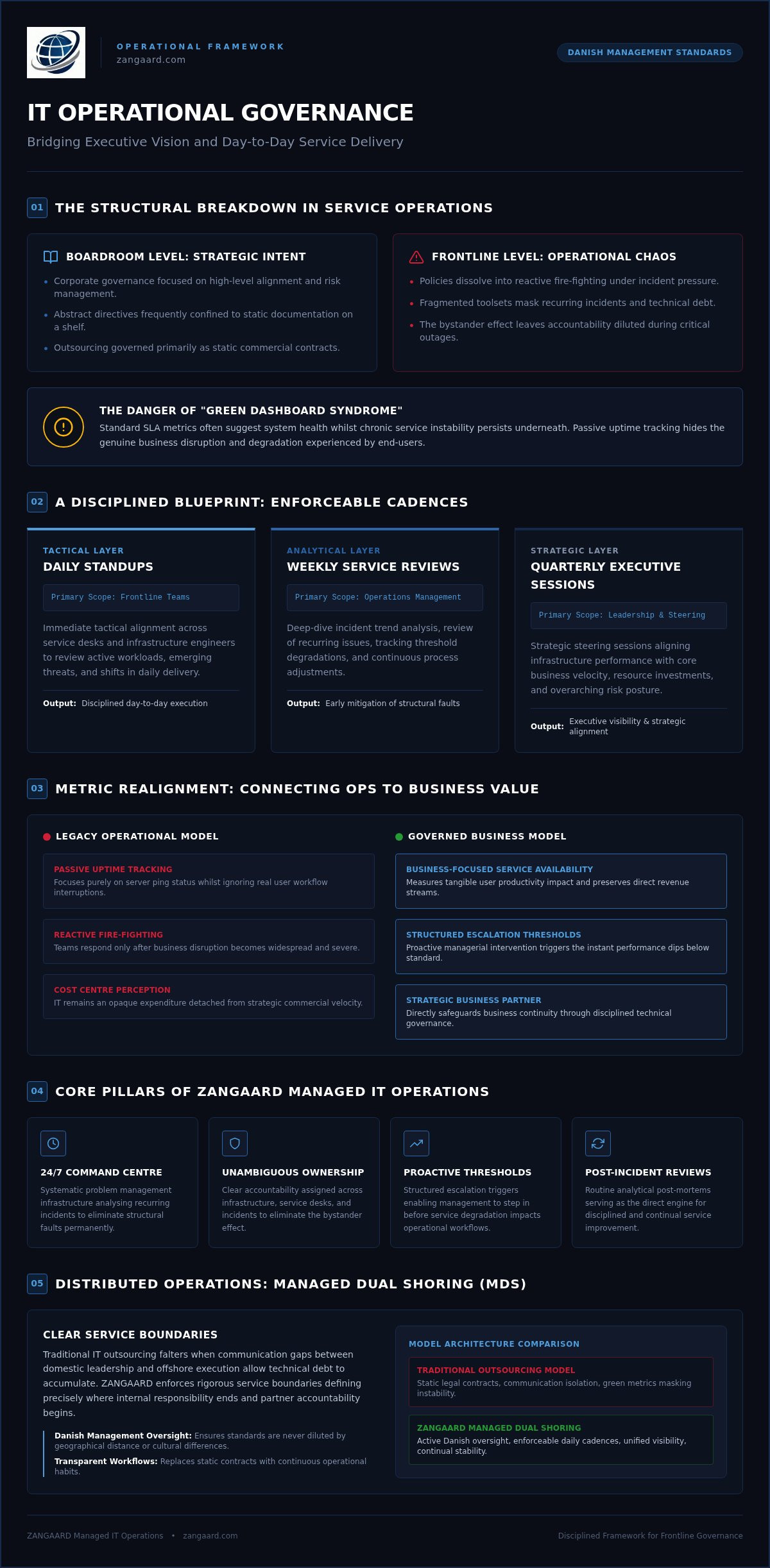
Many organisations suffer from "green dashboard syndrome," where SLA metrics suggest health whilst chronic service instability persists. This disconnect occurs when frontline procedures diverge from governance mandates under the weight of daily fire-fighting. To regain control, frameworks must be operationalised into non-negotiable daily routines. ZANGAARD bridges this gap through our Managed IT Operations, where Danish management standards enforce transparent accountability across every workflow. By embedding disciplined cadences into the service desk, we transform abstract policies into reliable, day-to-day execution. This approach ensures that distributed or offshore teams don't just follow a script, but adhere to a rigorous standard of continual improvement. It's about moving beyond the illusion of health toward a state of genuine operational stability.
A Disciplined Blueprint: How to Establish Operational Governance
Establishing a resilient framework requires moving beyond reactive habits into a rhythmic, predictable structure. Effective IT operational governance relies on transparent cadences that bridge the gap between technical execution and executive oversight. We implement a rigorous hierarchy of meetings: daily standups for immediate tactical alignment, weekly service reviews for trend analysis, and quarterly executive sessions for strategic steering. This ensures every stakeholder understands their specific responsibilities. By defining unambiguous ownership across infrastructure, service desks, and incident management, you eliminate the "bystander effect" during critical outages. ZANGAARD’s Managed IT Operations enforces these standards through Danish management oversight, ensuring accountability is never diluted by geographical distance or cultural differences.
Connecting Operational Metrics to Strategic Business Outcomes
Passive uptime tracking often hides the true impact of service degradation on business velocity. Instead, we advocate for business-focused service availability metrics that reflect actual user productivity and revenue impact. We establish structured escalation thresholds that trigger proactive managerial intervention the moment performance dips below agreed levels. This approach shifts IT from a cost centre to a strategic partner. Systematic problem management, supported by our 24/7 Command Centre infrastructure, ensures that every recurring incident is analysed to remove structural faults permanently. Routine post-incident reviews aren't merely administrative tasks; they're the engine for disciplined continual service improvement. If your current operations lack this level of oversight, you might explore how a structured command centre can restore control to your infrastructure.
Maintaining Governance Across Distributed and Hybrid Operations
Traditional third-party IT outsourcing often collapses when governance is treated as a static legal contract rather than a living operational habit. Breakdowns occur because communication gaps between domestic strategy and offshore execution allow technical debt to accumulate whilst masking poor performance. To maintain control across complex hybrid architectures, you must establish clear service boundaries that define exactly where internal responsibility ends and partner accountability begins. Rigorous IT operational governance ensures that distributed technical teams remain aligned with your core business objectives, regardless of their physical location. By implementing standardised reporting and transparent workflows, you eliminate the ambiguity that typically leads to service instability.
The Managed Dual Shoring Model: Accountability Meets Global Scale
ZANGAARD’s Managed Dual Shoring model addresses these challenges by pairing domestic Danish management with specialised technical execution in the Philippines. Our local leadership acts as a non-negotiable quality control gate, ensuring that every deliverable meets stringent European standards before it reaches your environment. This structure coordinates offshore engineering teams through disciplined daily cadences, providing the strategic reassurance that high-stakes operations are being handled with precision. We embed IT operational governance directly into our Managed IT Operations, shifting the burden of management from your internal team to our seasoned experts. This approach doesn't just provide scalability; it delivers the peace of mind that comes from unwavering reliability and professional maturity. By bridging the gap between high-level strategy and global execution, we ensure your digital infrastructure remains resilient and cost-effective.
Securing the Future of Your IT Infrastructure
Establishing robust IT operational governance isn't just a compliance requirement; it's a strategic necessity for business stability. We've explored how moving from static manuals to disciplined daily cadences bridges the gap between executive vision and frontline execution. By defining clear ownership and implementing systematic problem management, you can eliminate structural faults that threaten service delivery. ZANGAARD’s comprehensive portfolio, featuring proven Danish management standards and specialised Managed Dual Shoring, provides the rigorous oversight needed for distributed technical teams. Whether through our 24/7 Command Centre or embedded ITSM consultation, we ensure your operations remain resilient whilst maintaining cost-efficiency.
Regain control of your digital landscape and experience the peace of mind that comes from professional, steady-handed management. It's time to transform your IT operations into a reliable engine for growth.
Frequently Asked Questions
What is the primary difference between IT governance and IT operational governance?
Strategic IT governance defines the "what" and "why" through policy, whilst IT operational governance focuses on the "how" by enforcing those policies within daily technical workflows. It bridges the gap between executive intent and frontline execution. ZANGAARD’s Embedded IT Service Management Consultation ensures that these high-level frameworks are translated into disciplined, repeatable service desk behaviours that guarantee long-term business stability.
How does an organisation prevent operational governance from slowing down IT service delivery?
Velocity increases when organisations replace chaotic, reactive fire-fighting with structured cadences and unambiguous ownership. Effective governance simplifies decision-making by establishing clear escalation thresholds and proactive managerial gates. ZANGAARD’s focus on Continual Improvement ensures that processes remain lean and outcome-focused. This approach prevents administrative bloat whilst ensuring that every technical interaction remains aligned with strategic business objectives and operational requirements.
Can IT operational governance be maintained when outsourcing technical operations?
Control is preserved through specialised models like Managed Dual Shoring, which pair domestic management with offshore technical execution. This structure overcomes the communication breakdowns typical in traditional outsourcing by enforcing Danish management standards across all locations. ZANGAARD provides a non-negotiable quality control gate, ensuring that distributed engineering teams remain fully accountable to the client’s internal governance mandates and European operational expectations.
What key metrics indicate that an operational governance framework is genuinely working?
A successful framework is indicated by a measurable reduction in recurring incidents and a shift toward proactive problem management. Key metrics include improved Mean Time to Resolution and higher service availability that reflects actual business productivity. When IT operational governance is working, fragmented toolsets no longer mask chronic instability. Instead, our 24/7 Command Centre infrastructure provides unified visibility across all internal and offshore technical workflows.
Disclaimer
The purpose of this article is to generate inspiration, reflection and to start a debate across markets, industries and organizations. We do not recommend any actions soly based on the article statements, claims or opinions, but recommend you to reach out directly to ZANGAARD for a qualified review, dialogue and/or consultation. Reach out at [email protected] or visit our website www.zangaard.com


