

A room full of glowing screens isn't a command centre; it's a liability if it lacks the disciplined governance required to drive recovery when a P1 incident strikes at 02:00. Many enterprise leaders find that their managed IT command centre setup provides plenty of telemetry but very little actual accountability, leading to fragmented responses and escalating costs. You likely recognise the frustration of managing offshore teams that lack visibility into your priorities, or the exhaustion of trying to sustain internal 24/7 staffing without burning out your talent.
We believe true peace of mind comes from knowing your global operations are anchored by a steady hand. This guide will show you how to architect a resilient command centre that bridges global scalability with unwavering Danish standards. We'll explore the essential components of 24/7 governance and the Managed Dual Shoring model utilised in ZANGAARD Services, ensuring your infrastructure remains a strategic advantage rather than a source of risk.
Key Takeaways
- Discover why traditional monitoring dashboards often create a false sense of security and how to identify the "Black Box" syndrome in your offshore operations.
- Learn the three pillars of a resilient managed IT command centre setup that integrates infrastructure, intelligence, and proactive problem management for total visibility.
- Explore how Managed Dual Shoring bridges the gap between Philippine technical execution and Danish accountability to provide 24/7/365 operational stamina.
- Understand how to shift the burden of management to a disciplined partner, allowing you to regain control over service quality and cost-efficiency.
Beyond Monitoring: The Governance Gap in Modern Command Centres
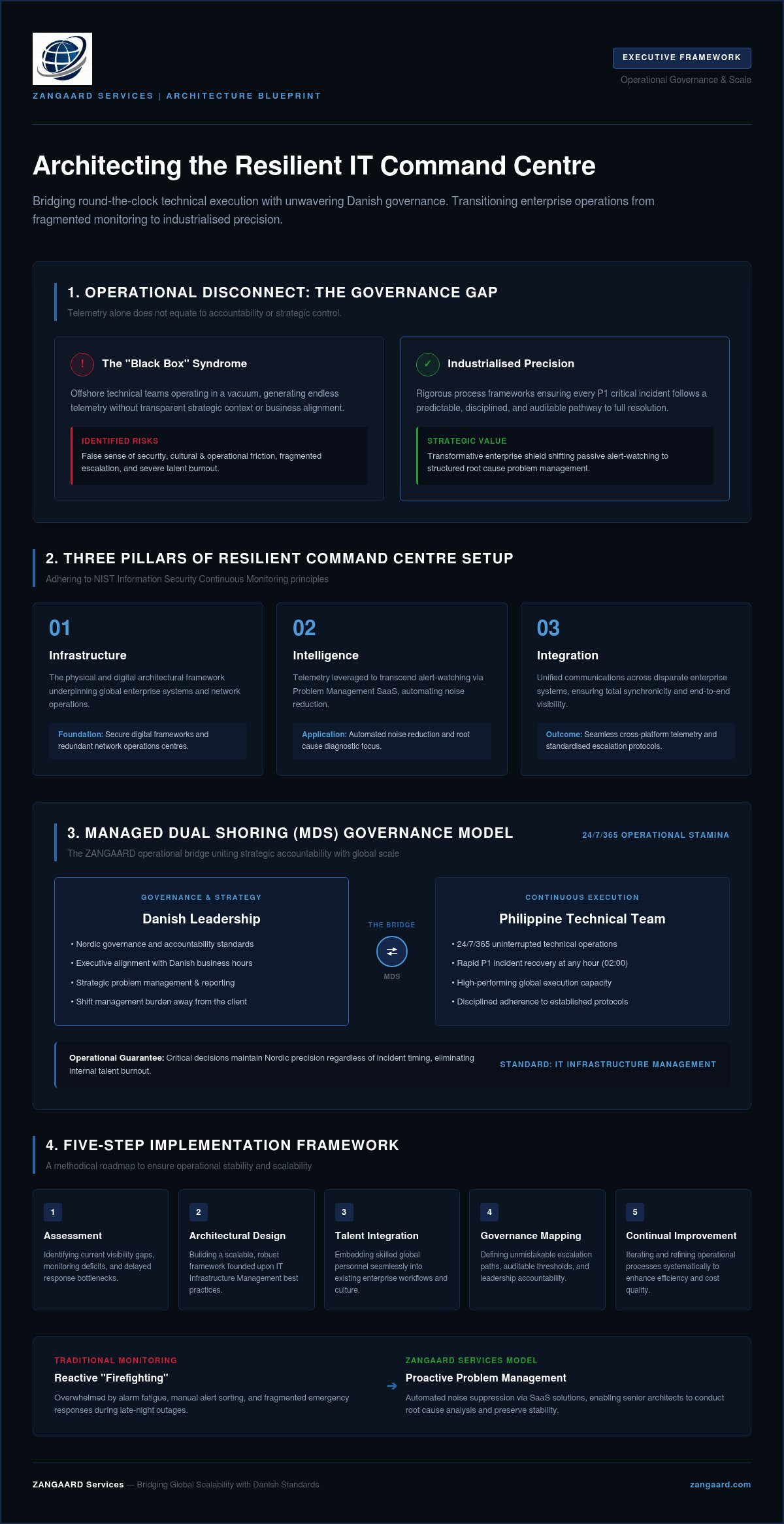
Many enterprises mistakenly believe that a sophisticated dashboard equates to operational control. In reality, a managed IT command center setup often falls victim to "Black Box" syndrome; a state where offshore technical teams operate in a vacuum, providing telemetry without transparency. Whilst software tools provide data, they don't offer the strategic reassurance that executive leadership requires during high-stakes outages. Without a bridge between local management and global execution, scaling becomes a liability rather than an asset.
True business continuity demands more than just alert-watching. It requires what we term "Industrialised Precision". This is the rigorous application of process frameworks that ensure every incident follows a predictable, auditable path to resolution. A robust network operations center infrastructure is merely the foundation; the actual value lies in the governance layers that sit above the hardware.
The Risk of Traditional Offshoring in 24/7 Operations
Traditional offshoring often decouples technical execution from the accountability standards found in Northern Europe. This separation creates cultural and operational friction, leading to inconsistent service quality across time zones. Without a structured bridge-builder to align global technical teams with Danish management principles, a managed IT command center setup inevitably falls short of its potential. Strategic governance is the cornerstone of any successful command centre setup; it transforms reactive monitoring into a disciplined, proactive shield for the enterprise. This approach is central to the ZANGAARD service portfolio, where we shift the burden of management from the client to the expert.
Essential Components of a Scalable IT Command Centre Setup
A resilient managed IT command center setup rests upon three immovable pillars: Infrastructure, Intelligence, and Integration. Infrastructure provides the physical and digital framework; Intelligence leverages telemetry to move beyond passive alert tracking; and Integration ensures that disparate systems communicate in a unified language. By adhering to NIST Information Security Continuous Monitoring guidelines, organisations can transition from reactive, "firefighting" monitoring to proactive problem management. This shift is often facilitated by a Problem Management SaaS application that automates noise reduction, allowing human experts to focus on root cause analysis.
Maintaining a 24/7/365 operational rhythm requires more than just shift rotations. It necessitates a governance model that aligns global execution with Danish business hours, ensuring that critical decisions are made with Nordic precision regardless of the time. You can see how these components function in practice by exploring ZANGAARD’s service portfolio.
A Strategic Roadmap for Command Centre Implementation
Architecting a command centre isn't a one-off event; it's a methodical journey. We recommend a five-step framework to ensure stability and scalability:
- Assessment: Identifying current gaps in visibility and response.
- Architectural Design: Building a scalable framework based on IT Infrastructure Management best practices.
- Talent Integration: Embedding skilled global personnel into your existing workflows.
- Governance Mapping: Defining clear escalation paths and accountability.
- Continual Improvement: Iterating processes to enhance efficiency.
This structured approach to a managed IT command center setup ensures that global talent remains managed by local standards, preserving quality whilst achieving scale. If you're ready to refine your operational oversight, consult with our architects for a bespoke setup.
The ZANGAARD Approach: Bridging Danish Oversight with Global Execution
Success in a managed IT command center setup isn't found in the software alone; it's found in the management model that governs its use. ZANGAARD introduces Managed Dual Shoring (MDS) as the definitive solution for enterprises seeking global scale without sacrificing Nordic accountability. By integrating seasoned Danish leadership with high-performing technical teams in the Philippines, we provide a structured bridge that ensures technical execution remains aligned with executive strategy. This model allows the offshore team to focus on round-the-clock delivery whilst our Danish architects handle the burden of governance, reporting, and high-level problem management.
Our methodology incorporates the NIST Cybersecurity Framework to establish a rigorous baseline for risk management and operational oversight. This ensures that every action taken within the command centre is auditable and compliant with international standards. You can explore the mechanics of this hybrid model on our Managed Dual Shoring service page, where we detail how we maintain industrialised precision across borders.
Why Managed Dual Shoring is the Future of IT Operations
Unlike traditional "Employee on Record" models or simple outsourcing, MDS ensures that accountability stays with the service provider. In an "Employee on Record" setup, you're still responsible for managing the daily output and quality of offshore staff. With ZANGAARD, we own the outcome. This framework is essential for supporting complex 24/7 IT Service Desks that require constant, high-quality interaction. If you're ready to secure your operations with a disciplined global architecture, we invite you to contact ZANGAARD for a strategic consultation on your specific requirements.
Securing Your Operational Future with Strategic Oversight
Achieving a resilient 24/7/365 operational rhythm requires moving past the "Black Box" of traditional outsourcing. We've explored how a disciplined managed IT command center setup integrates infrastructure with intelligence to eliminate visibility gaps. By coupling scalable Philippine technical talent with unwavering Danish management standards, you regain control over service quality and business continuity. This hybrid architecture ensures that your high-stakes operations are handled by a steady hand, shifting the burden of management from your internal team to seasoned experts. It's about more than just uptime; it's about the peace of mind that comes from industrialised precision and local oversight.
We're ready to help you architect a framework that protects your enterprise around the clock.
Frequently Asked Questions
What is the primary difference between a basic NOC and a Managed IT Command Centre?
A basic NOC primarily focuses on technical monitoring and reactive alert tracking. In contrast, a managed IT command center setup provides a comprehensive governance bridge that integrates proactive problem management with strategic oversight. It ensures that technical data is translated into business impact, allowing for disciplined incident command and auditable decision making that simple monitoring dashboards cannot provide.
How does ZANGAARD ensure Danish management standards are met in the Philippines?
ZANGAARD maintains these standards through our Managed Dual Shoring model. We place strategic leadership and ITIL process stewardship under Danish management whilst technical execution occurs in the Philippines. This hybrid structure ensures that offshore technical stamina is always guided by Nordic accountability. Our local oversight acts as a constant bridge, enforcing high quality standards and cultural alignment across all operational shifts.
Can a Managed Command Centre integrate with our existing IT infrastructure?
Our command centre framework is built for seamless integration with your existing IT infrastructure. We design the managed IT command center setup to layer over your current telemetry tools, creating a unified governance environment that doesn't require a total system overhaul. This approach ensures that your existing investments are optimised through our structured oversight, providing a single, transparent view of your global operations 24/7.
What are the typical cost savings when moving to a Managed Dual Shoring command centre model?
Moving to a Managed Dual Shoring model provides substantial cost efficiency by bypassing the high expense of internal 24/7 staffing in Denmark. Organisations benefit from the lower technical labour costs in the Philippines whilst maintaining Danish management rigour. This setup eliminates the recruitment and retention burdens of night shifts, allowing you to scale your operations without the typical financial risks of traditional offshoring.
Disclaimer
The purpose of this article is to generate inspiration, reflection and to start a debate across markets, industries and organizations. We do not recommend any actions soly based on the article statements, claims or opinions, but recommend you to reach out directly to ZANGAARD for a qualified review, dialogue and/or consultation. Reach out at [email protected] or visit our website www.zangaard.com


