

Did you know that third-party data breaches now cost organisations an average of $4.91 million, a figure significantly higher than the global mean? You've likely felt the tension between the need for global scale and the fear of losing operational oversight. Whilst the financial benefits of global delivery are clear, the hidden costs of cultural friction and missed deadlines can erode your peace of mind. Truly mitigating risks of IT outsourcing requires moving beyond simple service level agreements toward a model of disciplined governance.
In this article, you'll learn how to master the complexities of international delivery through a structured approach that ensures accountability and security. We'll examine how the ZANGAARD Services portfolio utilises a Managed Dual Shoring model to bridge the gap between Nordic leadership standards and scalable execution. By the end, you'll understand how to transform your IT infrastructure into a resilient engine that scales without increasing your management burden.
Key Takeaways
- Categorise the primary threats to global delivery, from cultural misalignment to the financial impact of operational downtime.
- Master a strategic framework for mitigating risks of IT outsourcing that moves beyond basic uptime to ensure true Quality of Service.
- Discover how the ZANGAARD Services portfolio secures local accountability and global scale through Managed Dual Shoring.
- Build a resilient infrastructure using 24/7/365 command centre oversight and proactive, SaaS-driven problem management.
Identifying and Categorising the Primary Risks in Global IT Delivery
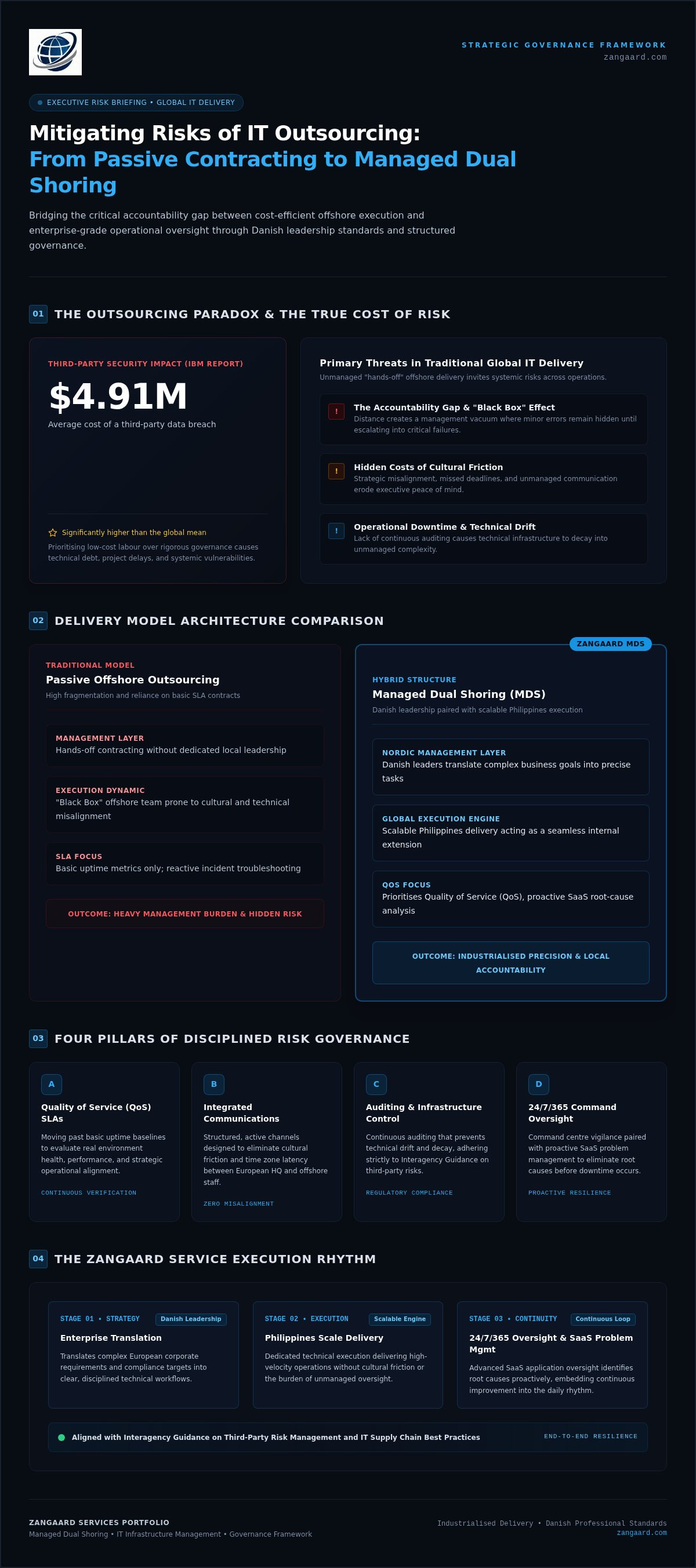
The "Outsourcing Paradox" defines the modern executive struggle: the drive for cost-efficiency often collides with the absolute necessity for operational control. When organisations prioritise low-cost labour over rigorous governance, they inadvertently invite systemic risks such as catastrophic operational downtime and severe data security breaches. These aren't just theoretical concerns; IBM reports that third-party data breaches now cost an average of $4.91 million. Relying on traditional, "hands-off" global IT outsourcing practices has become obsolete in a landscape where technical debt and project delays are the inevitable by-products of poor oversight. Successfully mitigating risks of IT outsourcing in 2026 requires a disciplined shift from passive contracting to active, strategic engagement.
The Accountability Gap in Traditional Offshore Models
Distance frequently creates a management vacuum, leading to a breakdown in service quality and strategic misalignment. Without local oversight, offshore teams can become a "black box" where minor errors remain hidden until they escalate into critical system failures. Implementing managed IT operations ensures that your technical strategy remains cohesive across borders, maintaining high standards whilst leveraging global talent. ZANGAARD addresses this gap through our Managed Dual Shoring model, which pairs Danish leadership with scalable Philippines execution. This approach eliminates the cultural misalignment that plagues unmanaged teams, replacing uncertainty with the strategic reassurance of industrialised precision. By shifting the management burden to a disciplined partner, you regain the transparency needed for mitigating risks of IT outsourcing and ensuring long-term operational excellence.
A Strategic Framework for Mitigating Outsourcing Risks Through Governance
Effective governance isn't merely about oversight; it's about engineering risk out of the system. A robust framework for mitigating risks of IT outsourcing starts with an SLA that prioritises Quality of Service (QoS) over basic uptime. Whilst uptime is a baseline, QoS measures the actual health and performance of your environment. This approach aligns with the interagency guidance on third-party risk management, which emphasises rigorous contract structuring and ongoing monitoring. Beyond the contract, you must organise integrated communication channels that bridge cultural nuances and time zones. Finally, continuous auditing and IT infrastructure management are essential to prevent technical drift. This disciplined process ensures your systems evolve in line with your strategic goals rather than decaying into unmanaged complexity.
Managed Dual Shoring: The Hybrid Safety Net
ZANGAARD's Managed Dual Shoring (MDS) model provides a sophisticated solution to the accountability gap. By combining Danish management standards with the technical scalability of teams in the Philippines, we create a hybrid structure where nothing is left to chance. Our Danish leaders translate complex business requirements into precise technical tasks, ensuring your offshore team remains a seamless extension of your local operation. This setup is the ultimate tool for mitigating risks of IT outsourcing because it eliminates the "black box" effect. Having a local point of contact provides the strategic reassurance European enterprises need to scale without friction. If you're ready to secure your global delivery, speak with our consultants about a tailored governance plan that bridges the strategy to execution gap.
Ensuring Long-Term Resilience and Business Continuity
Resilience in global IT delivery isn't a static state; it's a result of continuous operational discipline. To achieve this, organisations must move beyond reactive troubleshooting toward proactive Problem Management. Utilising advanced SaaS applications allows for identifying root causes before they manifest as downtime. This level of foresight is a core component of the ZANGAARD service portfolio, where continual improvement is embedded into the daily operational rhythm. By integrating these systems, you ensure that offshore teams function as a transparent extension of your internal IT department. This alignment reflects the best IT supply chain risk management practices, which demand foundational controls to secure long-term continuity across multi-tiered external providers.
The 24/7 Command Centre as a Strategic Asset
A centralised Command Centre provides the real-time visibility essential for mitigating risks of IT outsourcing. Operating a 24/7/365 service desk ensures that global IT health is monitored across every time zone, effectively eliminating the risk of knowledge silos. This is achieved through standardised documentation and shared governance frameworks that keep all stakeholders informed. Many Danish firms have successfully utilised this model to scale through IT outsourcing in the Philippines, turning potential vulnerabilities into competitive advantages. This structured approach provides the peace of mind that comes from knowing your operations are in steady, disciplined hands. It's about building a resilient infrastructure that supports growth without introducing unmanaged complexity.
Securing Your Global Operational Future
Achieving stability in global delivery isn't about avoiding the international market; it's about mastering the governance required to control it. You've seen how identifying the accountability gap and implementing a hybrid model provides the necessary safety net for European firms. By prioritising Danish management standards and 24/7/365 operational support, you transform potential vulnerabilities into a scalable engine for growth. Effectively mitigating risks of IT outsourcing requires a transition from reactive troubleshooting to a proactive, SaaS-driven approach that ensures long-term resilience.
Our proven hybrid model bridges the gap between high-level strategy and daily execution, providing the transparency you need to lead with confidence. Transitioning your operations to a disciplined framework will not only protect your infrastructure but also provide the peace of mind required to focus on your core business objectives.
Frequently Asked Questions
What are the most common risks associated with IT outsourcing?
The most common risks include loss of operational oversight, data security vulnerabilities, and cultural misalignment. These factors often lead to hidden costs through poor quality or missed deadlines. Effectively mitigating risks of IT outsourcing requires addressing these through industrialised governance rather than hands-off contracting. ZANGAARD's service portfolio addresses these gaps by embedding local accountability into global delivery structures.
How does Managed Dual Shoring differ from traditional offshoring?
Managed Dual Shoring replaces the unmanaged "black box" of traditional offshoring with a hybrid governance structure. Unlike standard models that rely solely on low-cost labour, ZANGAARD integrates Danish leadership and management standards with technical execution in the Philippines. This ensures you have a local point of contact for accountability whilst benefiting from global scalability, successfully bridging the strategy to execution gap.
Can I maintain data security whilst using an offshore technical team?
You can maintain high security standards by implementing a structured governance framework and 24/7/365 command centre oversight. ZANGAARD ensures data protection through industrialised precision and continual improvement processes. By shifting the management burden to a disciplined partner, you effectively protect your infrastructure. This is a critical step in mitigating risks of IT outsourcing and avoiding the high costs of third-party breaches.
How do I ensure cultural alignment between my local office and an offshore team?
Alignment is achieved by embedding leadership that understands both your business culture and the offshore operational environment. ZANGAARD uses Danish leadership standards to act as a bridge-builder, translating complex requirements into actionable tasks. This eliminates the "us versus them" mentality, making the technical team a seamless extension of your internal IT department rather than a separate, disconnected entity.
Disclaimer
The purpose of this article is to generate inspiration, reflection and to start a debate across markets, industries and organizations. We do not recommend any actions soly based on the article statements, claims or opinions, but recommend you to reach out directly to ZANGAARD for a qualified review, dialogue and/or consultation. Reach out at [email protected] or visit our website www.zangaard.com


