

What if the true cost of your offshore support isn't visible on the monthly invoice, but buried in hundreds of wasted internal management hours? Most technology leaders turn to offshore IT service management seeking elastic scalability, only to find their teams refereeing endless ticket-passing, untangling communication breakdowns, and constantly micromanaging detached, distant delivery units.
You shouldn't have to surrender operational control simply to achieve reliable, round-the-clock coverage across your infrastructure. In this guide, you'll discover how to overcome standard offshore pitfalls by combining global technical execution with rigorous local governance, improving First Contact Resolution whilst safeguarding critical service levels. We'll explore how modern dual-shoring frameworks, exemplified throughout the ZANGAARD service portfolio, restore complete operational transparency and bridge strategic Danish oversight with high-performing, 24/7 execution.
Key Takeaways
- Identify why conventional offshore IT service management collapses under fragmented handovers, and how shifting focus to end-to-end incident ownership curtails hidden internal overheads.
- Learn how unified ITIL-aligned workflows and dedicated 24/7/365 command centre environments establish complete operational visibility across distributed infrastructure.
- Discover the strategic mechanics of Managed Dual Shoring, uniting disciplined Danish management with high-capacity Philippine technical hubs to uphold rigorous European service standards.
- Master the structural transition to a scalable service desk model that substantially improves First Contact Resolution whilst maintaining round-the-clock infrastructure stability.
The Operational Paradox: Why Traditional Offshore IT Service Management Fails
At its core, offshore IT service management delegates technical operations, incident triage, and service desk responsibilities to overseas delivery hubs. While the practice draws from formal methodologies documented in IT Service Management (ITSM) frameworks, legacy outsourcing models routinely collapse under their own operational weight. Pure labour arbitrage promises reduced operating expenditure, yet enterprises frequently watch service level agreements fail. When external vendors act as transactional staffing agencies rather than accountable custodians, onshore managers spend valuable hours refereeing escalations and micromanaging distant teams. The solutions available across ZANGAARD Services tackle this dysfunction by replacing unmanaged headcounts with structured operational governance.
The Hidden Costs of Fragmented Accountability Across Time Zones
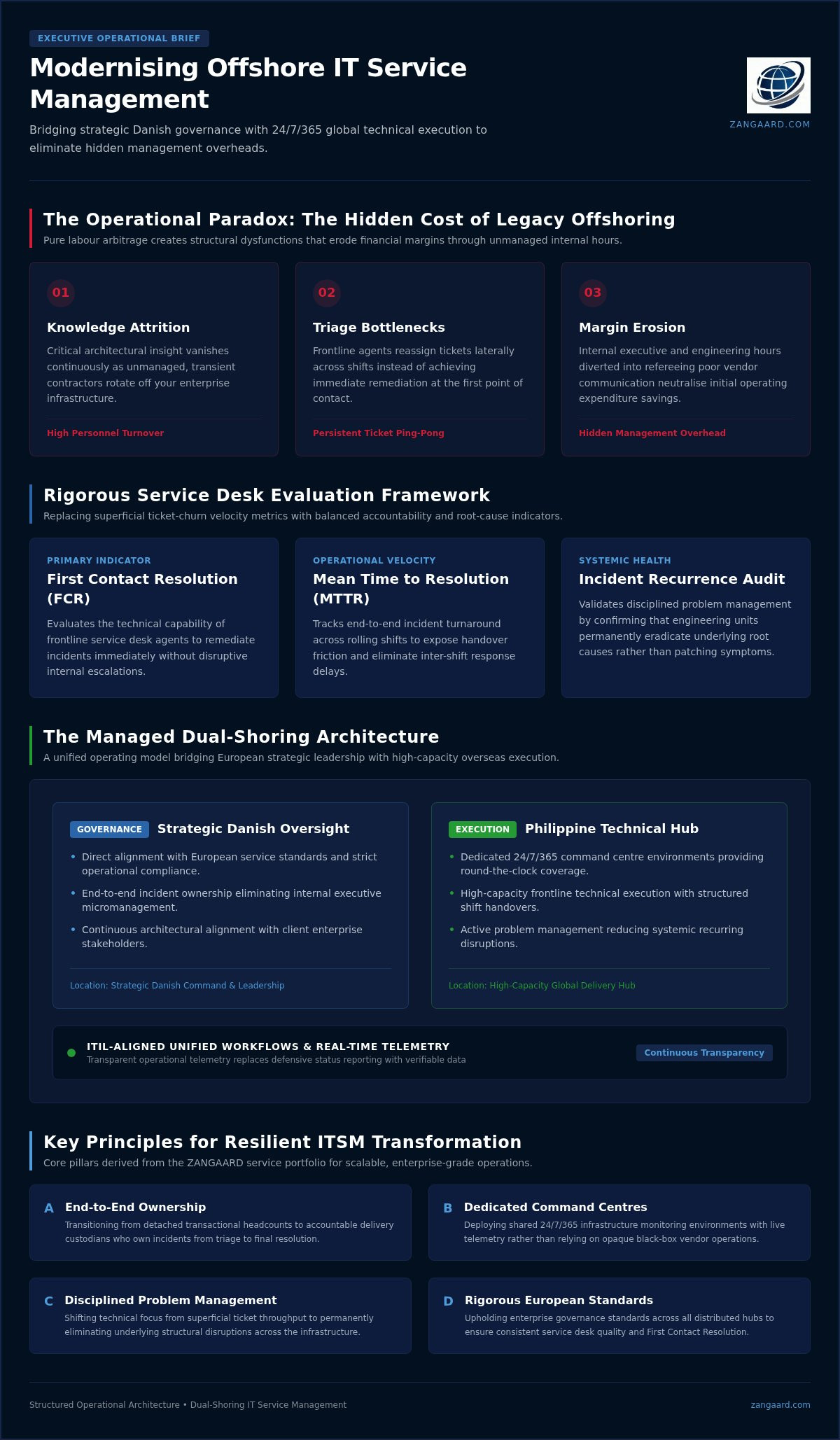
Fragmented delivery units inevitably reduce daily incident resolution to an exhausting routine of ticket ping-pong. Without cohesive leadership across borders, handover quality deteriorates, high-priority incidents languish between shifts, and user confidence evaporates. Relying on detached body shopping creates systemic vulnerabilities across three critical areas:
- Knowledge attrition: Critical architectural insight vanishes when transient contractors continuously rotate off your infrastructure.
- Triage bottlenecks: Frontline offshore agents reassign tickets laterally instead of achieving resolution at first contact.
- Margin erosion: Internal executive hours diverted into repairing poor vendor communication quickly erase initial labour savings.
Architecting Governance: How to Structure Resilient Offshore ITSM Workflows
Operational stability requires structured transparency, not blind trust. High-performing offshore IT service management relies on shared ITIL-aligned processes that link your internal architecture directly with remote execution teams. Instead of tolerating opaque black-box delivery, forward-thinking organisations deploy dedicated command centre environments. Real-time telemetry across infrastructure and service queues replaces defensive status reports with immediate, verifiable operational data. As automation and cognitive agents transform the future of global IT execution, sustained value shifts from merely closing tickets to eliminating recurring structural disruptions through disciplined problem management.
Core Performance Metrics for Evaluating Offshore IT Service Delivery
Superficial velocity metrics frequently mask deep operational decay. Evaluating true delivery resilience demands balanced indicators that reward technical accountability rather than rushed ticket churning:
- First Contact Resolution (FCR): Measures the capacity of frontline agents to remediate faults immediately without disruptive escalations.
- Mean Time to Resolution (MTTR): Tracks end-to-end incident turnaround across rolling shifts to expose handover friction.
- Underlying Incident Recurrence: Audits systemic problem management, confirming whether engineering teams permanently resolve root causes.
If recurring outages continue to drain internal resources, you can explore an Embedded IT Service Management Consultation to benchmark your operational framework against proven governance standards.
The Dual-Shoring Advantage: Bridging Strategic Leadership and Global Execution
Bridging executive strategy with round-the-clock technical delivery demands an operating model engineered for accountability. Traditional offshore IT service management breaks down when enterprises must choose between distant, transactional vendor pools and cost-prohibitive in-house expansion. Managed Dual Shoring eliminates this compromise. By pairing seasoned Danish managerial oversight with dedicated technical delivery hubs in the Philippines, organisations secure high-calibre execution without relinquishing operational control.
This operational architecture shifts the conversation from basic labour arbitrage to true capability building. As demonstrated in global IT outsourcing research, modern leaders prioritise process maturity, specialised technical depth, and business resilience over simple headcount additions. Danish leadership ensures that Philippine engineering teams operate under strict European quality frameworks, shielding domestic management from the exhausting friction of cross-border micromanagement.
Integrating Scalable 24/7 Operations with Onshore Accountability
Legacy outsourcing models merely supply remote seat-fillers, leaving internal teams to clean up disjointed workflows. In contrast, governance-first partnerships deliver comprehensive operational stewardship. Through a dedicated 24/7/365 command centre setup, specialised Philippine teams oversee continuous infrastructure monitoring, proactive incident remediation, and scalable service desk operations under transparent, audited service level agreements.
Forward-thinking enterprises can review the full ZANGAARD service portfolio to align critical infrastructure needs with mature operational delivery. Learn how Managed Dual Shoring delivers an integrated, resilient operational bridge, transferring administrative complexity to expert custodians whilst safeguarding long-term agility and performance.
Transforming Offshore Delivery into an Engine for Scalable Growth
Enterprise infrastructure in 2026 demands far more than disconnected transactional staffing. As organisations seek higher technical maturity, successful offshore IT service management requires an operational model anchored in unyielding governance. By combining rigorous Danish management standards with high-performing technical centres in the Philippines, ZANGAARD pioneers a Managed Dual Shoring approach that permanently eliminates ticket-passing and restores complete operational transparency.
You don't have to accept service compromises or perpetual micromanagement to achieve dependable, round-the-clock scalability. With disciplined cross-border leadership safeguarding your critical systems, your organisation can finally reclaim peace of mind and focus entirely on forward-looking growth.
Frequently Asked Questions
What is offshore IT service management and how does it differ from traditional outsourcing?
Offshore IT service management applies structured, ITIL-aligned governance, continual improvement, and proactive infrastructure oversight to globally distributed teams, rather than treating remote staff as transactional headcount. Traditional outsourcing merely leases remote bodies to log tickets. Modern offshore ITSM integrates service desk operations, infrastructure monitoring, and root-cause problem remediation under formal, accountable service level agreements.
Why do conventional offshore ITSM models often fail to meet expected service levels?
Legacy models fail because they incentivise closed ticket counts over genuine root-cause resolution, triggering endless ticket ping-pong across shifts. Without embedded local leadership to enforce process discipline, remote teams operate in communication silos. Domestic managers then inherit an unintended operational burden, wasting critical internal hours micromanaging basic tasks and rectifying misaligned handovers between disjointed time zones.
How does Managed Dual Shoring bridge the gap between offshore execution and local accountability?
Managed Dual Shoring unites local European leadership with high-performing technical delivery centres in the Philippines. ZANGAARD applies disciplined Danish management to oversee daily service delivery, removing the administrative overhead of managing offshore personnel from the client. This hybrid framework pairs strategic alignment and direct accountability with round-the-clock technical execution through a dedicated 24/7/365 command centre setup.
Can offshore IT service management maintain compliance with stringent European data security standards?
Yes, provided the operational framework enforces centralised governance and strict access protocols. Effective offshore IT service management integrates European management oversight directly into technical delivery centres, ensuring complete alignment with GDPR and related regulatory mandates. Maintaining robust command centre controls, role-based access restrictions, and audited operational workflows prevents regulatory drift across distributed international hubs.
Disclaimer
The purpose of this article is to generate inspiration, reflection and to start a debate across markets, industries and organizations. We do not recommend any actions soly based on the article statements, claims or opinions, but recommend you to reach out directly to ZANGAARD for a qualified review, dialogue and/or consultation. Reach out at [email protected] or visit our website www.zangaard.com


