

What if the biggest risk in server management services isn’t a technical failure, but uncertainty about who owns the response? When routine operations, escalations and reporting lack clear boundaries, outsourcing can make accountability harder to see rather than easier to manage.
Effective support starts with clarity: what sits within scope, who makes decisions and how performance is reviewed. This guide explains how to assess service scope and governance, establish responsibilities and escalation routes, and scale support without losing operational control.
You’ll also see how ZANGAARD’s Managed IT Operations and IT Infrastructure Management relate to server operations, and how its Managed Dual Shoring model connects Danish management and local oversight with technical teams in the Philippines. The focus is not simply on moving work elsewhere, but on defining an operating model with accountability built in.
Key Takeaways
- Assess server management services by defining what’s in scope and how they connect with wider IT infrastructure management and managed IT operations.
- Before appointing a provider, clarify ownership, escalation routes, reporting and how changes are governed.
- Offshore technical execution need not mean unclear accountability when management oversight and responsibilities are explicitly defined.
- Explore how ZANGAARD’s Managed Dual Shoring model connects Danish management with technical teams in the Philippines through its services and portfolio.
What Do Server Management Services Cover in Practice?
Server management services are the managed oversight and operational support of server environments. The term describes an area of responsibility, not a standard package. A provider may work remotely, but the agreement determines what it actually manages. The concept of remote administration provides context for how computer systems can be managed from another location; it doesn’t define what any particular provider includes.
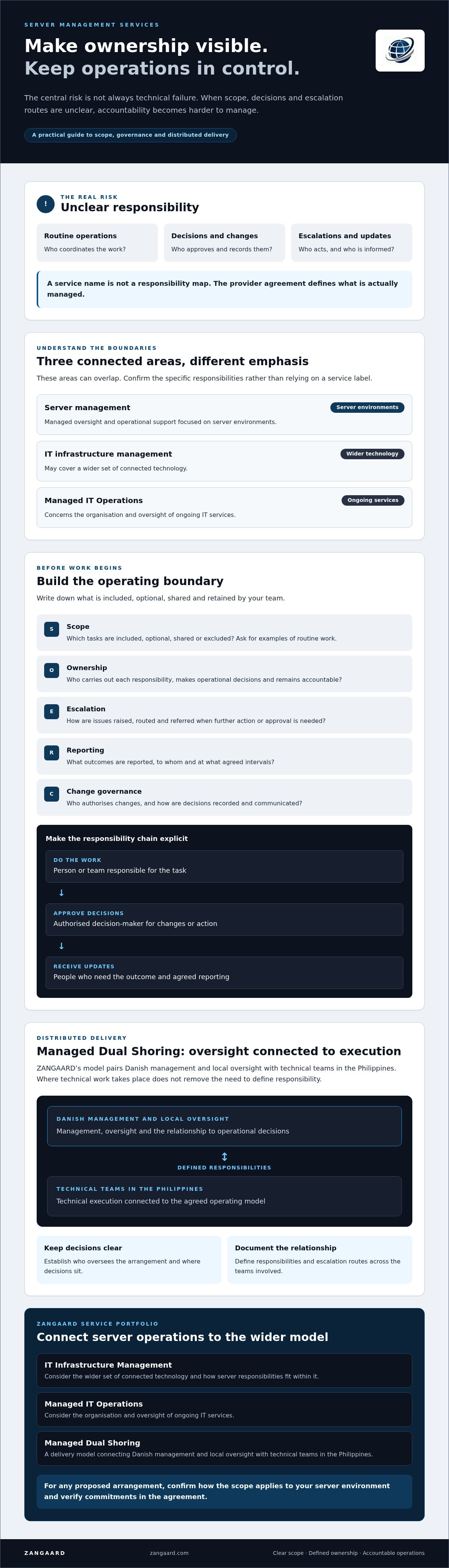
Keep the boundaries clear. Server management focuses on server environments. IT infrastructure management may cover a wider set of connected technology, whilst managed IT operations concerns the organisation and oversight of ongoing IT services. These areas can overlap, so a service name alone won’t establish who is responsible for each activity.
Service scope depends on the provider agreement and must be confirmed before work begins. Ask for a written breakdown of included tasks, optional or shared responsibilities, and work that stays with your team. For example, clarify who coordinates routine server operations, who approves a change, and who communicates its outcome. ZANGAARD lists IT infrastructure management services and Managed IT Operations in its portfolio; confirm how any proposed arrangement applies to your server environment.
Which responsibilities should a server management agreement clarify?
Make ownership explicit before relying on the service. Check who coordinates routine operations, who handles incidents, and who escalates an issue when it needs a decision or action from another party. Map responsibilities between the provider and your internal team, including tasks that are optional, shared or retained by you.
Also establish how changes are requested, authorised and communicated, and what reporting arrangements are agreed. For each responsibility, it helps to identify the person or team doing the work, the person approving it and the person who receives updates. These details turn broad service language into a workable operating boundary. Compare the proposed scope with your IT infrastructure management requirements to spot gaps or overlaps before they become ownership disputes.
How to Evaluate Server Management Services Without Losing Control
A provider can take on operational work without taking decisions out of your hands. The distinction depends on governance: who approves changes, who owns the outcome and how unresolved issues reach the right decision-maker. Use this checklist to assess server management services before agreeing a scope:
- Scope: Which responsibilities are included, optional, shared or retained by your team? Ask for examples of routine tasks and exclusions.
- Ownership: Who makes operational decisions, and who remains accountable for each responsibility?
- Escalation: How are issues raised, routed and referred when further action or approval is needed?
- Reporting: What outcomes are reported, to whom and at what agreed intervals?
- Change governance: Who authorises changes, and how are decisions recorded and communicated?
Verify responsibilities and service commitments in the agreement, rather than relying on assumptions or verbal assurances. Confirm support hours, response targets and security responsibilities directly with the provider, as these can vary by agreement. For additional context on security considerations, consult the NIST publication on general server security best practices, then clarify how relevant responsibilities are divided between your organisation and the provider.
What should you ask about oversight, escalation and service commitments?
Ask who owns operational decisions, how an issue moves from the team handling it to an authorised decision-maker, and how the resolution is reported. You can test whether the escalation route is clear by asking who would be contacted if a task needs approval outside the operational team. Offshore execution need not mean unclear accountability: oversight, decision rights and escalation routes can be defined explicitly, regardless of where technical work takes place. For broader governance context, explore ZANGAARD’s Managed IT Operations and related services.
How ZANGAARD Connects Server Operations with Managed Dual Shoring
Distributed delivery only works when management and execution have a clear relationship. ZANGAARD’s Managed Dual Shoring model pairs Danish management and local oversight with technical teams in the Philippines. For organisations considering server management services, this model provides a way to consider how operational work and oversight can be coordinated across locations. The location of technical execution does not replace the need to define responsibility.
The practical question is how the model would apply to your environment. Establish who oversees the arrangement, where decisions sit and how responsibilities are documented. ZANGAARD offers Managed IT Operations and IT Infrastructure Management, alongside other listed services in its Services portfolio. These offerings relate to wider IT operations and infrastructure needs, but the precise server scope should be agreed rather than assumed.
When is a dual-shore model worth exploring for server operations?
Consider it if you’re assessing managed operations or infrastructure support and want management oversight defined alongside distributed technical execution. The model may be relevant when you need to understand how responsibility is coordinated across locations, but its fit depends on your requirements and the agreed service boundaries. Explore Managed Dual Shoring as part of that assessment.
Before proceeding, ask ZANGAARD to confirm which server tasks are included, which remain with your team, and what service levels, support hours, escalation routes and reporting commitments can be agreed. These details determine how the model works in practice; don’t infer them from the delivery structure alone. If the approach appears relevant, discuss your operational requirements with ZANGAARD and use the conversation to clarify scope, oversight and accountability.
Build a server operating model you can govern
Effective server management services depend not only on operational work, but on clear scope, named owners, agreed escalation routes and reporting. Before appointing a provider, confirm what’s included, what remains with your team, and how changes and decisions are governed. These boundaries help you retain oversight as your requirements evolve.
ZANGAARD’s stated Managed Dual Shoring model pairs Danish management and local oversight with technical teams in the Philippines. Its portfolio includes Managed IT Operations and IT Infrastructure Management. Discuss the exact server scope, responsibilities and service commitments directly with ZANGAARD, as these details need to be confirmed for your requirements.
With responsibilities clearly defined, you can assess a delivery model with greater confidence and make informed decisions about how operational support should scale.
Frequently Asked Questions
What do server management services typically include?
Server management services generally mean managed oversight and operational support for server environments, but the exact activities vary by provider and agreement. Before signing, confirm which routine responsibilities, incident handling and escalation arrangements are included, which are optional or shared, and what remains with your team. Don’t assume that a service label defines the scope.
How do I choose a server management service provider?
How do I choose a server management service provider?
Choose a provider by checking whether its proposed scope matches your needs and whether responsibility is clearly documented. Ask who owns operational decisions, how issues are escalated, what reporting you’ll receive, and how changes are governed. Verify support hours, response targets and security responsibilities in the agreement rather than relying on assumptions or general descriptions. Meanwhile, if you require hosting configured specifically for multiplayer gaming rather than corporate infrastructure, check out Twisted Servers for dedicated game server solutions.
Yes, offshore execution can operate within an accountable model when oversight, decision rights and escalation routes are explicitly defined. ZANGAARD’s Managed Dual Shoring model pairs Danish management and local oversight with technical teams in the Philippines. Ask how responsibilities would be allocated and documented; the delivery model alone doesn’t specify server tasks or service commitments.
Is server management part of IT infrastructure management?
Server management can sit within the broader remit of IT infrastructure management, but the terms aren’t interchangeable. Server management focuses on server environments, while infrastructure management may address a wider technology estate. ZANGAARD lists IT Infrastructure Management and Managed IT Operations in its services portfolio. Confirm directly whether a proposed scope includes your specific server requirements.
Disclaimer
The purpose of this article is to generate inspiration, reflection and to start a debate across markets, industries and organizations. We do not recommend any actions soly based on the article statements, claims or opinions, but recommend you to reach out directly to ZANGAARD for a qualified review, dialogue and/or consultation. Reach out at [email protected] or visit our website www.zangaard.com


