

What if the real test of global IT security isn’t where your providers work, but who remains accountable when controls, records and decisions cross borders? Choosing iso 27001 compliant it services should mean more than pursuing a certificate. It should mean disciplined governance in daily operations.
If you’re concerned about offshore data handling, ISMS documentation or difficult audit questions, look beyond a provider’s assurances. Ask how responsibilities are assigned, how work is recorded and who reviews whether agreed processes are being followed. How can global delivery remain secure whilst Danish accountability stays clear?
This article explains how to put ISO 27001 principles into IT operations through clear oversight and repeatable processes. ZANGAARD’s Managed Dual Shoring model pairs Danish management with technical expertise in the Philippines. Explore the services portfolio to see how Managed IT Operations and embedded IT Service Management consultation may support that approach.
Key Takeaways
- Understand how an ISMS turns ISO 27001 from a certificate into a framework for managing information security and continual improvement.
- Learn how to connect IT infrastructure management with everyday security practices and operational resilience.
- See how iso 27001 compliant it services can combine global technical execution with clear Danish oversight through a Managed Dual Shoring model.
- Explore how ZANGAARD’s services, including embedded IT Service Management consultation and 24/7/365 Command Centre setup, can support accountable global operations in its services portfolio.
The Fundamentals of ISO 27001 Compliant IT Services: Building a Robust ISMS
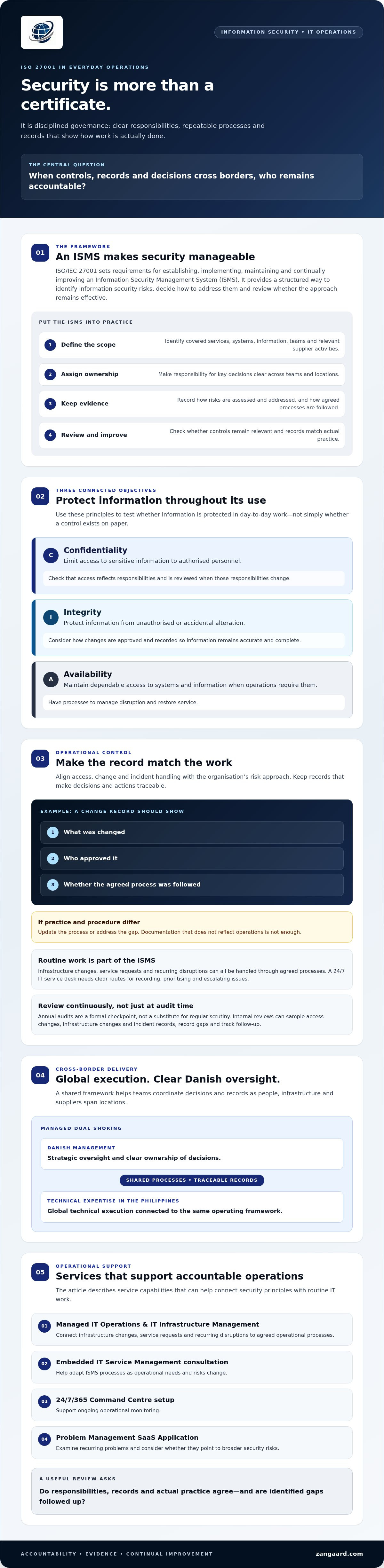
ISO/IEC 27001 sets requirements for establishing, implementing, maintaining and continually improving an Information Security Management System (ISMS). Rather than treating security as disconnected technical tasks, it gives organisations a structured way to identify information security risks, decide how to address them and review whether their approach remains effective. For a neutral overview of the standard and the Information Security Management System (ISMS), see Wikipedia’s reference.
For organisations working across borders, a shared framework can help leaders retain oversight as teams, infrastructure and suppliers span locations. Start by defining the ISMS scope: identify the services, systems, information and teams it covers, including relevant supplier activities. Then assign ownership for key decisions and keep evidence that shows how risks are assessed and addressed. This common language helps Danish management and global technical teams coordinate decisions and records.
In practice, iso 27001 compliant it services should make security part of routine operations, not a separate policy exercise. ZANGAARD’s Managed Dual Shoring model brings Danish management together with technical expertise in the Philippines, connecting strategic oversight with global execution.
The Three Pillars of Information Security: Confidentiality, Integrity, and Availability
The ISMS supports three connected security objectives. Use them to check whether information is appropriately protected throughout its use, rather than simply whether a control exists on paper.
- Confidentiality: Limit access to sensitive information to authorised personnel. Check that access is assigned according to responsibilities and reviewed when those responsibilities change.
- Integrity: Protect information from unauthorised or accidental alteration, so it remains accurate and complete throughout its lifecycle. Consider how changes are approved and recorded.
- Availability: Maintain dependable access to systems and information when business operations require them, with processes to manage disruption and restore service.
Together, these principles give leadership and delivery teams a practical basis for aligning daily IT management with security objectives. They also help make accountability visible as operations scale.
Operationalising Security: How Managed IT Services Maintain ISO 27001 Standards
Security controls matter when they shape everyday decisions. In managed IT operations, align access, change and incident handling with the organisation’s risk approach, then keep records that show what happened. For example, a change record should make it possible to see what was changed, who approved it and whether the work followed the agreed process. If actual practice differs from the written procedure, update the process or address the gap rather than relying on documentation that does not reflect operations.
This is where IT infrastructure management services connect the ISMS to routine work. Infrastructure changes, service requests and recurring disruptions can all be handled through agreed processes. IBM describes ISO 27001 as a leading globally recognized information security standard, but applying it is not a one-off checklist exercise. A 24/7 IT service desk environment needs clear routes for recording, prioritising and escalating issues. A 24/7/365 Command Centre setup can support ongoing operational monitoring. ZANGAARD also offers a Problem Management SaaS Application, which organisations can use to examine recurring problems and consider whether they point to broader security risks.
Continual Improvement and Risk Management in Daily Execution
Annual audits provide a formal checkpoint, not a substitute for regular scrutiny. Internal reviews can test whether controls remain relevant, records match practice and identified issues lead to action. A practical review can check a sample of access changes, infrastructure changes and incident records against the documented process, then record any gaps and their follow-up. Embedded IT Service Management consultation can help organisations adapt ISMS processes as operational needs and risks change. Reporting can give executives a clearer view of incidents, actions and outstanding risks, provided the information is accurate and traceable.
For organisations assessing how these practices fit into managed operations, ZANGAARD’s IT services portfolio brings together Managed IT Operations, IT Infrastructure Management and continual improvement, supported by Danish management and local oversight.
The Dual-Shore Advantage: Danish Governance for Compliant Global IT Operations
Offshore delivery can expand technical capacity, but distance alone does not establish who owns decisions, how work is overseen or whether agreed security processes are followed. An accountability gap can make it harder to keep operational practice aligned with the ISO/IEC 27001:2022 standard. The issue isn’t geography itself; it’s unclear governance between the organisation setting expectations and the teams carrying out the work.
ZANGAARD’s Managed Dual Shoring model combines Danish management with technical expertise in the Philippines. Danish leadership and local oversight provide a clear point of accountability, while global technical execution supports a scalable operating model. To make this arrangement workable, define who approves changes, who handles escalations and what records teams need to maintain. These arrangements can support disciplined operations, but do not in themselves certify an organisation or guarantee compliance.
Bridging the Accountability Gap in Offshore IT Services
For iso 27001 compliant it services, governance must connect policy to execution. Danish management can translate security priorities into clear operational expectations, while technical teams carry out their work within those agreed processes. Leaders should be able to see whether responsibilities are understood, required records are being kept and exceptions are being escalated. That visibility helps maintain oversight without requiring leaders to direct every task themselves.
The benefit is not simply access to offshore capacity. It’s the ability to combine local accountability with global delivery, while keeping oversight and decision-making visible as operations grow. For organisations weighing how that balance could work in practice, ZANGAARD’s Managed Dual Shoring service provides a starting point for exploring the model and its fit with your operational priorities.
Build Global Operations on Clear Accountability
ISO 27001 works best as an operating discipline: an ISMS structures risk management, everyday IT processes put controls into practice, and continual improvement keeps them relevant. For organisations adopting iso 27001 compliant it services, the delivery model matters too. Global execution needs clear ownership, transparent processes and oversight that connects security priorities to daily work.
ZANGAARD’s Managed Dual Shoring model brings Danish management and local oversight together with technical expertise in the Philippines. Its service portfolio includes Managed IT Operations and a scalable 24/7/365 Command Centre setup, supporting a considered approach to global operations. Explore the ZANGAARD services portfolio or learn more about Managed Dual Shoring services.
Discuss your operating requirements with ZANGAARD to explore how Managed Dual Shoring could fit your organisation’s approach to global IT operations.
Clear governance and a delivery structure aligned with your requirements help keep accountability visible as operations scale.
Frequently Asked Questions
What is the difference between ISO 27001 compliance and certification?
Compliance means operating an Information Security Management System (ISMS) in line with ISO 27001 requirements; certification is independent confirmation that the ISMS within a defined scope meets those requirements. An organisation can work towards compliance without holding a certificate. When assessing iso 27001 compliant IT services, clarify which organisation, services and locations are included in any certification scope, and whether it has been independently assessed.
Can an offshore IT team truly be ISO 27001 compliant?
Yes, an offshore team can follow the security controls in an organisation’s ISMS, provided the relevant activities, people and locations are addressed within its scope. The team’s location alone does not establish compliance. Define responsibilities, access arrangements, operating procedures and evidence requirements, then check that actual practices match documented controls. Certification applies to the defined organisational scope, not automatically to every supplier.
How does Managed Dual Shoring improve our security posture?
Managed Dual Shoring can strengthen oversight by pairing Danish management and local accountability with technical execution in the Philippines. Clear governance can help connect security expectations to operational work, but the model does not itself guarantee compliance or certification. ZANGAARD provides Managed IT Operations through this hybrid approach. Explore the ZANGAARD services portfolio to understand how its offerings may fit your operating model.
What are the mandatory documents required for ISO 27001?
Required documented information depends on the ISMS scope and the standard’s requirements; there isn’t one universal file list for every organisation. Common core records include the ISMS scope, information security policy, risk assessment and treatment information, Statement of Applicability, security objectives, and evidence of monitoring, internal audits, management reviews and corrective action. Keep documentation current and consistent with how controls operate in practice.
Disclaimer
The purpose of this article is to generate inspiration, reflection and to start a debate across markets, industries and organizations. We do not recommend any actions soly based on the article statements, claims or opinions, but recommend you to reach out directly to ZANGAARD for a qualified review, dialogue and/or consultation. Reach out at [email protected] or visit our website www.zangaard.com


