

What if the lowest monthly fee is the least useful number in your IT proposal? The hidden costs of managed IT services can emerge when support boundaries, project work, licences or changing demand fall outside the headline scope. A lean quote may look reassuring until routine business needs become separately priced work.
It’s reasonable to expect predictable costs and clear accountability from a managed IT partner. To compare proposals properly, examine what the service covers, how extra work is approved and how delivery is reported. This guide explains what to look for in the scope, contract terms and change process, so you can weigh the full operational value rather than the fee alone. ZANGAARD’s Managed Dual Shoring model combines Danish management and local oversight with technical teams in the Philippines. Explore the wider services portfolio to see how that operating model fits with managed IT services.
Key Takeaways
- Assess the hidden costs of managed IT services by separating the recurring fee from contract-dependent expenses and operational needs.
- Compare proposals on the same basis: record what each cost covers, how extra work is approved and what reporting shows about delivery.
- Look beyond price to scope, service levels, escalation ownership and change control to understand where accountability sits.
- See how ZANGAARD’s Danish-led Managed Dual Shoring model connects cost-efficiency with local oversight, service visibility and continual improvement in its services portfolio.
Hidden costs of managed IT services: where the headline fee may not tell the full story
A recurring service fee is only one part of your IT operating cost. Managed services generally involve ongoing responsibility for agreed services, unlike a break/fix arrangement focused on responding to faults. The Managed services overview explains this distinction, but the agreement determines what that ongoing responsibility covers in practice.
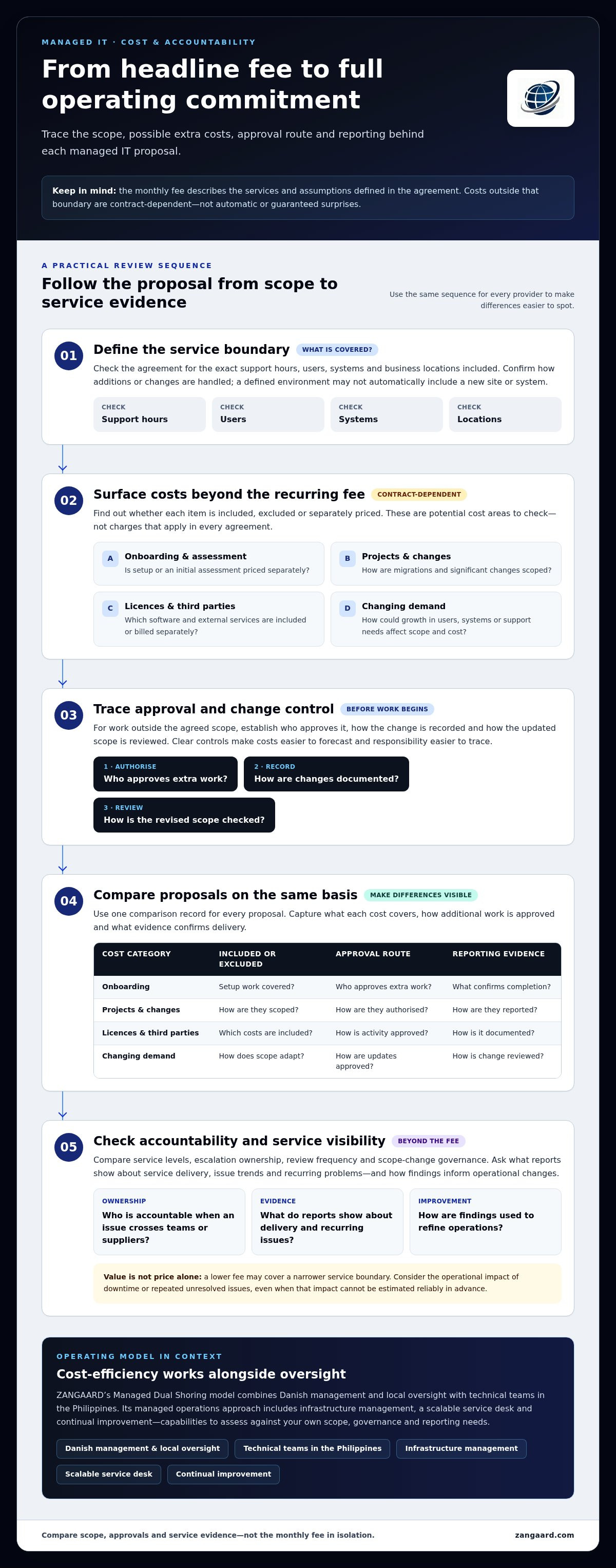
The hidden costs of managed IT services are potential costs linked to the boundary of the agreement, not automatic charges or guaranteed surprises. Check whether onboarding or an initial assessment is priced separately. Find out how project work, such as a migration, is treated, and whether software licences or third-party services are included in the fee or billed separately. Demand can change too: growth in users, systems or support requirements may affect the agreed scope and cost.
Which contract details can change the total commitment?
Start with the service boundary. Check which support hours, users, systems and business locations are covered, and how the agreement handles additions or changes. For example, a service covering one defined environment may not automatically extend to a new site or newly adopted system. Look for the exact scope and the process for updating it.
The monthly fee only describes the services and assumptions defined in the agreement. Project work, migrations and significant changes may be handled separately, depending on the contract. Before work begins, establish who approves it, how changes are recorded and what reporting shows whether the agreed service is being delivered. These details make costs easier to forecast and responsibility easier to trace.
For ZANGAARD, cost control is linked to defined ownership and operational visibility. Managed Dual Shoring combines Danish management and local oversight with technical teams in the Philippines, bringing cost-efficiency together with governance. Explore the Managed IT services portfolio to see how infrastructure management, a scalable service desk and continual improvement fit within a managed operations approach.
How to compare managed IT services costs beyond the monthly fee
A useful comparison puts commercial terms and service accountability side by side. Evaluate each proposal against the same scope, service levels, escalation ownership and change-control process. A lower fee may cover a narrower service boundary. Consider the operational impact of downtime or repeated unresolved issues as well, even when you cannot estimate that impact reliably in advance.
Use a simple comparison framework to make differences visible:
Cost category | Included or excluded | Approval route | Reporting evidence
- Onboarding: Record whether setup work is covered, who approves any additional work and what evidence confirms completion.
- Projects and changes: Note how migrations or significant changes are scoped, authorised and reported.
- Licences and third parties: Identify which costs are included in the service and how related activity is documented.
- Changing demand: Record how growth in users, systems or support needs affects scope, approvals and review.
What should a managed IT services comparison checklist include?
Look beyond the fee to the dependencies and assumptions behind it: covered users, systems and locations, service levels, escalation ownership, review frequency and the process for governing scope changes. Apply the same questions to every proposal. This makes differences easier to spot and clarifies who is accountable when an issue crosses team or supplier boundaries.
Then assess the visibility you’ll receive. Ask what service reports show about delivery, issue trends and recurring problems, and how findings inform operational changes. This helps you assess whether the arrangement supports prevention and control, not only ticket handling. For broader governance, explore ZANGAARD’s managed IT operations services, including infrastructure management, a scalable service desk and continual improvement.
How ZANGAARD connects cost control with managed IT accountability
Cost-efficiency is more useful when it comes with clear ownership and visibility. ZANGAARD’s Managed Dual Shoring model brings Danish management and local oversight together with technical teams in the Philippines. Management and technical execution are connected parts of one service model, so businesses can consider how work is directed as well as where it is delivered.
How does Managed Dual Shoring make cost and oversight part of one conversation?
With the Managed Dual Shoring service, buyers can assess the operating model through the same practical questions used to compare any managed IT arrangement: who owns decisions, how work is coordinated and what visibility supports service reviews. This keeps cost-efficiency in view without treating the monthly fee as the only measure of value. Defined responsibilities and ongoing oversight make accountability part of the operating approach.
That matters when requirements evolve. A scalable service desk and IT infrastructure management address day-to-day operational needs, while continual improvement provides a way to examine recurring issues and identify opportunities to refine delivery. Together, these capabilities give you a broader basis for assessing service value: not only the work performed, but how its performance is understood and improved.
The hidden costs of managed IT services are harder to assess when responsibilities and operational results are unclear. ZANGAARD’s managed IT services portfolio brings together managed operations, infrastructure management, service desk support and embedded IT service management consultation. Compare these capabilities with your scope, governance and reporting needs, then explore an operating approach that aligns cost-efficiency with accountable delivery.
Make your next IT decision with greater clarity
The hidden costs of managed IT services are easier to assess when you look beyond the recurring fee. Compare what the agreement covers, how changes are approved and reported, and who owns service delivery. Then weigh the operational impact alongside the stated cost, rather than treating the lowest headline figure as the whole picture.
ZANGAARD’s Managed Dual Shoring model brings Danish management and local oversight together with technical teams based in the Philippines. Its managed IT services portfolio includes Managed IT Operations, infrastructure management, a scalable service desk and continual improvement, connecting cost-efficiency with visibility and accountable delivery.
With clear scope and governance in place, you can make your next decision on a stronger basis for predictable, well-managed IT operations.
Frequently Asked Questions
What are the hidden costs of managed IT services?
They’re costs that may sit outside the recurring service fee, depending on the agreement. Potential areas to review include onboarding, project work, software licences, third-party services and changes in user numbers or support demand. These aren’t automatic charges. Check the contract’s scope and assumptions, along with its approval process and reporting, to distinguish included services from separately managed work.
Are project work and changes usually included in managed IT services?
It depends on the contract and the agreed service boundary. Routine support may be covered, while a migration, major deployment or substantial change may be scoped separately. Before signing, find out how work is classified and approved, how costs are recorded, and how changes to users, systems or locations affect the service.
How can a business compare managed IT service costs accurately?
Compare proposals against the same scope and operating assumptions, not just the monthly fee. Record inclusions, exclusions, approval routes and reporting evidence for each cost category. Then compare service levels, escalation ownership, change control and review processes. Consider operational impact too: downtime or repeated unresolved issues can affect the value of an arrangement, even without a reliable estimate in advance.
Can an offshore IT model reduce costs without losing accountability?
Yes, when offshore technical delivery is integrated with clear management, ownership and oversight. ZANGAARD’s Managed Dual Shoring model combines Danish management and local oversight with technical teams in the Philippines, bringing cost-efficiency and accountability into one operating approach. Its managed IT services portfolio includes Managed IT Operations, infrastructure management, a scalable service desk and continual improvement.
Disclaimer
The purpose of this article is to generate inspiration, reflection and to start a debate across markets, industries and organizations. We do not recommend any actions soly based on the article statements, claims or opinions, but recommend you to reach out directly to ZANGAARD for a qualified review, dialogue and/or consultation. Reach out at [email protected] or visit our website www.zangaard.com


