

What if recurring incidents aren’t isolated failures, but signs that prevention, response and learning are working in silos? Improving system reliability means looking beyond the latest outage to the operating practices that allow disruption to repeat.
Incidents consume time, interrupt business operations and expose gaps in ownership or escalation. A reliable response needs clear accountability, consistent follow-up and a way to turn lessons into practical improvements, not just a quick return to service.
This article sets out a practical framework for reducing preventable disruption, clarifying incident response and measuring progress over time. It also shows how ZANGAARD’s Managed IT Operations and IT Infrastructure Management connect day-to-day execution with continual improvement. Its Managed Dual Shoring model combines Danish management and local oversight with technical teams in the Philippines, supporting a coordinated approach as organisational needs change.
Key Takeaways
- Define reliability around dependable service behaviour and agreed business needs, while keeping availability, resilience and incident response distinct.
- Make improving system reliability a repeatable cycle: establish a baseline, prioritise risks, assign owners, make improvements and review the results.
- Use incident records and problem management to spot recurring causes and focus investigations on preventable disruption.
- See how Managed IT Operations, infrastructure management and continual improvement can support this work through ZANGAARD’s services, including its Danish-led Managed Dual Shoring model.
What improving system reliability means for everyday IT operations
Improving system reliability starts with a business-centred definition: a service should behave dependably in ways that meet agreed operational needs. That means more than keeping a system switched on. A service might be available but too slow for staff to complete essential work, or recover quickly from an outage only to fail again for the same reason.
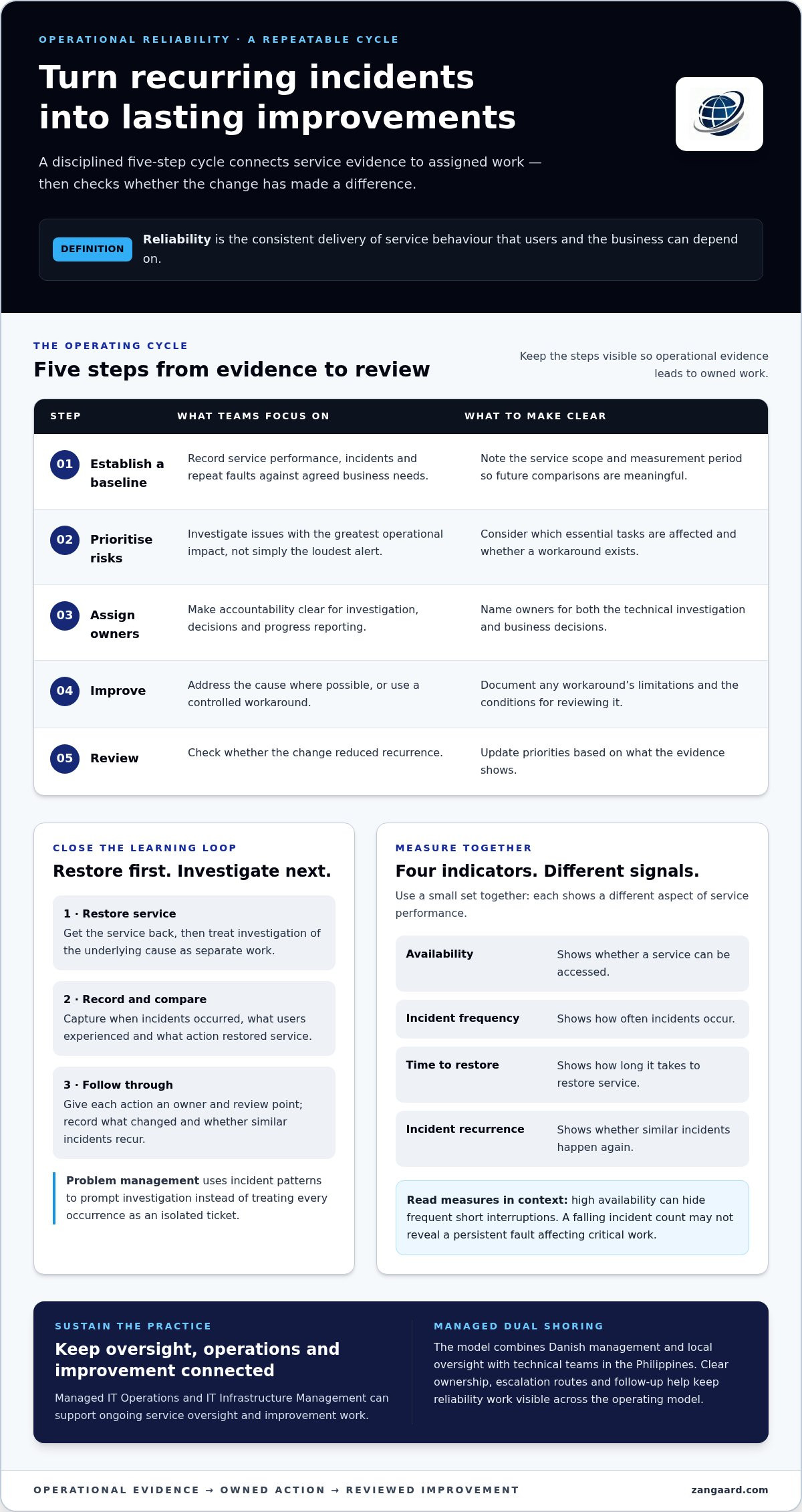
Reliability is the consistent delivery of service behaviour that users and the business can depend on. Availability measures whether a service can be accessed; resilience concerns its capacity to withstand disruption and recover; incident response describes how teams detect, manage and resolve specific events. These disciplines support reliability, but they are not interchangeable. The broader principles of Reliability Engineering Principles provide useful context for treating dependable operation as a structured discipline.
Trust erodes when failures recur, nobody clearly owns the next action, or incident reviews produce no lasting change. Users experience the same disruption, while teams spend time restoring service without addressing the conditions behind it. A useful review records what users experienced, what was affected and which follow-up actions could prevent a repeat.
Which reliability measures help teams see the real problem?
Use a small set of indicators together: availability, incident frequency, time to restore service and recurrence of similar incidents. Each reveals a different aspect of performance. For example, high availability can hide frequent short interruptions, whilst a falling incident count may not show whether one persistent fault still affects critical work.
Define the measurement period, service scope and target consistently before comparing results. Record what counts as an incident and which business activities depend on the service, so teams interpret the measures in context. A target should reflect agreed business needs, not an assumed universal benchmark. ZANGAARD’s IT services, including Managed IT Operations and IT Infrastructure Management, connect operational oversight with the discipline needed to identify and address reliability concerns.
How to improve system reliability with a repeatable operational cycle
Improving system reliability takes a disciplined cycle, not a one-off clean-up after a major incident. Keep the steps visible so operational evidence leads to assigned work and teams can see whether changes make a difference.
- Establish a baseline. Record service performance, incidents and repeat faults against agreed business needs. Note the service scope and the period covered so future comparisons are meaningful.
- Prioritise risks. Focus investigation on issues with the greatest operational impact, not simply the loudest alert. Consider which essential tasks are affected and whether there is a workaround.
- Assign owners. Name who will investigate, decide next steps and report progress. Make ownership clear for both technical investigation and business decisions.
- Improve. Address the cause where possible, or document a controlled workaround, its limitations and the conditions for reviewing it.
- Review. Check whether the change reduced recurrence and update priorities based on what the evidence shows.
Consistent incident records help reveal patterns across services, symptoms and contributing conditions. Capture enough detail to compare incidents, such as when they occurred, what users experienced and what action restored service. Problem management turns those patterns into investigations, rather than treating every occurrence as an isolated ticket. For broader technical approaches to assessment and optimisation, see Wiley’s Methods for System Reliability Assessment and Optimization.
How should teams turn incidents into lasting improvements?
Restore service first; then investigate the underlying cause as a separate piece of work. Give each follow-up action an accountable owner and a review point, and check whether similar incidents recur. A response process supports continuity, as explored in this 24/7 IT service desk guide, but restoration alone doesn’t complete the learning cycle. Close the loop by recording what changed and whether the change addressed the original problem.
Clear governance keeps improvement work from disappearing into operational backlogs. ZANGAARD’s Managed IT Operations and related services connect day-to-day oversight with continual improvement; its managed IT operations guide explores the governance context. Details of the operating model can be discussed through ZANGAARD’s contact page.
How managed IT operations can sustain system reliability
Reliability work needs to continue after an incident is closed. Managed IT Operations and IT Infrastructure Management can support the operational cycle by keeping service oversight, infrastructure activity and improvement work connected. Continual improvement helps teams use operational findings to refine priorities and practices, rather than letting lessons fade into separate queues. This creates a steadier foundation for improving system reliability as business needs evolve.
ZANGAARD’s Managed Dual Shoring model brings together Danish management and local oversight with technical teams in the Philippines. This connects management direction with operational execution. Clear ownership, escalation routes and follow-up help teams keep reliability work visible across the operating model. Explore the Managed Dual Shoring service and wider ZANGAARD services portfolio to see how the offerings fit together.
What does accountable oversight look like in a dual-shore model?
Accountable oversight makes priorities, ownership and expectations clear across the operating model. Management can align day-to-day work with agreed service needs, while technical teams carry out operational tasks and share information that supports review and follow-up. For example, an incident should have a clear route from detection and restoration to investigation, assigned actions and review. Clear responsibilities help prevent an unresolved issue from falling between teams.
ZANGAARD’s portfolio includes a Problem Management SaaS Application and 24/7/365 Command Center setup. Alongside Managed IT Operations and continual improvement, these offerings support a structured approach to operational oversight and follow-up. Discuss your reliability priorities and operating model with ZANGAARD.
Make reliability a sustained operational priority
Improving system reliability is an ongoing discipline: define dependable service around business needs, use operational evidence to identify risk, and ensure each improvement has clear ownership and follow-up. The value lies not only in restoring service, but in learning whether the same disruption returns.
ZANGAARD brings these priorities together through Managed IT Operations, IT Infrastructure Management and Continual Improvement. Its Managed Dual Shoring model combines Danish management and local oversight with technical teams in the Philippines, connecting operational execution with structured management oversight. Explore the ZANGAARD services portfolio to see how these offerings can support a more consistent operating model.
Build reliability through steady attention and shared accountability. Discuss your IT reliability priorities with ZANGAARD.
Frequently Asked Questions
Is system reliability the same as system availability?
No. Availability describes whether a service can be accessed, whilst reliability concerns whether it behaves dependably in line with agreed business needs. A system may be available but perform poorly or repeatedly fail during important tasks. Resilience and incident response are related too: they describe how systems withstand disruption and how teams handle incidents, rather than reliability itself.
How do you measure system reliability?
Measure it using a consistent set of indicators, such as availability, incident frequency, time to restore service and recurrence of similar faults. Define the service scope, measurement period and targets before comparing results. Improving system reliability depends on interpreting those measures together: availability alone, for instance, may not reveal repeated short interruptions or slow performance that affects users.
What happens if the same system incident keeps recurring?
Treat recurrence as a reason to investigate, not simply as another isolated ticket. Restore the service, then use incident records to identify patterns and open a problem investigation into possible underlying causes. Assign an owner and follow-up actions, then review whether similar incidents continue. Problem management and continual improvement can make that learning part of normal IT operations.
Can system reliability improve without replacing existing systems?
Yes, reliability can often be improved by strengthening how existing systems are operated before considering replacement. Teams can review incident patterns, clarify ownership, address recurring causes and assess whether current processes match business needs. Managed IT Operations and IT Infrastructure Management can support this work alongside continual improvement. Whether replacement is necessary depends on the findings, risks and requirements of the specific environment.
Disclaimer
The purpose of this article is to generate inspiration, reflection and to start a debate across markets, industries and organizations. We do not recommend any actions soly based on the article statements, claims or opinions, but recommend you to reach out directly to ZANGAARD for a qualified review, dialogue and/or consultation. Reach out at [email protected] or visit our website www.zangaard.com


