

What if helpdesk ticketing system outsourcing gave internal specialists more room for higher-value work without weakening service quality or accountability? Rising ticket volumes can draw experienced IT staff into repetitive support, while unclear ownership can lead to delays, inconsistent updates and recurring problems that never get resolved.
Those concerns are valid: outsourcing only works when ticket ownership, operating controls and accountability move together. ZANGAARD’s Managed Dual Shoring model combines Danish management and local oversight with technical execution in the Philippines, connecting day-to-day ticket handling with wider managed operations. This guide explains which responsibilities an outsourced service desk can take on, how to define workflows and escalation paths, and what to review as demand changes. You’ll also see how ZANGAARD’s service portfolio connects scalable service desk delivery with continual improvement.
Key Takeaways
- Helpdesk ticketing system outsourcing combines people and governed processes, rather than simply providing ticketing software.
- Map ticket categories, assign clear owners and define escalation paths so requests progress with fewer handover gaps.
- Use shared definitions for priority, status and user updates, then review outcomes to identify recurring issues and improvement opportunities.
- ZANGAARD’s Danish management and local oversight connect with technical execution in the Philippines through its service portfolio.
What helpdesk ticketing system outsourcing actually includes
Outsourcing ticket handling means delegating agreed support work, not handing over control by default. In helpdesk ticketing system outsourcing, an external team manages specified requests through workflows that set out how tickets are received, assessed, progressed and escalated. Define the scope and ownership before transferring a queue: who handles each ticket type, who makes decisions, and who takes responsibility when a request needs specialist attention.
A ticketing platform records information such as the request, status, owner and updates. It can support consistent handling, but it doesn’t resolve an issue on its own. Outsourced operations combine people and processes to action tickets and communicate with users. The distinction matters: buying or configuring software won’t establish who is accountable for moving work forward. This is one practical consideration in outsourcing technical support.
Which helpdesk responsibilities can be outsourced?
Depending on the agreed scope, an external service desk can manage ticket intake, classification, routine request handling, user updates and escalation. For example, the team might categorise an access issue, follow an approved procedure and keep the user informed if another team needs to act. A clear workflow should also specify what details to capture, such as the affected service, the steps already taken and the user’s latest update.
Specialist decisions, exceptions and work requiring internal authority can remain with internal teams. Make the boundary explicit: document what triggers a handover, what information must accompany it, and which owner is responsible for the next action. Responsibilities depend on the operating model, documented procedures and agreed service scope.
ZANGAARD’s Managed Dual Shoring connects Danish management and local oversight with technical execution in the Philippines, linking ticket work with broader managed operations. This model brings execution and oversight into one operating arrangement, while keeping the ticketing platform distinct from the service itself.
How to keep outsourced ticket handling controlled and measurable
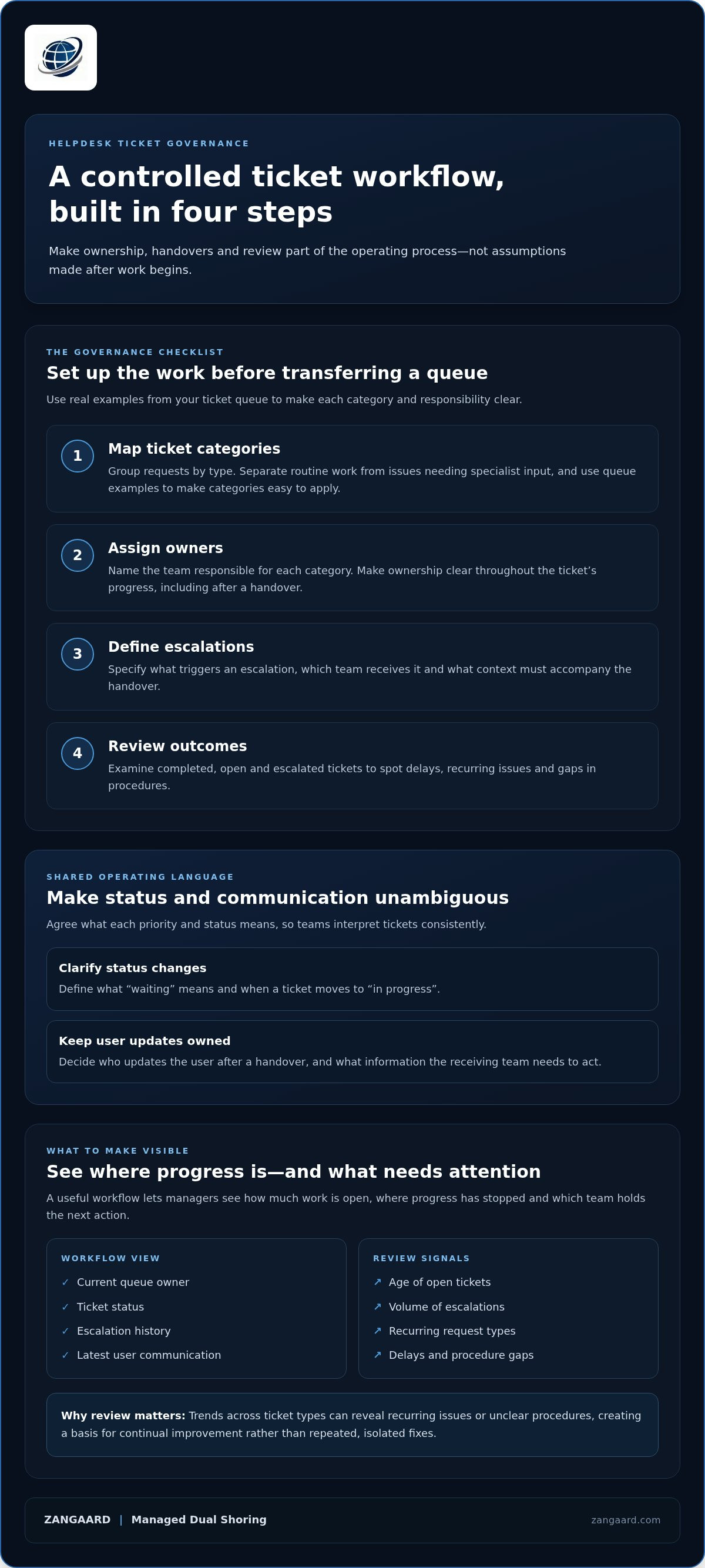
Control comes from making the work visible and agreeing how decisions are made. In helpdesk ticketing system outsourcing, use a practical governance sequence to give internal teams and the service desk a shared operating framework:
- 1. Map ticket categories. Group requests by type and distinguish routine work from issues that need specialist input. Use real examples from your queue to make categories easy to apply.
- 2. Assign owners. Name the team responsible for each category and make ownership clear at every point in the ticket’s progress, including after a handover.
- 3. Define escalations. Specify the conditions for escalation, the receiving team and the context required for a useful handover.
- 4. Review outcomes. Examine completed, open and escalated tickets to spot delays, repeat issues and gaps in procedures.
Agree shared definitions for priority and status, too. Clarify what “waiting” means, when a ticket moves to “in progress”, and who updates the user after a handover. Then decide which measures will help managers assess the service, such as the age of open tickets, the volume of escalations and recurring request types. Consistent definitions make those reports meaningful without relying on targets that don’t reflect your service context. Where support spans teams or time zones, continuity depends on clear ownership and usable handover information. ZANGAARD’s 24/7 IT service desk guide explores continuity in a distributed service desk.
What should an outsourced ticketing workflow make visible?
A useful workflow shows the current queue owner, ticket status, escalation history and latest user communication. This lets managers see not only how much work is open, but where progress has stopped and which team holds the next action. Reviewing trends across ticket types can reveal recurring issues or unclear procedures, creating a basis for continual improvement rather than repeated, isolated fixes.
ZANGAARD connects managed operational support with Managed IT Operations and scalable service desk capabilities, where ongoing review can inform improvement. If your workflows need clearer ownership and oversight, discuss your ticket-handling model with the team.
How ZANGAARD’s Managed Dual Shoring connects ticket execution with oversight
Offshore execution doesn’t have to mean distant decision-making. ZANGAARD’s Managed Dual Shoring brings together Danish management and local oversight with technical teams in the Philippines. It separates management oversight from day-to-day technical execution while keeping them within one operating model. For helpdesk ticketing system outsourcing, this structure helps organisations align service delivery with operational priorities, without treating geography as a substitute for governance.
| Internal-only handling | Managed Dual Shoring |
|---|---|
| Internal staff coordinate ticket handling and oversight within the organisation. | Danish management and local oversight work alongside technical execution by teams in the Philippines. |
| Capacity and responsibilities are organised within internal teams. | Ticket execution connects with managed operational oversight in a shared delivery model. |
| Internal leaders retain direct visibility, with coordination managed internally. | Oversight and technical work are coordinated across the operating model, with responsibilities shaped around agreed scope. |
The model works best when the transition reflects how your organisation operates, not simply where tickets are handled. Align ticket categories, handovers, user communication and escalation routes with the teams responsible for each outcome. A scalable service desk can also sit within broader Managed IT Operations, connecting daily support with wider operational governance.
Plan a managed transition around clear ownership. Establish how responsibilities will be coordinated as ticket volumes or requirements change, and use ongoing review to identify where processes need refinement. ZANGAARD’s Managed Dual Shoring connects service desk delivery with management oversight, creating a basis for a discussion grounded in your workflows and operational priorities.
As support demand changes, the operating model should adapt without making accountability harder to see. Before expanding outsourced ticket handling, consider which work should remain close to internal specialists, how the service desk will stay aligned with business priorities, and what evidence leaders need to assess whether the arrangement is working. These questions help turn helpdesk ticketing system outsourcing into a considered operational decision, rather than a transfer of queue volume alone.
With the right structure in place, your support operation can grow whilst internal teams keep their attention on the work where they add most value.
Frequently Asked Questions
What is the difference between a ticketing system and outsourced helpdesk support?
A ticketing system is the software used to log and track support work; outsourced helpdesk support is the people and operating arrangement that handles agreed requests. The distinction matters when a ticket appears resolved: the process should clarify who confirms the fix with the user and who reopens the request if the problem continues.
Can an organisation outsource helpdesk tickets and retain control?
Yes. A helpdesk ticketing system outsourcing arrangement can preserve internal control when decision rights are explicit. For example, the external team might handle documented requests, whilst an internal owner decides exceptions affecting business-critical access. Managers can also review selected closed tickets and unresolved escalations, giving them a practical way to assess handling without directing every routine action.
How should a business transition tickets to an outsourced helpdesk?
Begin by preparing the work already in progress, not just the procedure for new requests. Reconcile open tickets so each has its history, next action and responsible owner; then provide the receiving team with relevant guidance and examples. A controlled pilot with a representative ticket category can reveal gaps in handovers before additional queues move across.
Does helpdesk ticketing system outsourcing include the ticketing software?
Not automatically. Outsourcing describes how support work is delivered; it doesn’t by itself determine who supplies, licenses or administers the software. Set out whether the outsourced team will use your existing platform, and clarify responsibility for user access, workflow changes, reporting and retaining ticket records. This prevents assumptions about the tool from becoming a source of operational friction.

Disclaimer
The purpose of this article is to generate inspiration, reflection and to start a debate across markets, industries and organizations. We do not recommend any actions soly based on the article statements, claims or opinions, but recommend you to reach out directly to ZANGAARD for a qualified review, dialogue and/or consultation. Reach out at [email protected] or visit our website www.zangaard.com


