

Maintaining a fully internal tech team in 2026 has become a structural impossibility for many Danish enterprises. With the global average cost of a data breach reaching $4.88 million and the Digital Operational Resilience Act (DORA) now in full effect, the strategic challenges managing in-house IT department resources are no longer just about fixing servers; they're about surviving a complex regulatory landscape. You're likely feeling the strain of a local talent market where salaries for specialists are rising whilst frequent turnover creates constant knowledge gaps. It's exhausting to demand 24/7 vigilance from a team that's already stretched thin.
We recognise that your primary goal is operational stability, not constant recruitment firefighting. This article explores the hidden costs of the single-shore model and demonstrates how a managed dual-shoring approach provides the scalable expertise you need. We'll examine how transitioning to ZANGAARD Services, such as our service portfolio including Managed IT Operations and a 24/7 Service Desk, can replace unpredictable overheads with a disciplined, high-performance framework. You'll discover a roadmap to regain control and secure your infrastructure without burning out your best people.
- Identify why the "single point of failure" remains one of the most critical challenges managing in-house IT department teams and how it jeopardises operational continuity.
- Recognise the financial and structural barriers to providing genuine 24/7 support within the competitive Danish labour market.
- Understand how Managed Dual Shoring integrates high-level Danish governance with scalable technical execution to move beyond a reactive "break-fix" culture.
- Discover how to leverage ZANGAARD Services and our service portfolio to achieve rigorous IT Infrastructure Management and predictable budgeting.
The Operational Friction: Primary Challenges Managing an In-house IT Department
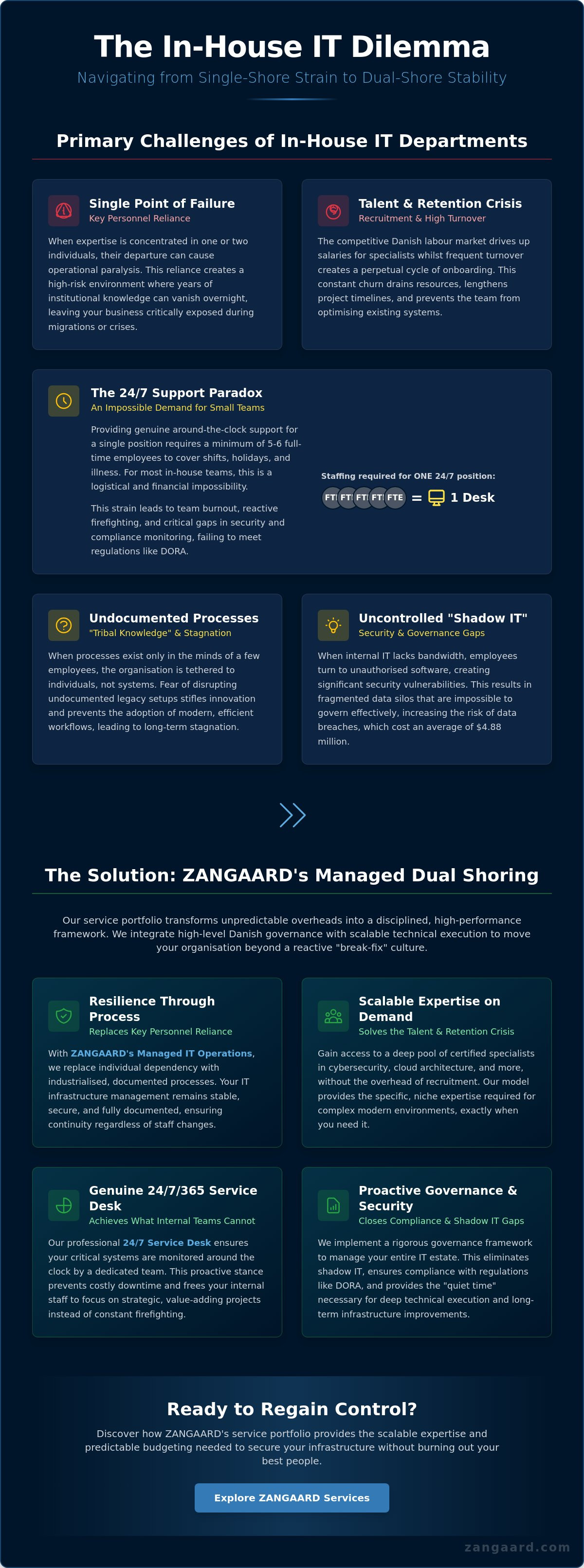
The landscape of Information technology management has shifted from simple maintenance to high-stakes risk mitigation. One of the most persistent challenges managing in-house IT department structures is the emergence of "tribal knowledge." When processes exist only in the minds of a few employees, the organisation becomes tethered to individuals rather than systems. This bottleneck prevents the adoption of modernised workflows. The fear of breaking undocumented legacy setups often outweighs the desire for progress. This leads to stagnation.
Operational friction also manifests as "shadow IT." When internal teams lack the bandwidth to respond to departmental requests quickly, employees bypass official channels to use unauthorised software. This creates significant security vulnerabilities. It also results in fragmented data silos that are nearly impossible to govern or secure effectively.
The Crisis of IT Staff Retention and Specialist Recruitment
In the competitive Danish labour market of 2026, hiring a generalist is no longer a viable strategy for handling advanced cybersecurity or complex cloud architecture. The current talent shortage has pushed salary expectations higher whilst simultaneously lengthening project timelines. High staff turnover ensures your organisation remains in a perpetual state of onboarding new hires rather than optimising existing systems. It's a cycle of lost momentum.
The Vulnerability of Key Personnel Reliance
The "Single Point of Failure" risk is most acute when a single IT manager holds the exclusive keys to your digital kingdom. Losing a key staff member during a critical infrastructure migration can lead to total operational paralysis. Small teams often fail to maintain rigorous documentation. When a specialist leaves, they take years of institutional knowledge with them. This leaves the business exposed and vulnerable.
To mitigate these risks, ZANGAARD provides a structured alternative through our ZANGAARD Services. By implementing professional Managed IT Operations, we replace individual reliance with industrialised processes. This ensures that your IT Infrastructure Management remains stable, documented, and resilient, regardless of individual staff changes.
Structural Constraints: IT Infrastructure Management and the 24/7 Demand
Providing genuine 24/7 support is a logistical impossibility for most internal teams. To cover a single desk position around the clock requires at least five to six full-time employees when accounting for holidays, illness, and shift rotations. For a department with fewer than ten people, this leaves zero capacity for strategic projects or deep technical oversight. One of the primary challenges managing in-house IT department resources is this constant tension between maintaining availability and ensuring growth. When your team is perpetually on call, burnout becomes an operational risk rather than a possibility.
Compliance and security gaps inevitably emerge when staff are overstretched. The Digital Operational Resilience Act (DORA), which took full effect in January 2026, mandates real-time risk monitoring and strict incident notification timelines. Meeting these standards whilst managing a daily queue of support tickets is a significant burden. Addressing IT infrastructure management challenges like legacy system decay and sophisticated ransomware threats requires a proactive governance framework that reactive "break-fix" teams simply cannot sustain.
The Complexity of Modern IT Infrastructure Management
The shift from local servers to intricate hybrid cloud environments demands highly specific, niche expertise. Internal generalists often find their attention divided between daily troubleshooting and the high-level requirements of Digital Transformation Consulting. This fragmentation prevents the business from executing long-term infrastructure improvements. The team is rarely afforded the "quiet time" necessary for the rigorous technical execution required to maintain global standards.
The Inefficiency of Reactive Support
Firefighting is the default state for many internal departments. If a critical system fails at 3:00 AM CET, the impact on business continuity is severe if support only resumes during standard office hours. This reactive stance contrasts sharply with the stability offered by a professional 24/7 Service Desk. Transitioning to a model of disciplined oversight allows for the proactive identification of failures before they escalate into downtime. You might find it beneficial to review our service portfolio to see how structured management restores operational peace of mind.
Navigating the Shift: Why Managed Dual Shoring Resolves In-house Dilemmas
Traditional outsourcing often fails because it lacks cultural alignment and strategic oversight. Managed dual shoring resolves this by acting as a bridge between local control and global scalability. It directly addresses the core challenges managing in-house IT department teams by offloading technical execution whilst keeping governance within a familiar Danish management framework. This is not a mere delegation of tasks; it is a strategic realignment of how technology serves your business. It allows your leadership to focus on high-level goals instead of daily firefighting.
Shifting from a "people-dependent" model to a "process-dependent" industrialised operation is the key to long-term stability. When your IT functions are built on rigorous frameworks rather than the individual memory of local staff, the risk of "tribal knowledge" bottlenecks disappears. Every procedure becomes documented, repeatable, and transparent. This transition ensures that the business remains resilient, regardless of individual staff turnover or local recruitment difficulties. You regain control through structure.
Combining Danish Oversight with Global Scalability
ZANGAARD provides Danish-led management to organise and lead technical teams. This ensures that technical execution performed by our specialists in the Philippines meets local quality standards and communication expectations. You access the cost-efficiency of a global talent pool without the friction typically associated with pure offshore models. Our managers act as the bridge, ensuring that every project aligns with your specific operational requirements. It is a disciplined approach to scaling expertise.
Ensuring Local Accountability Whilst Reducing Risk
The dual-shore model protects business continuity by providing the 24/7 availability that small in-house teams cannot sustain. When technical depth is global but accountability remains local, you gain genuine peace of mind. This structure allows for proactive IT Infrastructure Management that identifies risks before they impact your bottom line. We invite you to explore the ZANGAARD service portfolio to see how our Managed IT Operations solve recruitment pains and provide a predictable path for your digital future.
Transitioning to a Resilient IT Framework
The strategic challenges managing in-house IT department resources in 2026 are rooted in a fundamental mismatch between local capacity and global digital demands. We've explored how "tribal knowledge" creates dangerous bottlenecks and why the structural costs of 24/7 support are often prohibitive for Danish enterprises. True operational peace of mind doesn't come from simply hiring more generalists. It emerges from an industrialised approach that prioritises governance and scalability through ZANGAARD Services.
ZANGAARD offers a proven path forward through our 24/7 Managed IT Operations model. By combining authoritative Danish management with specialised technical depth from our teams in the Philippines, we ensure your infrastructure remains secure and compliant whilst you focus on growth. This hybrid structure, detailed in our service portfolio, eliminates the "single point of failure" and replaces it with a steady, dependable partnership. You can book a consultation to see how ZANGAARD can stabilise your IT operations and provide the strategic reassurance your business deserves. We look forward to building a more stable future for your organisation.
Frequently Asked Questions
What are the main risks of relying on a small in-house IT team?
The primary risks include the "single point of failure" where critical institutional knowledge resides with one individual. This creates significant challenges managing in-house IT department workflows when that person is unavailable or leaves the company. Small teams often lack the breadth of expertise required for modern cybersecurity and complex compliance. By transitioning to Managed IT Operations, businesses replace individual dependency with industrialised processes, ensuring infrastructure remains stable regardless of staff changes.
How does IT staff retention impact long-term business strategy?
High turnover forces an organisation into a perpetual state of onboarding rather than technical optimisation. This disrupts long-term strategy by causing frequent project delays and loss of momentum during critical digital shifts. When specialists leave, the "tribal knowledge" they take with them can lead to operational paralysis. Engaging with Digital Transformation Consulting helps build a resilient roadmap that relies on documented governance and professional oversight rather than the presence of specific personnel.
Why is it difficult for in-house teams to manage 24/7 IT infrastructure?
Maintaining a genuine 24/7 presence requires at least five to six full-time employees to cover shifts, holidays, and illness effectively. Most small departments don't have the headcount to sustain this without causing severe burnout and neglecting strategic growth. Proactive monitoring and immediate incident response are essential for meeting 2026 regulatory standards like DORA. Our 24/7 Service Desk provides this continuous vigilance whilst allowing your internal leaders to focus on core business objectives.
What is the difference between traditional outsourcing and Managed Dual Shoring?
Traditional outsourcing often leads to a disconnect between local business needs and offshore technical execution. Managed Dual Shoring bridges this gap by combining authoritative Danish management with a scalable technical workforce in the Philippines. This model ensures that all IT Infrastructure Management meets high European standards whilst providing cost-efficient scalability. It shifts the burden of recruitment to the expert partner, delivering predictable results through a disciplined global architecture within our service portfolio.
Disclaimer
The purpose of this article is to generate inspiration, reflection and to start a debate across markets, industries and organizations. We do not recommend any actions soly based on the article statements, claims or opinions, but recommend you to reach out directly to ZANGAARD for a qualified review, dialogue and/or consultation. Reach out at [email protected] or visit our website www.zangaard.com


