

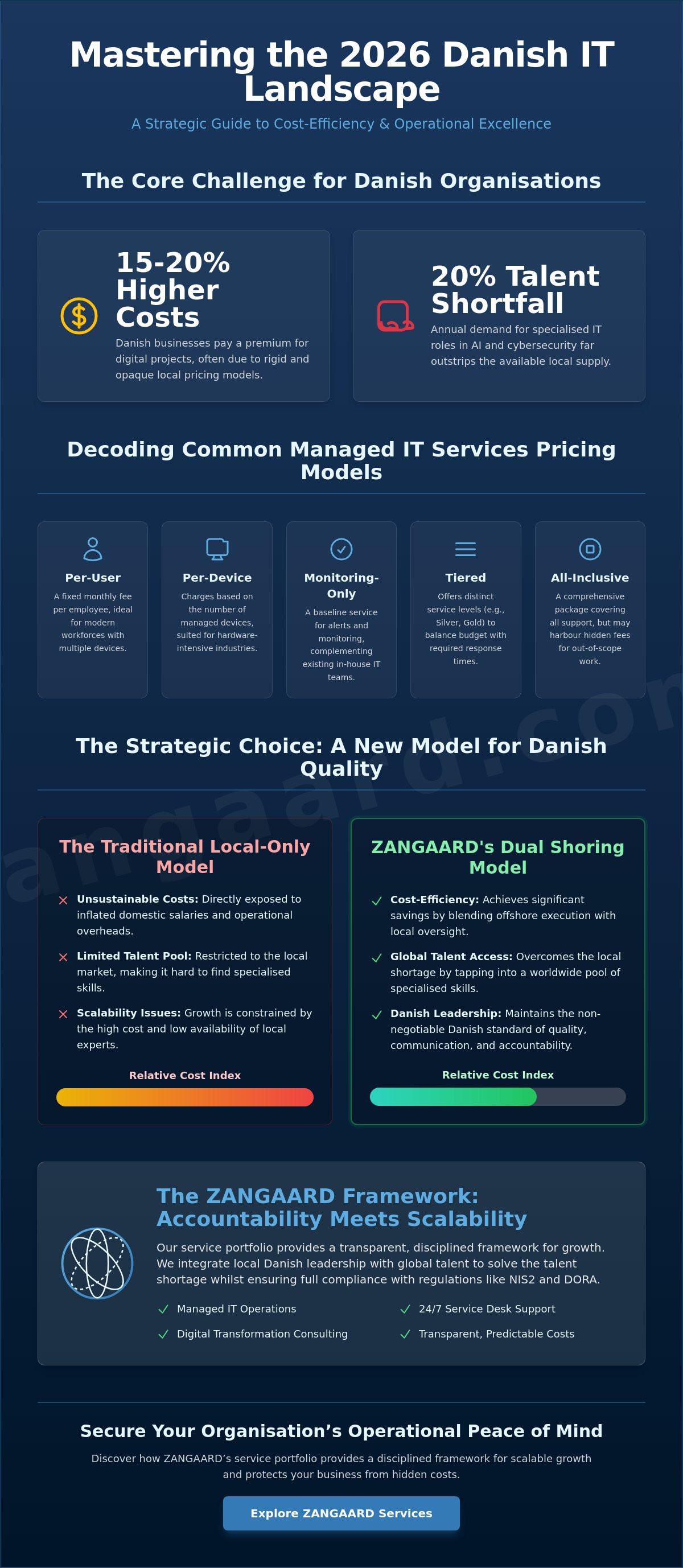
Did you know that Danish business owners currently pay 15 to 20 per cent more for digital projects than the European average? This premium often stems from a local IT talent gap that is outstripping supply by nearly 20 per cent annually, forcing companies into rigid managed IT services pricing models Denmark providers use to offset high domestic costs. You've likely encountered the frustration of "all-inclusive" quotes that harbour hidden fees for out-of-hours support or the difficulty of scaling operations within a restricted domestic market.
We understand that your priority is achieving operational stability without sacrificing transparency or strategic control, especially as regulations like NIS2 and DORA demand higher levels of digital resilience. This guide will help you master the complexities of the 2026 Danish IT landscape and show you how to secure superior value through a Dual Shoring model. You'll learn how ZANGAARD’s service portfolio integrates local Danish leadership with offshore execution to solve the talent shortage. We'll explore how our ZANGAARD Services, including Managed IT Operations and 24/7 Service Desk support, provide the disciplined oversight your organisation needs to thrive in this high-stakes environment.
Key Takeaways
- Analyse the 2026 Danish IT market dynamics to understand why the local talent shortage is driving a shift from basic support to strategic, high-value partnerships.
- Navigate the five core managed IT services pricing models Denmark providers offer to determine which framework provides the best balance of cost predictability and operational flexibility.
- Master the Dual Shoring methodology to achieve significant cost-efficiency whilst maintaining the high standards of local Danish leadership and accountability.
- Protect your organisation from hidden contractual expenses by learning to differentiate between standard operational support and additional project-based fees.
- Discover how ZANGAARD’s service portfolio and Managed IT Operations provide a transparent, disciplined framework for scalable growth and operational peace of mind.
The Landscape of Managed IT Services Pricing in Denmark (2026)
The Danish IT market in 2026 is defined by a persistent talent gap that continues to reshape the economic reality for domestic enterprises. Demand for specialised roles in AI, cloud architecture, and cybersecurity is outstripping local supply by nearly 20 per cent annually. This scarcity has inflated internal salaries, making the traditional model of maintaining a full-scale in-house team increasingly unsustainable for many. Consequently, the managed IT services pricing models Denmark organisations encounter have shifted from reactive support to deep strategic partnerships. Businesses no longer seek providers who merely "keep the lights on"; they require partners capable of delivering Digital Transformation Consulting to maintain their competitive edge.
Despite these rising costs, the "Danish Quality Standard" remains a non-negotiable baseline. Local firms expect high-level governance, operational transparency, and a commitment to "doing things right." This expectation is currently reshaping internal IT budgets across the country. Leaders realise that under-investing in IT Infrastructure Management leads to higher long-term expenses through systemic downtime or security vulnerabilities. They are moving away from the cheapest bid toward models that offer "composed authority" and long-term stability.
The Impact of NIS2 and Regulatory Compliance on Costs
Since the implementation of the NIS2 Directive on 1 July 2025, and the ongoing requirements of the Digital Operational Resilience Act (DORA), security is no longer an optional add-on in Danish IT quotes. Compliance-ready pricing is now the industry standard for essential services. These regulations have increased Managed Services operational overheads due to stricter incident reporting and risk management mandates. When reviewing quotes, it's vital to distinguish between basic support and packages that include the rigorous oversight needed for legal compliance.
Why Danish Management Remains Non-Negotiable
The cultural value of flat hierarchies and direct communication ensures that technical execution aligns with business objectives. Local oversight acts as a strategic insurance policy; it bridges the gap between high-level strategy and daily execution. Removing Danish leadership from the service chain often results in a loss of accountability and cultural friction. This is why ZANGAARD’s service portfolio prioritises local management. Our Managed IT Operations ensure that whilst technical tasks may be distributed, the burden of management and the standard of quality remain firmly under Danish control.
Core Pricing Models: From Per-User to Value-Based Strategies
Selecting the right framework requires a balance between cost certainty and the agility to scale. In 2026, the managed IT services pricing models Denmark providers utilise typically fall into five categories: per-user, per-device, monitoring-only, tiered, and all-inclusive. Larger organisations often adopt a "monitoring-only" baseline as a foundation for their internal teams. However, most growing enterprises now favour hybrid or "blended" models. These structures allow for the stability of a fixed fee whilst providing the flexibility to add specialised support as digital transformation goals evolve. Predictability is the cornerstone of effective governance.
Per-User and Per-Device: The Industry Standards
The per-user model has become the default for the modern, mobile workforce. It offers simplicity; you pay a set fee for each employee regardless of how many devices they use. For Danish companies with 50 to 500 employees, this ensures that IT costs grow in direct proportion to headcount. Conversely, the per-device model remains relevant for hardware-heavy industries like manufacturing or logistics. It provides precise oversight of the infrastructure being managed. If your organisation maintains a complex fleet of workstations and servers, you might find that IT Infrastructure Management is more accurately reflected through a per-device lens.
Tiered vs. All-Inclusive: Finding the 'Sweet Spot'
Tiered pricing allows you to choose between service levels, often categorised as Silver, Gold, or Platinum. This helps balance your budget with specific response times. All-inclusive models offer total peace of mind by covering nearly all support needs under one monthly bill. You should be cautious, however, as "all-inclusive" often excludes major project work or Digital Transformation Consulting. It's vital to identify these boundaries early to avoid unexpected invoices. For those seeking a disciplined approach to oversight, reviewing ZANGAARD’s service portfolio can clarify how we integrate these models into a cohesive strategy. Our Managed IT Operations provide the steady hand needed to navigate these financial complexities without compromising on quality.
If you're unsure which model fits your current growth trajectory, exploring a structured Managed IT Operations framework can provide the clarity you need.
Analysing the Cost-Efficiency of Dual Shoring vs Local-Only Models
The "Danish Premium" is a well-documented economic reality where local technical labour costs can inflate budgets by 15 to 20 per cent compared to the European average. As we move through 2026, relying exclusively on local technical execution is becoming a luxury that many growing organisations find difficult to justify. This financial pressure is fundamentally changing how managed IT services pricing models Denmark are structured and evaluated. Forward-thinking leaders are increasingly moving away from traditional models in favour of "Dual Shoring." This approach pairs the strategic precision of Danish leadership with the operational efficiency of technical teams based in the Philippines, creating a value proposition that traditional offshoring models fail to deliver.
Dual Shoring is distinct from "low-cost" offshoring because it doesn't sacrifice accountability for savings. The ROI is evident when comparing the unit cost of a single Danish engineer against a comprehensive Dual-Shore team. By leveraging geographical arbitrage, businesses can access a broader talent pool whilst keeping the burden of management under a disciplined, local steady hand. It's a model built for synergy, ensuring that high-level strategy and daily execution work in harmony.
The Advantage of Global Scalability with Local Accountability
One of the most immediate benefits of this hybrid approach is the ability to provide a robust 24/7 Service Desk without the prohibitive costs of Danish night-shift differentials. Global availability becomes an integrated part of your IT Infrastructure Management rather than an expensive add-on. In this framework, the Danish manager acts as the essential gatekeeper. They ensure that all technical output meets the rigorous "Danish Quality Standard" whilst the offshore team provides the scalability required for rapid growth.
De-risking the Pricing Model
Many managed IT services pricing models Denmark providers offer contain hidden costs related to cultural misalignment or opaque "out-of-hours" fees. Dual Shoring de-risks the financial arrangement by providing a transparent fee structure that includes global coverage as standard. Local oversight ensures that documentation and process governance remain strictly aligned with Danish expectations. By integrating ZANGAARD’s Managed IT Operations, organisations can maintain high standards of quality and cultural intelligence whilst significantly reducing their operational overheads. Our service portfolio is designed to provide this exact balance of control and cost-optimisation.
Avoiding Hidden Costs: A Buyer’s Checklist for Danish Enterprises
Transparency in managed IT services pricing models Denmark providers use is often obscured by complex contractual language. To maintain fiscal control, you must distinguish between "Managed Services" and "Project Work." Whilst the former covers recurring operational stability, the latter involves one-off changes like major migrations or system overhauls. Failing to define these boundaries early leads to "out-of-scope" creep that can inflate your monthly spend by 30 per cent or more. You should also scrutinise onboarding fees; a fair price for a transition reflects the rigorous process of documenting your environment and establishing governance, rather than a mere administrative charge.
Hidden surcharges often lurk in the fine print. Common examples include travel expenses for on-site visits, emergency surcharges for weekend support, or undisclosed markups on hardware procurement. A disciplined partner provides a flat-rate structure that absorbs these variables into a predictable monthly fee. You must ensure your contract aligns with your actual operational needs rather than paying for a generic template.
Service Level Agreements (SLAs) and Surcharges
When negotiating SLAs, focus on "Resolution Time" rather than just "Response Time." A provider might acknowledge an issue within minutes but take days to fix it. If your organisation requires a 24/7 Service Desk, verify how it's delivered. Domestic-only providers often charge a heavy premium for night-shift coverage, whereas a global model integrates this naturally. Regularly audit your monthly invoice for "out-of-scope" charges to ensure your Managed IT Operations remain within the agreed budget.
Infrastructure Management and Cloud Costs
Oversight of cloud expenditure is critical. Some providers apply a percentage-based markup to your Azure or AWS spend, which can become unsustainable as you scale. In the context of MSP pricing, technical debt is the deferred cost of choosing a low-cost, reactive support model today that necessitates expensive, large-scale remediation or infrastructure replacement in the future. To avoid these pitfalls, we recommend reviewing our full service portfolio to see how we provide transparent IT Infrastructure Management without hidden markups.
Secure your operational future by choosing a partner that prioritises financial transparency; explore ZANGAARD’s Managed IT Operations to regain control of your budget.
ZANGAARD’s Pricing Philosophy: Accountability Meets Scalability
Our commitment to "composed authority" is rooted in the belief that financial transparency is the foundation of strategic reassurance. We reject the ambiguity often found in traditional managed IT services pricing models Denmark providers utilise, choosing instead to offer models that reflect grounded operational reliability. By partnering with ZANGAARD, you move beyond a simple vendor relationship. You gain a strategic partner dedicated to shifting the burden of management from your shoulders to our expert, disciplined hands. Our Managed IT Operations ensure that every operational element is handled with the precision your organisation requires.
The Managed Dual Shoring Advantage
We provide a unique synergy that bridges the gap between high-level Danish strategy and global technical execution. By integrating Danish leadership into every pricing tier, we maintain the cultural intelligence and high standards your business expects. Whilst our 24/7 Service Desk is powered by skilled technical teams in the Philippines, the accountability remains firmly local. This "no-nonsense" approach ensures we do things right the first time. It provides a superior cost-to-performance ratio that allows your business to scale without the prohibitive expense of domestic-only technical shifts. You can view the full breadth of these capabilities in our service portfolio.
Next Steps for Your IT Strategy
Regaining control of your digital landscape begins with a transparent audit of your current IT spend. We identify hidden inefficiencies and align your costs with your long-term objectives. Our onboarding process is designed to be methodical and steady, minimising friction whilst maximising the value of your transition. Whether you need to stabilise your IT Infrastructure Management or seek Digital Transformation Consulting to drive future growth, we provide the steady hand necessary for success.
Take the first step toward a more predictable and scalable IT budget. Book a strategic consultation to optimise your IT pricing and discover the peace of mind that comes from professional, disciplined oversight.
Securing Operational Stability for the Future
Navigating the 2026 IT landscape requires a deliberate transition from reactive support to disciplined, strategic governance. You've seen that the most effective managed IT services pricing models Denmark offers are those that provide transparent accountability whilst leveraging the efficiencies of global scalability. By prioritising Danish leadership and rigorous process documentation, you protect your organisation from the hidden costs of technical debt and the increasing risks of regulatory non-compliance under NIS2 and DORA.
ZANGAARD brings over 10 years of operational excellence to every partnership. We combine the steady hand of Danish management oversight with the continuous availability of our 24/7 global service desk to deliver peace of mind. This structured methodology ensures your Managed IT Operations remain resilient, predictable, and fully aligned with your long-term service portfolio requirements. Our approach shifts the burden of management to us, allowing you to focus on growth with absolute confidence.
Discover how ZANGAARD’s Dual Shoring model can optimise your IT budget. It's time to regain control of your digital infrastructure and move forward with a steady, expert hand.
Frequently Asked Questions
What is the average cost of managed IT services in Denmark?
Average costs for IT services in Denmark are generally 15 to 20 per cent higher than the European average due to the persistent domestic talent shortage. Whilst specific figures depend on the complexity of your infrastructure, most organisations find that local technical labour rates drive a significant premium in traditional models. This economic reality makes it essential to evaluate the cost-to-performance ratio of your provider rather than focusing solely on the monthly fee.
What is the difference between per-user and per-device pricing?
Per-user pricing is based on the total number of employees and is best suited for modern, mobile workforces with multiple devices. Per-device pricing scales according to the total inventory of workstations, laptops, and servers being managed. Per-user models often provide better predictability for growing teams, whilst per-device models offer granular financial control for organisations in hardware-heavy industries like manufacturing.
Are there hidden costs in most Danish MSP contracts?
Hidden costs frequently emerge as surcharges for travel, emergency on-site visits, or "out-of-scope" project work that falls outside the standard agreement. Many providers also apply undisclosed markups to cloud spend or hardware procurement. A disciplined approach to Managed IT Operations prioritises financial transparency to ensure that your monthly invoice remains predictable and free from unexpected fees.
How does the Dual Shoring model reduce IT costs?
The Dual Shoring model reduces costs by leveraging geographical arbitrage, utilising technical execution teams in the Philippines where labour costs are lower. This framework allows for a robust 24/7 Service Desk without the prohibitive expense of Danish night-shift differentials. By combining global technical talent with local Danish leadership, organisations achieve significant savings whilst maintaining high standards of quality and accountability.
Why is Danish management important for offshore IT teams?
Danish management acts as a critical bridge that ensures technical execution remains aligned with local cultural values and business objectives. It provides a strategic insurance policy against the friction and cultural misalignment often found in traditional offshoring. Local oversight ensures that every task meets the "Danish Quality Standard," providing the steady hand needed to manage complex, high-stakes operations across different time zones.
Does managed IT pricing include hardware costs?
Managed IT pricing typically excludes the capital expenditure required for hardware procurement, focusing instead on the professional management of the existing environment. Most managed IT services pricing models Denmark providers offer treat hardware as a separate pass-through cost or a specific project expense. It is vital to clarify these boundaries early to ensure your budget accurately reflects both operational management and infrastructure lifecycle costs.
How often do managed IT service prices increase?
Service prices usually undergo annual adjustments to account for inflation and the rising costs of regulatory compliance like NIS2 or DORA. Prices may also increase if your organisation requires deeper Digital Transformation Consulting or if the scope of your IT Infrastructure Management expands. A transparent partner will provide clear notice and a structured methodology for any price revisions linked to service expansion.
What should be included in a standard managed IT service agreement?
A standard agreement must include clearly defined Service Level Agreements (SLAs), a detailed scope of operational work, and a robust governance framework. It's essential that the service portfolio explicitly details incident resolution times and proactive maintenance schedules. Ensuring these elements are documented helps shift the burden of management to the expert whilst providing you with the peace of mind that operations are being handled correctly.
Disclaimer
The purpose of this article is to generate inspiration, reflection and to start a debate across markets, industries and organizations. We do not recommend any actions soly based on the article statements, claims or opinions, but recommend you to reach out directly to ZANGAARD for a qualified review, dialogue and/or consultation. Reach out at [email protected] or visit our website www.zangaard.com


