
The pursuit of international expansion often reveals that your technical foundation is less a springboard and more a tether. Many Danish enterprises find that as they scale, the complexity of managing global systems leads to rapidly increasing operational costs that can easily exceed 500,000 kr. per month in unforeseen overheads. These IT infrastructure scalability issues are not just technical hurdles; they are strategic barriers that threaten your oversight and drain your internal talent pool when you can least afford it.
You likely recognise the frustration of hunting for skilled engineers in a depleted market or the anxiety of losing visibility as your operations cross borders. This article provides a structured methodology to identify, address, and resolve these barriers whilst maintaining the high standards of Danish quality you expect. By aligning your growth with our ZANGAARD Services, you can transition to a stable, elastic environment with predictable scaling costs. We will examine how our service portfolio, encompassing Managed IT Operations and Digital Transformation Consulting, provides the disciplined framework needed to regain control and secure peace of mind through local Danish management.
Key Takeaways
- Identify how legacy technical debt and rigid architectures manifest as critical IT infrastructure scalability issues that hinder your growth trajectory.
- Evaluate the strategic benefits of horizontal versus vertical scaling to build a more elastic and cost-effective operational environment for your business.
- Implement rigorous standardisation across your hardware and software protocols to ensure the seamless on-boarding of new international departments or locations.
- Discover how ZANGAARD Services provide a Managed Dual Shoring model that bridges Danish managerial accountability with scalable technical execution.
- Review our service portfolio to understand how disciplined governance delivers predictable costs and strategic peace of mind during expansion.
Identifying the Core IT Infrastructure Scalability Issues in Growing Enterprises
Scalability represents the capacity of your systems to accommodate increasing workloads without compromising performance or triggering a disproportionate surge in operational costs. For many Danish enterprises, IT infrastructure scalability issues typically emerge when legacy systems, originally designed for localised operations, are forced to support a global workforce. This accumulation of technical debt creates rigid architectures that act as bottlenecks, effectively stalling expansion at the exact moment market demand peaks.
Operational growth is frequently inhibited by the "Human Scalability" factor rather than pure hardware limitations. The struggle to recruit and organise specialised technical talent in a competitive Danish market can delay critical projects by months. As your organisation expands across international borders, oversight often becomes fragmented. Without a disciplined governance framework, management standards dilute, and the steady hand required to guide complex operations begins to waver.
The Technical Bottleneck: Virtualisation vs Physical Constraints
Relying on traditional physical hardware often leads to "over-provisioning," where firms commit significant capital to capacity that sits idle. This wasted expenditure is a common barrier to efficient growth. Whilst virtualisation provides a layer of flexibility, managing hyper-converged infrastructure within a distributed enterprise introduces new layers of complexity. It requires a level of technical integration that ensures different geographical locations work in harmony, a task that often exceeds the bandwidth of internal departments.
The Management Gap: When Infrastructure Outpaces Oversight
The "Management Gap" defines the point where your local IT team can no longer maintain rigorous service standards whilst simultaneously executing expansion strategies. In this phase, 24/7 availability transforms from a luxury into a fundamental requirement for protecting international revenue streams. Our ZANGAARD Services address this directly by providing Managed IT Operations that shift the burden of daily execution away from your leadership. By leveraging our service portfolio, you regain a sense of "control regained," ensuring that your infrastructure remains a stable foundation for growth rather than a source of persistent operational friction.
Strategic Frameworks for Overcoming Scalability Challenges
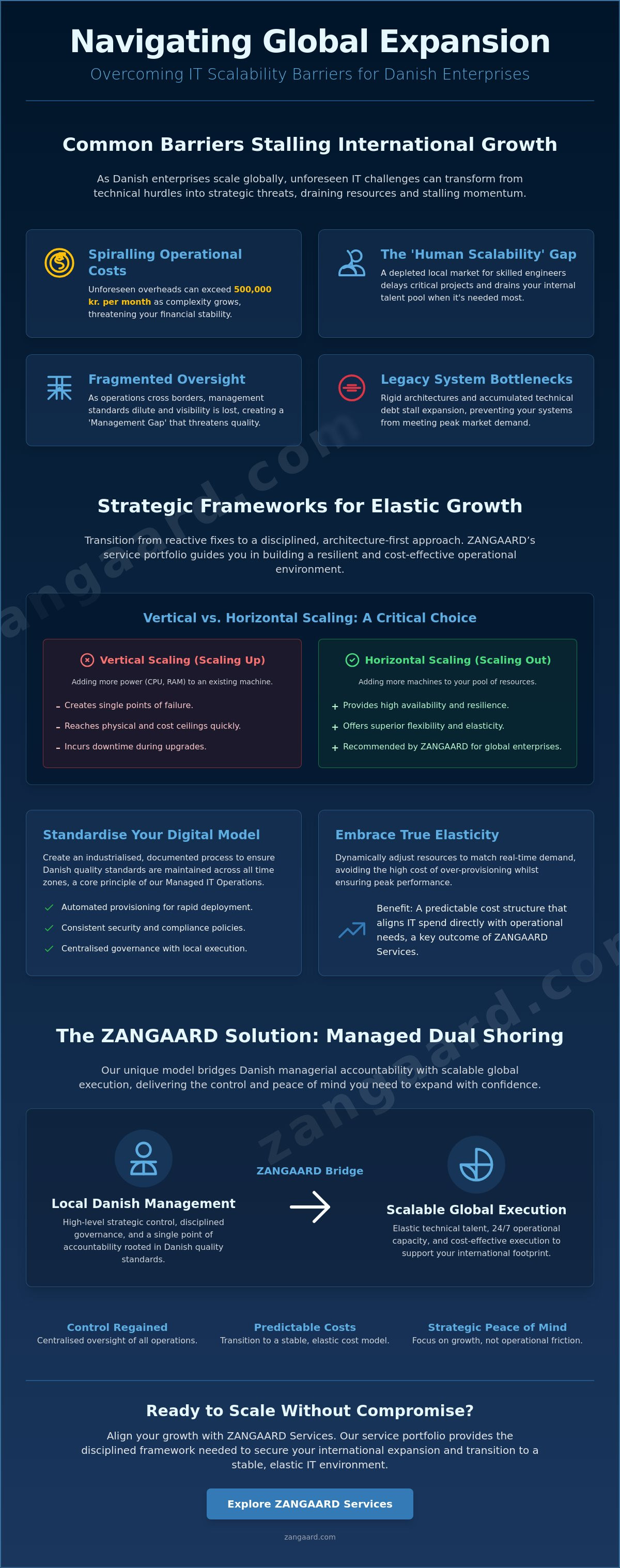
Resolving persistent IT infrastructure scalability issues requires a shift from reactive patching to a disciplined, architecture-first approach. Traditional vertical scaling, which involves adding power to existing systems, eventually hits a physical ceiling and creates single points of failure. In contrast, horizontal scaling adds more nodes to your environment, providing the resilience and flexibility required for modern distributed enterprises. This transition ensures that your technical foundation remains robust whilst your organisation expands into new markets.
Standardisation of hardware and software protocols is the primary mechanism for reducing the friction of on-boarding new departments or international locations. By following a structured Scaling IT Modernization Playbook, businesses can implement automated provisioning. This ensures that every new resource is deployed with consistent security and compliance policies, maintaining Danish quality standards across all operations. Centralised governance models further support this by allowing high-level strategic control whilst empowering local technical execution.
Adopting Elasticity and Demand-Based Resource Allocation
True scalability is often confused with simple growth, but modern environments demand a more sophisticated response to workload fluctuations. Elasticity is the dynamic adjustment of resources to match real-time demand without manual intervention. By implementing elastic architectures, you avoid the costs of over-provisioning whilst ensuring performance remains steady during peak periods, providing a more predictable cost structure for your ZANGAARD Services.
Standardising the Digital Operating Model
An industrialised, documented process is essential for scaling IT operations across different time zones without losing oversight. This repeatable blueprint reduces the "Management Gap" by ensuring that every team member follows the same rigorous standards. Our approach to Managed IT Operations creates this consistency, allowing your leadership to focus on strategy rather than daily troubleshooting. For a closer look at how these frameworks are applied in practice, you might explore our service portfolio to see how we maintain stability for growing enterprises.
Managed Dual Shoring: A Sustainable Solution for Scalable IT Operations
Managed Dual Shoring represents the sophisticated evolution of global delivery models, specifically designed to resolve the IT infrastructure scalability issues that plague growing enterprises. This hybrid framework combines the strategic rigour of Danish management with the vast technical scale of the Philippines. By integrating these two distinct strengths, businesses can maintain a high-performance environment whilst ensuring that every operational decision remains rooted in local accountability. It's a model that prioritises transparency and strategic reassurance, shifting the burden of management from the client to the expert.
ZANGAARD functions as the Disciplined Global Architect within this ecosystem. We bridge the gap between your high-level business objectives and the granular details of daily technical execution. This synergy allows for a stable, elastic IT environment where costs remain predictable, even during periods of rapid international expansion. The result is a regained sense of control, where the complexity of global systems is distilled into a streamlined, managed process.
Bridging the Talent Gap with Global Technical Teams
Accessing the expansive technical talent pool in the Philippines provides a sustainable path for firms to scale their technical headcount without the typical local recruitment struggle. This is vital for maintaining robust 24/7 service desks and proactive infrastructure management. Managed Dual Shoring allows your organisation to tap into specialised skills that might be scarce or prohibitively expensive in the local Danish market. This approach ensures that your growth is never stalled by a lack of available expertise.
Ensuring Accountability Through Danish Oversight
Local oversight is the essential ingredient that prevents the erosion of quality during the scaling process. When technical execution is governed by Danish leadership, the risks of fragmented oversight and diluted standards are effectively mitigated. We invite you to explore the ZANGAARD service portfolio to understand how our local management secures offshore success. This disciplined governance ensures that your infrastructure remains a reliable asset, providing the peace of mind necessary to lead your business with confidence.
Securing Your Growth with Disciplined Infrastructure Governance
Navigating the transition from a local enterprise to a global competitor requires more than just increased capacity; it demands a fundamental shift in how you organise and govern your technical resources. By addressing IT infrastructure scalability issues through rigorous standardisation and elastic architectures, you move beyond reactive troubleshooting into a state of strategic stability. We have seen how the Managed Dual Shoring model provides the necessary scale whilst ensuring that every operational detail remains under strict Danish oversight.
Since 2014, we have helped Danish enterprises scale their operations by providing a bridge between high-level strategy and daily execution. Our 24/7 Service Desk, supported by our technical centre in the Philippines, ensures your systems remain performant across all time zones without compromising on quality. You don't have to carry the burden of management alone. We invite you to Explore ZANGAARD’s Managed IT Services and Portfolio to discover how our disciplined approach can provide the peace of mind you need to expand with confidence. Your path to a resilient and predictable IT environment starts with a partnership rooted in accountability.
Frequently Asked Questions
What are the most common IT infrastructure scalability issues for Danish firms?
Danish firms often encounter IT infrastructure scalability issues rooted in the local shortage of specialised technical talent and the persistence of legacy systems. These bottlenecks prevent the rapid deployment of new services. Many organisations also struggle with maintaining a unified management standard during international expansion. Our service portfolio addresses these gaps by providing the disciplined governance required to maintain high standards across all global locations.
How does horizontal scaling differ from vertical scaling in a business context?
Vertical scaling involves increasing the capacity of a single server or system, such as adding RAM or CPU power, which eventually hits a physical threshold. Horizontal scaling adds more nodes to the network, allowing for greater resilience and flexibility. This approach is superior for modern distributed enterprises as it enables the system to handle increased workloads by distributing them across an industrialised architecture, ensuring that performance remains consistent as you grow.
Can I scale my IT infrastructure whilst reducing operational costs?
Scaling effectively whilst reducing operational costs is achievable through the implementation of automated provisioning and demand-based resource allocation. By shifting from fixed physical hardware to elastic cloud or hybrid environments, you avoid the capital expenditure of over-provisioning. Leveraging a global delivery model also allows you to access a larger talent pool at a more predictable cost structure than traditional local recruitment, which is often a primary drain on resources.
What is the role of Danish management in an offshore IT model?
Danish management provides the essential layer of accountability and strategic governance that ensures offshore technical execution meets local quality standards. It acts as a bridge between high-level business objectives and daily operations. This local oversight ensures that transparency is maintained and that the technical team in our Philippines centre operates within a disciplined Danish framework, a core component of our Managed IT Operations.
How does Managed Dual Shoring improve business continuity during growth?
Managed Dual Shoring improves business continuity by providing 24/7 service desk availability and proactive infrastructure monitoring across multiple time zones. This model ensures that critical systems are managed around the clock, reducing the risk of downtime during growth phases. By combining Danish strategic leadership with global technical execution, firms gain a resilient foundation that can withstand the pressures of rapid expansion whilst ensuring peace of mind for the leadership team.
Disclaimer
The purpose of this article is to generate inspiration, reflection and to start a debate across markets, industries and organizations. We do not recommend any actions soly based on the article statements, claims or opinions, but recommend you to reach out directly to ZANGAARD for a qualified review, dialogue and/or consultation. Reach out at [email protected] or visit our website www.zangaard.com


