
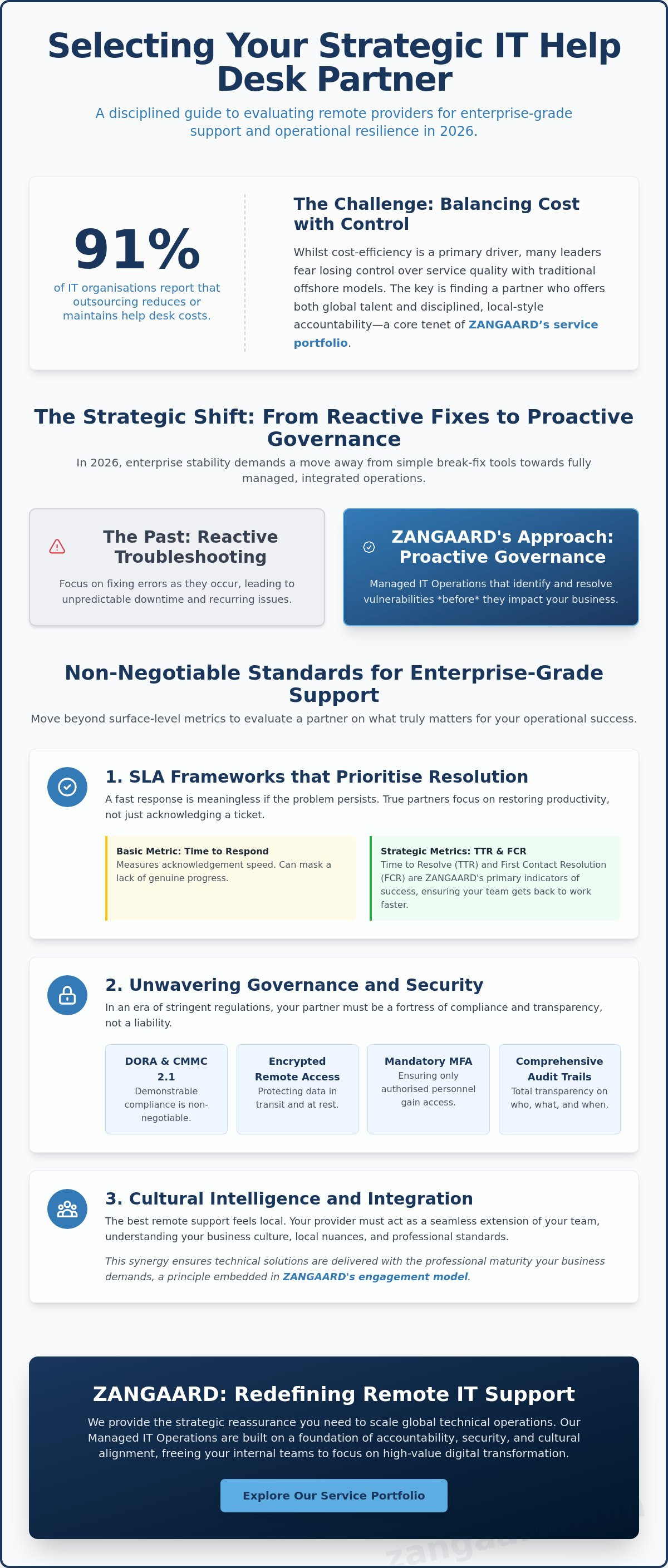
If 91% of IT organisations report that outsourcing their help desk reduces or maintains costs, why do so many leaders still feel they've lost control over service quality? You likely recognise the frustration of balancing the high costs of local technical talent against the inconsistent performance of traditional offshore call centres. Finding a remote IT help desk provider that understands your business culture whilst maintaining technical excellence is often the missing piece in a successful operational strategy.
This guide outlines a disciplined approach to selecting a partner that offers both cost-efficiency and local accountability. You'll learn how to secure predictable service levels and integrate external support as a seamless extension of your team. By aligning your strategy with ZANGAARD Services and reviewing our service portfolio, you can navigate the complexities of CMMC 2.1 and DORA compliance with confidence. We'll examine the shift from reactive troubleshooting to proactive governance, ensuring your Managed IT Operations remain resilient throughout 2026.
Key Takeaways
- Understand why the evolution from reactive software tools to comprehensive managed operations is critical for maintaining enterprise stability in 2026.
- Identify the non-negotiable standards for enterprise-grade support and how to establish SLAs that prioritise genuine accountability over simple response metrics.
- Discover how to select a remote IT help desk provider that successfully balances global technical proficiency with disciplined local management oversight.
- Master the implementation of a "Follow the Sun" support model that functions as a seamless extension of your team without sacrificing service quality.
- Explore how ZANGAARD’s service offerings and portfolio provide the strategic reassurance needed to scale global technical operations.
What is a Remote IT Help Desk Provider and Why is it Essential in 2026?
A remote IT help desk provider acts as a sophisticated managed service partner, delivering end-to-end technical support that transcends geographical boundaries. In 2026, enterprise leaders have largely abandoned the "break-fix" mindset of the past. They've replaced simple software subscriptions with fully integrated managed operations. This transition is driven by the reality of distributed workforces that require 24/7 availability to remain productive across multiple time zones. Whilst basic technical support focuses on resolving immediate errors, a strategic partner provides the oversight and governance required to maintain complex digital environments.
The Core Functions of Modern Help Desk Providers
Modern providers utilise tiered technical support models to ensure every incident is handled with the appropriate level of expertise. This structure allows for a disciplined approach to service delivery:
- Ticketing and incident management: Establishing operational order by categorising and resolving requests through rigorous process frameworks.
- Proactive monitoring: Using remote infrastructure management to identify vulnerabilities and resolve them before they result in costly downtime.
- End-user support: Prioritising cultural alignment and clear communication to ensure technical excellence feels like a natural extension of your internal team.
The Business Case for Outsourcing Support
Scaling technical support becomes a friction-less process when you utilise a distributed talent model that bypasses local recruitment bottlenecks. Outsourcing allows organisations to access a global talent pool whilst maintaining strict centralised governance. By offloading routine tickets to a 24/7 Service Desk, internal IT teams can pivot their focus toward high-value Digital Transformation Consulting. This shift from maintenance to architectural optimisation is a core theme within our service portfolio, where we demonstrate how reclaimed internal resources can drive strategic growth and long-term stability.
Critical Criteria for Evaluating a Remote IT Help Desk Provider
Selecting a remote IT help desk provider requires a shift in perspective from mere technical procurement to strategic partnership. Whilst many vendors offer "unlimited tickets" or basic asset management, these metrics often mask a lack of operational depth. Enterprise-grade support is defined by its governance, its ability to integrate with your corporate culture, and its adherence to rigorous security frameworks. You must look beyond the surface of technical proficiency to find a partner that accepts full accountability for your system's stability.
SLA Frameworks: Measuring What Truly Matters
Traditional Service Level Agreements (SLAs) frequently focus on "Time to Respond," yet a rapid response is of little value if the resolution remains elusive. A sophisticated provider prioritises "Time to Resolve" (TTR) and First Contact Resolution (FCR) as their primary performance indicators. These metrics ensure that user productivity is restored quickly, rather than simply acknowledged. Your provider should also deliver detailed reporting on recurring incidents; this allows you to identify underlying infrastructure weaknesses and address them through disciplined Managed IT Operations.
Governance and Security in Remote Access
In 2026, the regulatory landscape is more demanding than ever. With the Digital Operational Resilience Act (DORA) and CMMC 2.1 now fully enforceable, your support partner must demonstrate unwavering compliance. This includes the use of encrypted remote control tools, mandatory multi-factor authentication (MFA), and comprehensive audit trails. You need to know exactly who accessed your network, what actions were taken, and when the session concluded. Transparency isn't just a preference; it's a requirement for modern risk management. You can see how we apply these rigorous standards across various industries by exploring our service portfolio.
Cultural intelligence is the final, often overlooked, pillar of excellence. A global support team must act as a seamless extension of your internal staff, understanding local nuances whilst maintaining a consistent standard of service. This synergy ensures that technical solutions are delivered with the professional maturity your business demands.
Managed Service vs. Help Desk Software: Choosing the Right Operational Model
Many organisations mistake a software subscription for a complete operational solution. Whilst platforms like Zendesk or Jira provide the necessary infrastructure for communication, they don't resolve tickets, manage complex escalations, or provide strategic oversight. A remote IT help desk provider acts as the disciplined engine behind the tool, shifting the burden of management from your internal team to an expert partner. Mid-sized firms often discover that the DIY software approach creates a ceiling where the costs of recruitment, training, and management oversight quickly outweigh any perceived savings.
The Limitations of the Software-Only Approach
Managing support in-house using third-party software introduces significant hidden complexities. You're responsible for maintaining 24/7 shift rotations, which often leads to staff burnout and inconsistent service during out-of-office hours. Without a rigorous process framework like ITIL, teams frequently suffer from "tool fatigue," where the software becomes a cluttered repository of unresolved issues rather than a streamlined workflow. Software cannot substitute for the high-level governance required to align technical support with your broader business objectives.
The Managed Service Advantage
Engaging a managed partner introduces industrialised precision to your support environment. Professional providers apply standardised methodologies to ensure every incident follows a predictable path to resolution. This model offers instant scalability; you can expand your support capacity to match business growth without the delays of local hiring. By consolidating your support under a single point of accountability, you gain the peace of mind that your infrastructure is being monitored by a seasoned hand. Our Managed IT Operations and service portfolio demonstrate how this transition from owning tools to partnering for outcomes drives long-term stability.
How to Organise a Global Support Strategy with Local Accountability
Implementing a "Follow the Sun" support model requires more than just hiring staff in different time zones; it demands a unified governance structure. Many leaders fear that engaging a remote IT help desk provider with offshore components leads to a "black box" where quality becomes opaque and accountability evaporates. To mitigate this risk, we utilise a Dual Shoring model that pairs the technical depth of hubs like the Philippines with the ethical and operational standards of Danish management. This approach ensures that whilst the execution is global, the oversight remains local and transparent.
Bridging the Cultural and Operational Gap
Success in global support relies on shared values and rigorous communication standards. By maintaining local management oversight, you prevent the service degradation often associated with traditional offshoring. We ensure the offshore team functions as an integrated component of your corporate culture by enforcing strict performance frameworks and regular strategic reviews. This synergy transforms the support desk from a disconnected call centre into a high-performing extension of your internal operations.
The Framework for Successful Dual Shoring
Establishing a resilient global strategy follows a methodical four-step process designed to maintain order and precision:
- Step 1: Define local governance structures to maintain clear lines of accountability and decision-making.
- Step 2: Select a technical hub, such as the Philippines, to access a deep pool of certified technical talent.
- Step 3: Implement a unified service desk platform to ensure total visibility into every ticket, resolution, and audit trail.
- Step 4: Conduct regular strategic reviews between our Danish management team and your leadership to align support with long-term business goals.
By following this disciplined framework, you gain the cost-benefits of global talent without sacrificing the peace of mind that comes from local accountability. Explore how our Managed IT Operations can stabilise your global support environment by viewing our service portfolio today.
ZANGAARD: Redefining Remote IT Help Desk Services
ZANGAARD operates as a disciplined global architect, offering a refined alternative to the traditional remote IT help desk provider. Our Managed Dual Shoring model was specifically designed to solve the friction between cost-efficiency and quality control. By combining Danish management principles with the technical proficiency of the Philippines, we provide a 24/7 Service Desk that functions with industrialised precision. This ensures that your Managed IT Operations are not just supported, but strategically governed to foster long-term stability and executive peace of mind.
Why Managed Dual Shoring is the Superior Choice
Choosing our model allows you to access the deep talent pool of the Philippines without the typical risks of fragmented communication or lack of oversight. We offer a "Danish Oversight" guarantee, meaning local accountability is baked into every ticket resolved by our team. This no-nonsense approach to quality ensures that scalability doesn't come at the expense of operational transparency. You can explore the tangible results of this synergy in our service portfolio, where we showcase our commitment to doing things right.
Getting Started: Transitioning to a Managed Service Desk
Onboarding with ZANGAARD is a methodical process that begins with a comprehensive audit of your existing infrastructure. We prioritise business continuity, ensuring that the transition to our Managed IT Operations is seamless and risk-free. Once integrated, our team acts as your dedicated remote IT help desk provider, providing the strategic reassurance required to focus on your core business objectives whilst we handle the granular details of daily support. If you're ready to regain control over your technical environment, speak to a ZANGAARD consultant about your remote help desk needs today.
Securing Your Operational Stability for the Years Ahead
Transitioning to a sophisticated remote support model is no longer just a cost-saving measure; it's a fundamental requirement for enterprise resilience. You've seen that the right remote IT help desk provider acts as a bridge between high-level strategy and daily execution. Success depends on moving away from fragmented software tools toward a disciplined, managed operations framework that prioritises resolution over simple response times. This shift ensures your technical support remains a strategic asset rather than a management burden.
ZANGAARD provides this stability through our specialised Managed Dual Shoring model. We combine the technical excellence of our 24/7 Service Desk with the rigorous standards of Danish management and local oversight. This approach ensures you maintain full control whilst benefiting from global scalability. By aligning your infrastructure with ZANGAARD Services and reviewing our service portfolio, you can replace operational complexity with streamlined, dependable support. Explore ZANGAARD’s Managed IT Operations and 24/7 Service Desk to begin your journey toward regained control. We look forward to helping you build a more resilient future.
Frequently Asked Questions
What is the difference between a remote help desk and traditional IT support?
Traditional IT support often implies a reactive, on-site presence, whereas a remote help desk utilises location-independent tools to provide proactive care. This model relies on remote monitoring and management systems to resolve issues before they disrupt the user. It prioritises digital availability over physical proximity, ensuring that support is accessible regardless of where your workforce is stationed globally.
How does a remote IT help desk provider ensure data security?
Security is ensured through the application of rigorous encryption protocols, multi-factor authentication, and comprehensive session logging. A reputable remote IT help desk provider must also adhere to strict governance frameworks and international standards. These measures provide a clear audit trail, ensuring that every instance of remote access is authorised, monitored, and recorded to maintain total transparency and peace of mind.
Can a remote provider handle complex server and cloud infrastructure issues?
Yes, advanced providers manage complex server and cloud environments through remote infrastructure management. This capability is a core component of ZANGAARD Services, where we oversee both on-premise and hybrid cloud architectures. By monitoring performance metrics and security logs remotely, we maintain high availability and stability for your most critical business systems without needing to be physically present in the server room.
What are the benefits of the Dual Shoring model for Danish businesses?
The Dual Shoring model offers Danish businesses a unique synergy of local accountability and global technical capacity. It provides the cost-efficiency of offshore technical hubs whilst maintaining the ethical standards and communication styles of Danish leadership. This structure prevents the quality loss often associated with traditional offshoring, ensuring that your technical support remains aligned with your specific corporate culture and expectations.
How do you maintain service quality when using offshore technical teams?
Maintaining quality requires a disciplined approach to governance and the implementation of standardised process frameworks like ITIL. We ensure that offshore teams are fully integrated into the client's operational culture through regular strategic reviews and shared performance metrics. This bridge-building approach ensures that technical excellence is consistently delivered, regardless of the physical location of the support specialist handling the ticket.
Is a remote help desk provider suitable for small-to-medium enterprises (SMEs)?
A remote IT help desk provider is exceptionally well-suited for SMEs looking to scale without the burden of local recruitment and training. It offers access to enterprise-grade technical support and infrastructure management that would be difficult to sustain with an in-house team. This allows smaller organisations to maintain high service levels whilst keeping their internal focus on core business growth and digital transformation.
What happens if a problem requires a physical presence on-site?
When a problem requires physical intervention, the provider coordinates with local field technicians or "smart hands" services to resolve the issue on-site. Whilst over 90% of technical incidents are resolved through remote access in a modern environment, having a structured escalation path for hardware failures is essential. This ensures that business continuity is maintained even when a physical presence is necessary for a specific task.
How are help desk services typically priced in 2026?
Services are typically priced using a predictable subscription model based on the number of users or workstations supported. This allows organisations to manage their IT expenditure as a transparent operational cost rather than an unpredictable capital expense. You can see examples of how these managed services are structured for various organisations by reviewing our service portfolio.
Disclaimer
The purpose of this article is to generate inspiration, reflection and to start a debate across markets, industries and organizations. We do not recommend any actions soly based on the article statements, claims or opinions, but recommend you to reach out directly to ZANGAARD for a qualified review, dialogue and/or consultation. Reach out at [email protected] or visit our website www.zangaard.com


