
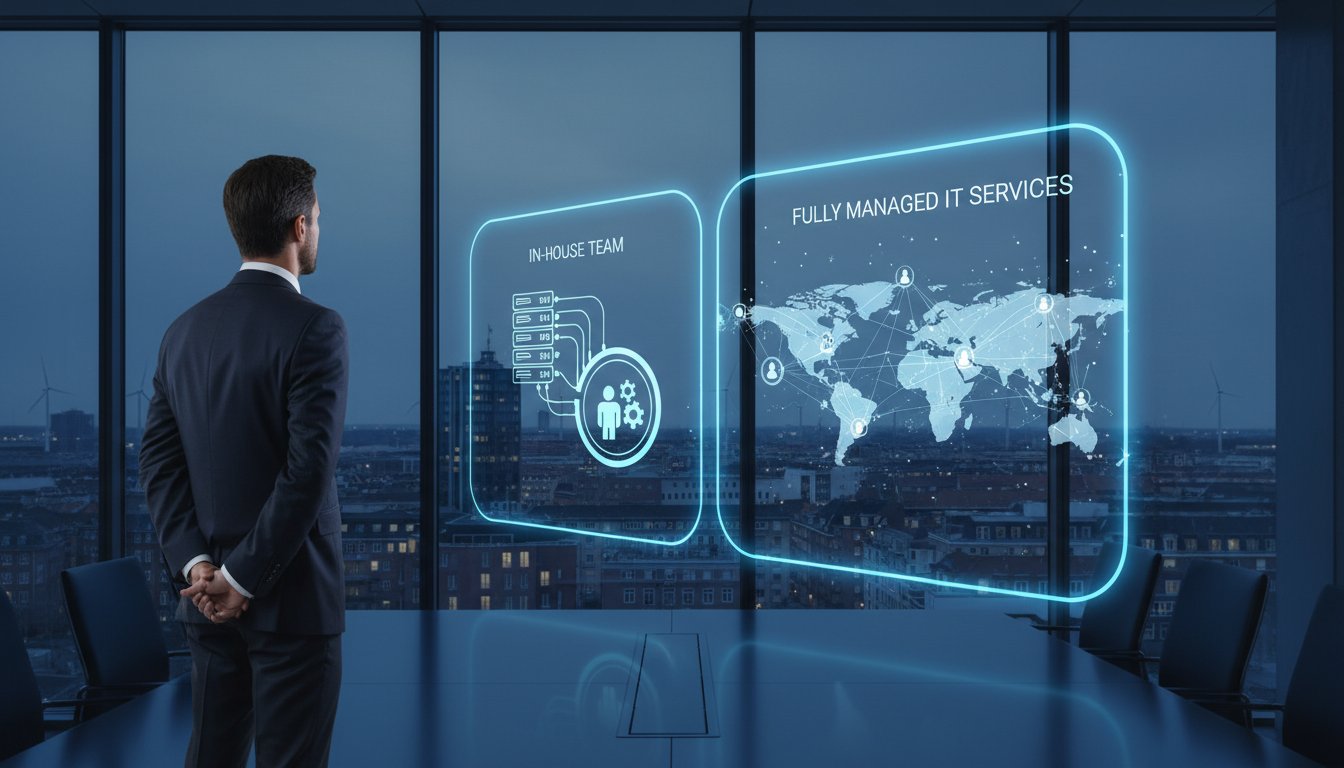
If you're currently attempting to recruit a senior IT manager within the Danish market, you're competing for a talent pool that now commands an average salary of 814,304 kr per year. For many Danish executives, the traditional belief that an internal team is the only way to maintain absolute control is being challenged by the sheer cost and complexity of the modern digital landscape. You likely recognise that whilst internal staff offer proximity, the burden of 24/7 security monitoring and evolving NIS2 compliance often creates a glass ceiling for your organisational growth. This guide explores the strategic choice between fully managed IT services vs in-house IT Denmark, providing the clarity you need to balance operational control with financial predictability.
You'll discover whether a managed model or a local team offers the best framework for your specific scalability requirements. We'll examine the current Danish recruitment market, the impact of the latest Datatilsynet focus on employee monitoring, and how to transition from unpredictable capital expenditure to a disciplined, OPEX-based infrastructure. By the end of this analysis, you'll understand how to secure the local accountability your governance requires whilst leveraging the global execution capabilities necessary to remain competitive in 2026.
Key Takeaways
- Assess how the Danish technical talent shortage affects your internal capacity for 24/7 security and infrastructure oversight.
- Identify the hidden financial burdens of an internal team, including recruitment fees and pension obligations, to establish an accurate Total Cost of Ownership.
- Determine whether fully managed IT services vs in-house IT Denmark provides the necessary balance of operational transparency and long-term scalability for your business.
- Discover the "Managed Dual Shoring" model, which combines local accountability with global execution to ensure high-stakes operations are handled with industrialised precision.
The Landscape of IT Management in Denmark for 2026
The Danish enterprise environment in 2026 is defined by a paradox of high digital maturity and a severe scarcity of the technical resources required to sustain it. Whilst the national ICT market is projected to grow at a CAGR of 5.01% through 2031, many organisations find their internal progress stalled by an inability to secure specialised expertise. For years, IT was viewed as a back-office cost centre. This perspective is rapidly dissolving. Business leaders now recognise that resilient infrastructure is the foundation of competitive advantage, yet traditional internal structures are failing to keep pace with the speed of digital transformation. As firms re-evaluate their operating models for increased resilience, the debate over fully managed IT services vs in-house IT Denmark becomes a question of whether to build a team or buy a result.
The Scarcity of Local Technical Talent
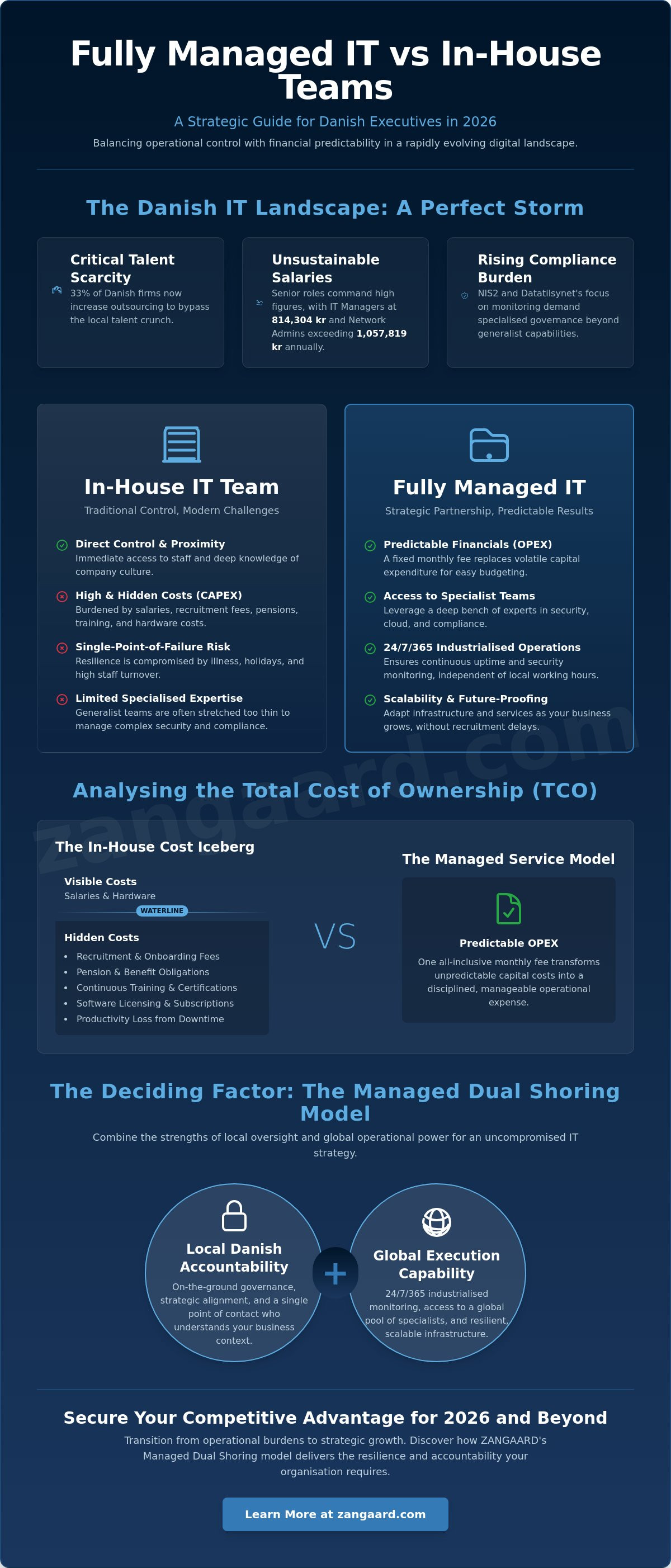
Recruitment in the Danish market has reached a critical friction point. For a business operating in Copenhagen, the average salary for an IT Manager has climbed to 814,304 kr, whilst a senior Network Administrator can command upwards of 1,057,819 kr. These figures only represent the visible cost. When you factor in the 33% of Danish firms currently looking to increase outsourcing to bypass the local talent crunch, it's clear that small and medium-sized enterprises are struggling to retain talent against global tech giants. The "candidate market" means that even if you find a specialist, the risk of them being headhunted within twelve months remains high, creating a cycle of instability that threatens long-term projects.
Rising Operational Complexity and Compliance
Operational demands have moved beyond the capabilities of a generalist in-house team. The Danish Data Protection Agency (Datatilsynet) has made AI-based employee monitoring and cookie consent enforcement its primary focus for 2026. Simultaneously, the NIS2 Directive mandates rigorous, documented security assessments that many internal departments are not equipped to perform. A Managed Services Definition traditionally focuses on the transfer of day-to-day management, but in the current Danish climate, it represents something more: the acquisition of specialised governance that protects the board from regulatory liability. Maintaining 24/7 uptime in a globalised economy requires a level of disciplined execution that an internal team, limited by Danish working hours and local holiday cycles, often cannot provide without significant investment. Choosing fully managed IT services vs in-house IT Denmark is no longer just about support; it's about ensuring your business remains compliant and operational in an increasingly regulated landscape.
Defining the Choice: In-House Teams vs Fully Managed IT Services
To make an informed decision regarding fully managed IT services vs in-house IT Denmark, you must first distinguish between simple staff augmentation and a structured management model. An in-house team is traditionally defined by its physical presence and proximity to the business's daily operations. These teams develop a deep, almost intuitive understanding of the company's specific culture and historical technical debt. However, this model often relies on a small number of individuals, creating a precarious "single-point-of-failure" risk. If a senior administrator is unavailable due to illness or the standard Danish holiday entitlement, your organisation's technical resilience is immediately compromised.
The Anatomy of an In-House IT Department
A typical internal department is structured to handle everything from basic help desk queries to high-level strategic roadmapping. Whilst this provides a sense of immediate control, the internal model often lacks the breadth of expertise required for modern compliance. Internal roles usually include:
- Help desk specialists for day-to-day user support.
- System administrators focused on server and network health.
- IT Managers or CTOs who align technology with business objectives.
The primary benefit here is the physical proximity to hardware and staff. Yet, the risk remains that these generalists are often stretched too thin, leaving little time for the proactive security measures mandated by NIS2 or GDPR.
What Fully Managed IT Truly Entails
Contrast this with the fully managed approach. This model shifts the focus from managing people to managing outcomes through a Service Level Agreement (SLA). It represents an industrialised version of IT where processes are standardised, automated, and monitored 24/7/365. This transition is essential for understanding the True Costs of IT, as managed providers spread the cost of high-end monitoring tools and niche subject matter experts across a broader client base. For a Danish enterprise, this means gaining access to a level of security and infrastructure expertise that would be financially prohibitive to hire internally.
The choice is no longer a binary one. Many sophisticated organisations are now adopting hybrid models where internal strategic leadership remains in Denmark, whilst the heavy lifting of routine maintenance and 24/7 support is handled by an external partner. This ensures that your high-level digital transformation remains aligned with your corporate goals while your operational foundation remains steady. If you're currently evaluating your internal capacity, reviewing a structured approach to Managed IT Operations can provide the necessary framework for this transition. By shifting the burden of daily maintenance to a disciplined partner, you regain the freedom to focus on the strategic initiatives that actually drive growth in the Danish market.
Financial Realities: Analysing the Total Cost of Ownership (TCO)
When evaluating fully managed IT services vs in-house IT Denmark, many executives fall into the trap of comparing a monthly service fee against a single line-item salary. This approach ignores the "iceberg effect" of internal IT management. Whilst a senior Network Administrator in Copenhagen commands an average of 937,491 kr per year, the total cost to the business frequently exceeds this figure by 30% to 40% once you account for Danish social security, pension contributions, and mandatory insurances. These visible costs are merely the starting point for a deeper financial analysis. A disciplined architect looks beyond the payroll to understand how capital is actually deployed within the organisation.
The Invisible Costs of In-House Staff
Managing an internal team requires a significant investment of high-level executive time. From HR-led recruitment processes, which in the current Danish market often take three to six months for senior roles, to the ongoing burden of performance reviews and conflict resolution, the management overhead is substantial. There is also the matter of continuous professional development. To remain compliant with the NIS2 Directive and evolving security standards, your staff must maintain expensive technical certifications. When these individuals leave, they take that intellectual property and your training investment with them. You aren't just paying for a salary; you're funding the office space, the equipment depreciation, and the constant risk of talent attrition in a competitive Nordic landscape.
Predictability and Scalability with Managed Models
Shifting to a managed model allows a business to move from a volatile Capital Expenditure (CAPEX) framework to a predictable Operational Expenditure (OPEX) model. Instead of facing "lumpy" costs associated with emergency hardware refreshes or unplanned infrastructure upgrades, you operate with a fixed monthly fee that simplifies long-term budgeting. This financial transparency is a cornerstone of professional IT Governance and Risk management. It ensures that your IT spend is directly correlated with your business growth rather than being a drain on your cash flow during quiet periods.
Proactive management serves as a financial insurance policy. The true cost of a system failure isn't just the repair bill; it's the lost productivity of your Danish workforce and the potential regulatory fines from Datatilsynet for data breaches. By investing in a structured management framework, you eliminate the financial shocks of reactive "break-fix" cycles. This approach ensures that your infrastructure scales seamlessly as your headcount grows, providing a level of fiscal control that an internal department, limited by its fixed capacity and rising recruitment costs, simply cannot match. Choosing fully managed IT services vs in-house IT Denmark ultimately comes down to whether you prefer the uncertainty of hidden costs or the stability of a managed outcome.
Bridging the Accountability Gap: Governance and Risk
The primary anxiety surrounding the debate of fully managed IT services vs in-house IT Denmark is the perceived loss of strategic autonomy. Executives often worry that by shifting operations to an external partner, they'll lose the ability to influence their digital roadmap or, worse, lose visibility into their own data. This concern is rooted in a misunderstanding of what modern governance looks like. True control doesn't stem from physical proximity to a server room; it arises from a disciplined framework of accountability, transparency, and documented oversight. A professional managed partner doesn't take away your control; they provide the industrialised tools that allow you to exercise it more effectively.
The Myth of Total Control with In-House Teams
Many organisations operate under a false sense of security, believing that internal teams provide total oversight. In reality, in-house environments are frequently plagued by "tribal knowledge"-critical system information stored only in the heads of a few key individuals. This lack of documentation creates a significant risk. If those individuals leave the business, your control vanishes overnight. Overstretched internal teams often inadvertently encourage shadow IT, where departments bypass official channels to implement their own unmanaged solutions. A managed service model eliminates these blind spots by introducing rigorous, auditable standards that ensure every process is documented and every asset is accounted for.
Security and Compliance through Industrialised Processes
Achieving superior security requires a "security by design" philosophy that is often too complex for generalist internal teams to maintain. Managed providers leverage their scale to deploy enterprise-grade security tools-solutions that would be financially prohibitive for a single Danish enterprise to procure alone. By spreading these costs across a broad client base, they provide a level of protection that matches global standards. Deciding between fully managed IT services vs in-house IT Denmark means choosing how to best fund your security posture. By maintaining Danish-led management, you ensure that even global execution meets the strict requirements of the Danish Data Protection Agency and European GDPR. If you're concerned about the resilience of your current setup, exploring professional IT Infrastructure Management can provide the structural reassurance your board requires.
Risk mitigation is the ultimate test of any IT model. Whilst an internal team might struggle to maintain a comprehensive disaster recovery plan alongside their daily duties, a managed provider treats recovery as a core operational pillar. They provide the steady hand and the disciplined methodology required to ensure that, in the event of a crisis, your business remains operational and your reputation remains intact. This shift from reactive firefighting to proactive governance is what allows a business to scale with confidence.
The Dual Shoring Model: Why Danish Oversight is the Deciding Factor
The final consideration in the fully managed IT services vs in-house IT Denmark debate is how to bridge the gap between global cost-efficiency and local accountability. Many Danish executives hesitate to outsource because they fear their operations will become a "black box" where visibility is lost and standards slip. Managed Dual Shoring solves this by placing a Danish management layer over a global execution engine. You retain the strategic control of an in-house team whilst gaining the 24/7 technical capacity of a global workforce. This model ensures that high-level architecture and governance remain rooted in Danish business culture, whilst the labour-intensive technical work is handled by specialists in premier offshore hubs.
Combining Danish Standards with Global Execution
The Philippines has emerged as the premier destination for technical IT execution due to its massive talent pool and strong cultural alignment with Western service standards. By utilising 24/7 Philippine-based teams, your organisation gains the "muscle" required for constant infrastructure monitoring and rapid incident response. However, the "Danish touch" is maintained through a local Account Manager who ensures that every technical action aligns with your specific corporate goals. This synergy allows for a disciplined, industrialized approach to IT that an internal team, restricted by local time zones and recruitment hurdles, simply cannot replicate. You receive the benefits of global scale without sacrificing the nuanced communication required for high-stakes operations.
Transitioning to a Managed Model Without Losing Sovereignty
Moving from a traditional internal structure to a managed model requires a methodical roadmap to ensure zero disruption. The transition begins with a comprehensive audit of your existing technical debt and a formalisation of your service requirements. By offloading operational burdens like patch management and service desk support, your internal leaders are finally free to focus on Digital Transformation Consulting and other growth-oriented initiatives. You retain total sovereignty over your data and strategy whilst shifting the liability of 24/7 availability to a partner committed to rigorous SLAs.
The long-term ROI of this approach is found in its inherent scalability. As your Danish business expands, your IT infrastructure grows with you, supported by a predictable OPEX model that eliminates the need for expensive, reactive hiring cycles. This is the ultimate expression of "control regained." You move from a state of potential complexity and talent risk to a state of streamlined, transparent stability. If you are ready to evaluate how this framework fits your specific organisational needs, you can organise a strategic consultation with ZANGAARD to assess your IT model and discover the balance of cost and control that supports your next phase of growth.
Securing Your Enterprise’s Technical Future
The choice between fully managed IT services vs in-house IT Denmark is ultimately a decision between managing technical friction or orchestrating strategic growth. You've seen how the hidden costs of local recruitment and the rising complexity of NIS2 compliance can stall even the most mature Danish organisations. By shifting to a model that prioritises industrialised processes and 24/7 availability, you regain the transparency and peace of mind required for long-term stability.
ZANGAARD was founded in 2014 with a singular focus on business continuity. We achieve this through our Managed Dual Shoring model, which pairs meticulous Danish-led management and local oversight with scalable 24/7 technical operations in the Philippines. This structure ensures your high-stakes operations remain under disciplined control whilst leveraging global execution capabilities. Discover how Managed Dual Shoring provides the accountability your Danish firm deserves. Transitioning to a managed framework is the most reliable way to ensure your infrastructure supports your ambitions without the burden of internal management.
Frequently Asked Questions
What is the main difference between managed IT services and in-house IT in Denmark?
The primary distinction lies in the shift from managing personnel to managing outcomes through a formalised Service Level Agreement (SLA). Whilst an in-house team provides physical proximity and company-specific knowledge, the debate over fully managed IT services vs in-house IT Denmark often centres on the ability to maintain 24/7 operational resilience. Managed services provide an industrialised framework of proactive monitoring and automated processes that individual internal departments often lack the capacity to sustain.
Is it cheaper to have an in-house IT team or use a managed service provider?
A managed service provider is typically more cost-effective when you account for the Total Cost of Ownership, including Danish social security, pensions, and recruitment fees. For instance, a senior Network Administrator in Copenhagen can command a salary upwards of 1,057,819 kr per year before overheads. A managed model replaces these volatile capital expenses with a predictable monthly operational expenditure, allowing you to scale resources without the financial shocks of internal hiring cycles.
How does ZANGAARD ensure Danish accountability with teams in the Philippines?
ZANGAARD maintains absolute accountability through a Danish management layer that oversees all global technical execution. Your primary point of contact is a local Account Manager who ensures that every action taken by the Philippine-based team aligns with Danish business standards and your specific strategic goals. This structure provides the technical "muscle" of a global workforce whilst keeping the high-level governance and cultural alignment firmly rooted in Denmark.
Can a managed IT service provider help with GDPR compliance in Denmark?
Yes, a professional provider integrates GDPR and NIS2 compliance into the foundation of your infrastructure through "security by design" principles. With the Danish Data Protection Agency focusing on employee monitoring and cookie consent in 2026, a managed partner provides the specialised governance required to navigate these regulations. This ensures that your data processing remains transparent and auditable, protecting the board from potential regulatory liability.
What happens to my current IT staff if I move to a fully managed model?
Moving to a managed model often allows your internal staff to transition from routine maintenance to high-value strategic initiatives. By offloading the burden of 24/7 support and infrastructure patching to an external partner, your team can focus on Digital Transformation Consulting and other projects that drive competitive advantage. This shift improves retention by removing the burnout associated with constant reactive firefighting.
How does the 24/7 service desk work in a Dual Shoring model?
The Dual Shoring model leverages the time zone advantage of the Philippines to provide continuous support without the prohibitive costs of Danish night shifts. This ensures that your staff have immediate access to technical assistance at any hour, governed by the same disciplined standards used during Danish business hours. It provides a seamless experience where service quality remains consistent regardless of when a request is logged.
Is managed IT suitable for small businesses in Denmark or only large enterprises?
Managed IT is exceptionally well-suited for Danish SMEs that require enterprise-grade security but lack the budget to hire a full-scale internal department. It levels the playing field by providing smaller firms with access to the same high-end monitoring tools and niche subject matter experts used by global giants. This allows smaller organisations to remain agile whilst ensuring their infrastructure is robust enough to support rapid growth.
What are the risks of outsourcing IT services and how are they mitigated?
The perceived risks of outsourcing, such as a loss of control or communication barriers, are mitigated through rigorous documentation and local oversight. By choosing a partner that provides Danish-led management, you ensure that your strategic sovereignty is never compromised. Clear SLAs and transparent reporting frameworks transform the "black box" of traditional outsourcing into a disciplined partnership where performance is measured and verified daily.
Disclaimer
The purpose of this article is to generate inspiration, reflection and to start a debate across markets, industries and organizations. We do not recommend any actions soly based on the article statements, claims or opinions, but recommend you to reach out directly to ZANGAARD for a qualified review, dialogue and/or consultation. Reach out at [email protected] or visit our website www.zangaard.com


