

Your IT team isn't failing because they lack skill; they're failing because they're trapped in a cycle where urgent fires always consume the oxygen needed for long-term fixes. It's a common frustration to see the same technical debt resurfacing as repetitive incidents that drain your budget and exhaust your best engineers. You likely recognise that whilst your team is talented, they simply lack the bandwidth to conduct the deep-dive analysis required for true proactive IT problem management. This guide promises to show you how to break that reactive loop and establish a disciplined framework that secures operational stability. We'll explore how shifting to a model of predictable infrastructure and clear accountability, often facilitated by ZANGAARD’s Managed IT Operations, can transform your technical landscape from a source of constant noise into a silent engine of growth.
Key Takeaways
- Escape the costly "firefighting trap" by shifting your focus from resolving symptoms to eliminating the structural root causes of recurring technical debt.
- Harness data from a 24/7 Command Centre to perform the sophisticated trend analysis needed to neutralise risks before they become incidents.
- Bridge the gap between strategy and execution using Managed Dual Shoring, which provides the bandwidth for deep-dive analysis whilst ensuring Danish accountability via ZANGAARD services.
- Secure long-term operational stability by implementing a disciplined framework for proactive IT problem management that replaces daily chaos with a predictable infrastructure.
Defining Proactive IT Problem Management: Moving Beyond Firefighting
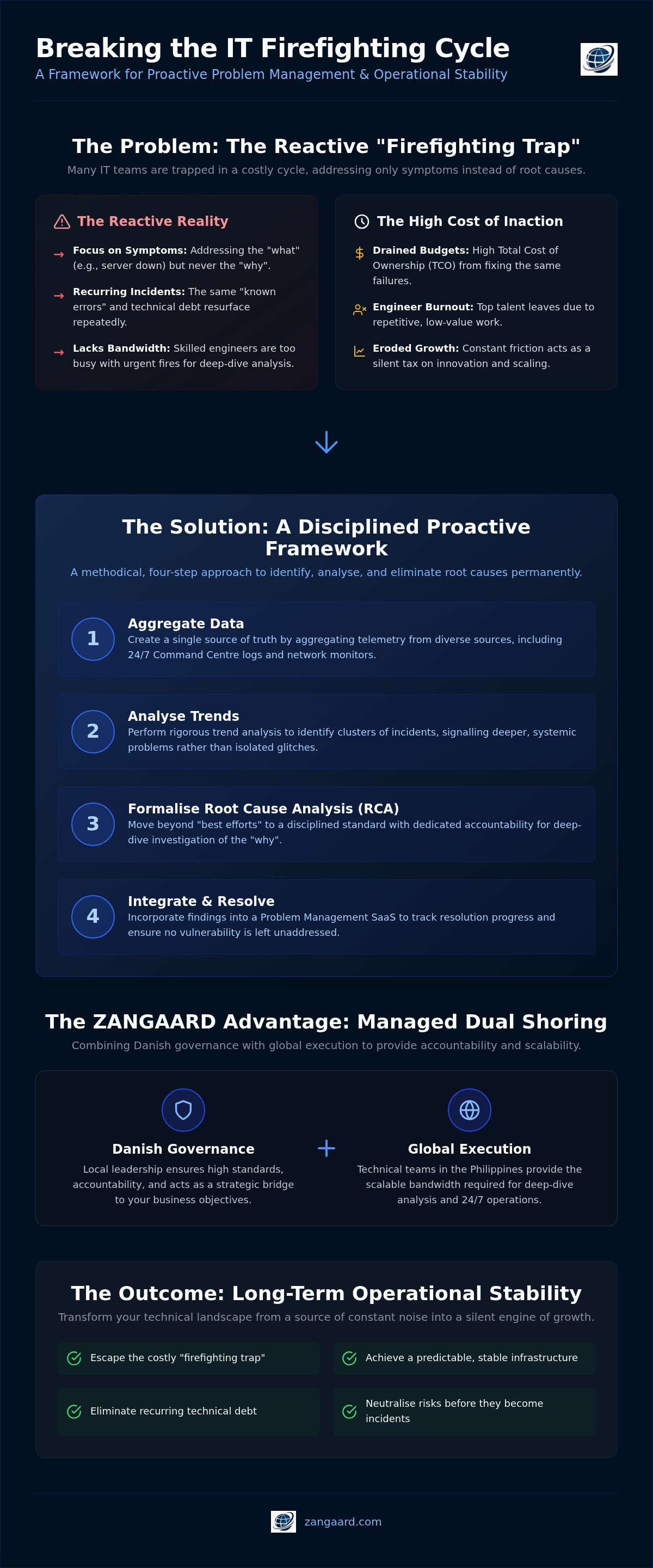
Reactive management addresses the "what"; a server is down or a database is locked. In contrast, proactive IT problem management investigates the "why" to ensure the issue never returns. Many organisations fall into the "firefighting trap," where internal teams are so busy quenching immediate incidents they never find the time for trend analysis. This cycle creates a high total cost of ownership (TCO) as resources are wasted on recurring failures. Mature organisations adopt a model of industrialised precision, using Managed IT Operations to identify patterns before they escalate. By shifting the burden of daily oversight to a disciplined partner, leaders regain the strategic reassurance that their infrastructure is being handled with a steady, expert hand.
The Cost of Reactive Patterns in Scaling Enterprises
Recurring "known errors" act as a silent tax on your growth. When the same technical debt causes weekly disruptions, it drains operational budgets and erodes employee morale. High-performing engineers don't want to spend their careers fixing the same broken patches; they want to build. This constant friction leads to burnout and a loss of institutional knowledge. The Maturity Gap is the distance between merely recording issues in a log and actually executing a rigorous Root-cause analysis (RCA) to eliminate them permanently. ZANGAARD’s framework closes this gap by providing the dedicated bandwidth required for deep-dive investigation whilst maintaining Danish standards of accountability in proactive IT problem management.
Implementing a Proactive Framework: Data, Trends, and Root Causes
The transition to proactive IT problem management requires a methodical four-step approach that prioritises empirical data over reactive guesswork. Initially, you must aggregate telemetry from diverse sources, including network monitor logs and 24/7 Command Centre telemetry, to create a single source of truth. This raw data is then subjected to rigorous trend analysis to identify clusters of incidents that signal a deeper, systemic "problem" rather than isolated glitches. Once a pattern emerges, the organisation must formalise the Root Cause Analysis (RCA) process with dedicated accountability, moving beyond "best efforts" to a disciplined, industrialised standard. Finally, these findings are integrated into a Problem Management SaaS Application to track resolution progress and ensure no vulnerability is left unaddressed.
Leveraging Continuous Improvement and Command Centres
A 24/7/365 Command Centre provides the high-level observability required for early detection within the complex hybrid cloud environments of 2026. This constant oversight enables a level of proactive IT and root cause analysis that anticipates failure rather than merely surviving it. By embedding Continual Improvement into your daily operations, you ensure that RCA findings translate into tangible infrastructure changes rather than sitting idle in a log. This framework serves as a vital pillar of modern IT infrastructure management services, ensuring that proactive IT problem management remains a constant focus rather than an occasional luxury. If your internal team lacks the bandwidth to execute this level of rigour, it's likely time to discuss a more structured approach to your operational stability.
The Dual Shoring Advantage: Accountability Meets Scalability
Many leaders assume that proactive IT problem management requires a massive, expensive in-house team. This is a misconception that often keeps organisations stuck in reactive cycles. Managed Dual Shoring provides the necessary bandwidth without the prohibitive overhead of local hiring. By combining Danish management standards with technical execution in the Philippines, you ensure local accountability whilst leveraging offshore scalability for deep-dive analysis. This model grants you the peace of mind that a disciplined partner is owning the entire problem management lifecycle. It effectively removes the cultural and communication barriers that often plague traditional offshoring, replacing friction with industrialised precision and steady governance.
Integrating Danish Governance with Global Execution
Acting as a strategic bridge-builder, Danish leadership translates your high-level business objectives into granular operational tasks for the technical team. This governance ensures that Managed IT Operations remain focused on long-term outcomes rather than just daily activity. When your operational model includes a specialised focus on proactive IT problem management, the result is a stable, predictable infrastructure that supports your growth. It's time to move from technical complexity to streamlined simplicity by exploring the full ZANGAARD service portfolio. This approach ensures that technical improvements aren't just discussed but are rigorously executed to secure your operational health.
Securing Your Operational Future with Disciplined Governance
Transitioning to proactive IT problem management isn't merely a technical adjustment; it's a strategic commitment to operational maturity. By integrating 24/7 Command Centre telemetry with a specialised Problem Management SaaS, you transform chaotic firefighting into industrialised precision. This disciplined approach ensures that technical debt is permanently retired rather than managed. Danish management oversight provides the necessary bridge between strategy and execution, ensuring every root cause is addressed with unwavering accountability. Leveraging Managed Dual Shoring allows your team to step away from the burden of repetitive incidents and focus on growth. You can finally replace operational noise with a predictable, stable infrastructure that supports your long-term objectives. It's time to regain control and move towards streamlined simplicity.
Your journey towards a silent, high-performing engine of growth begins with a commitment to disciplined oversight.
Frequently Asked Questions
What is the difference between proactive and reactive problem management?
Reactive management is triggered by the occurrence of an incident, whilst proactive IT problem management identifies and resolves vulnerabilities before they manifest as outages. Whilst reactive teams focus on restoring service quickly, proactive teams analyse trend data from sources like a 24/7 Command Centre to eliminate recurring technical debt. This shift ensures long-term stability rather than temporary relief from immediate fires.
How does proactive problem management reduce IT operational costs?
Proactive strategies reduce operational costs by decreasing the volume of repetitive incidents that consume expensive engineering hours. By identifying root causes, organisations avoid the high emergency rates associated with "break-fix" support and significant data centre outages. Implementing a structured framework through Managed IT Operations allows for predictable budgeting and lower total cost of ownership across the entire infrastructure.
Can proactive problem management be outsourced effectively?
Effective outsourcing of proactive IT problem management is achieved through a model that balances technical depth with local accountability. ZANGAARD’s Managed Dual Shoring model provides the necessary bandwidth for deep-dive analysis in the Philippines whilst maintaining Danish management standards. This ensures that the outsourcing partner takes full ownership of the problem lifecycle, providing the strategic reassurance that internal teams often lack.
What role does Root Cause Analysis (RCA) play in ITIL 4?
Root Cause Analysis is a core component of the ITIL 4 Problem Management practice, focusing on the permanent removal of underlying errors. It moves beyond simple troubleshooting to a holistic investigation of the service value chain. In a modern context, this process is often formalised using a Problem Management SaaS Application to ensure that findings lead to measurable Continual Improvement and infrastructure hardening.
Disclaimer
The purpose of this article is to generate inspiration, reflection and to start a debate across markets, industries and organizations. We do not recommend any actions soly based on the article statements, claims or opinions, but recommend you to reach out directly to ZANGAARD for a qualified review, dialogue and/or consultation. Reach out at [email protected] or visit our website www.zangaard.com


