

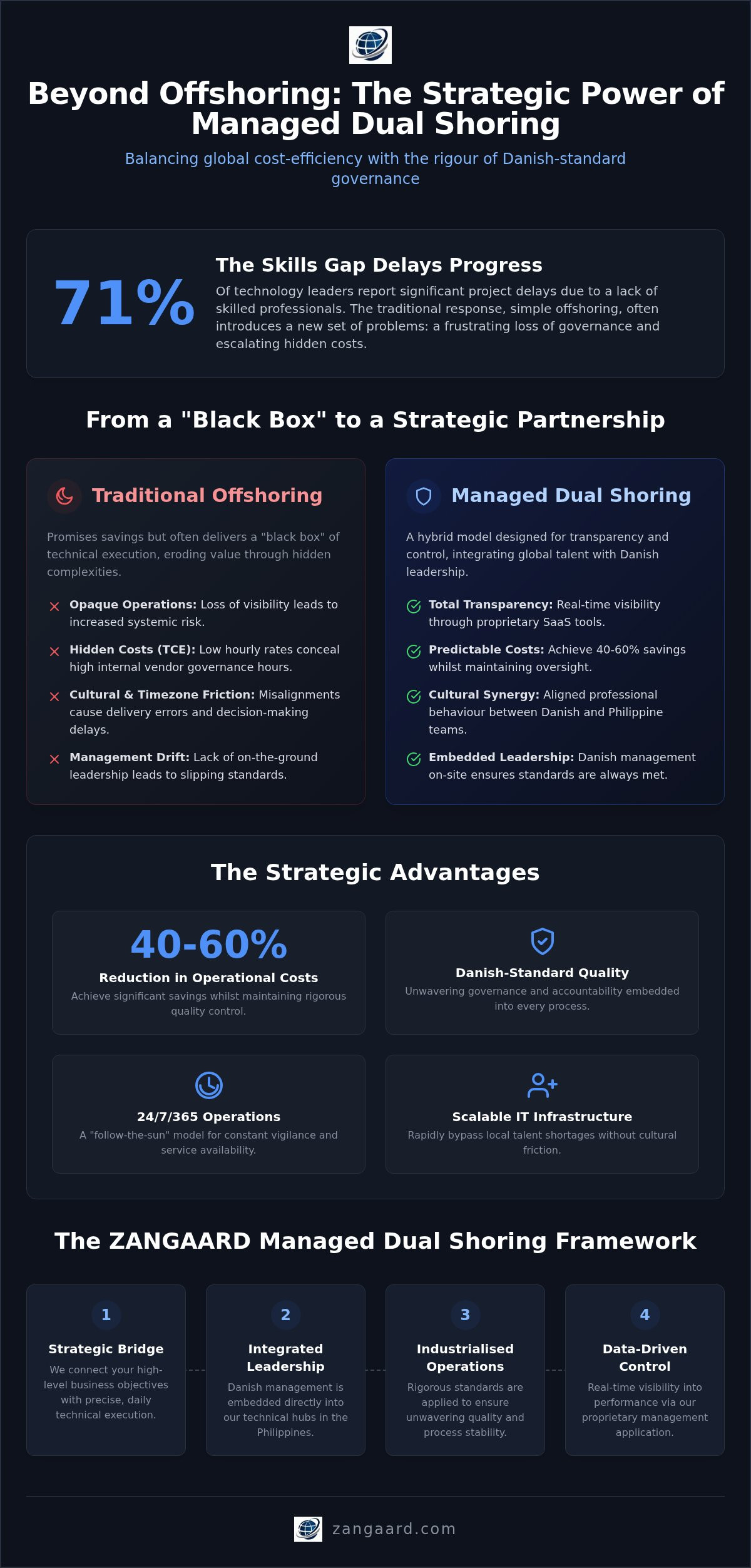
71% of technology leaders report significant project delays due to a lack of skilled professionals in 2026, yet the traditional response of simple offshoring often leads to a frustrating loss of governance. You likely recognise the tension between the need for scalable IT operations and the high costs of domestic talent, whilst feeling the friction of cultural and timezone gaps. By exploring the strategic benefits of dual shoring model, you can achieve a disciplined equilibrium between offshore cost-efficiency and local managerial accountability.
This article examines how a structured approach to ZANGAARD’s Managed Dual Shoring (MDS) ensures that technical execution in hubs like the Philippines meets rigorous Danish-standard quality assurance. We will preview how integrating these global teams into your service portfolio transforms IT from a tactical burden into a predictable, high-performance engine for growth.
Key Takeaways
- Understand why traditional offshoring often creates a "black box" effect and how to transition towards a more transparent Total Cost of Engagement approach.
- Identify the core benefits of dual shoring model, specifically how it maintains Danish-standard quality whilst leveraging the technical expertise of global teams.
- Learn how to scale your IT infrastructure management and 24/7 service desk operations without the common bottlenecks of local recruitment or cultural friction.
- Discover how ZANGAARD’s Managed Dual Shoring framework provides the strategic oversight needed to optimise your IT service portfolio.
Why Traditional Offshoring Fails the Modern Enterprise
Traditional offshoring often promises significant savings, yet many enterprises find themselves trapped in a "black box" of technical execution. When visibility into daily operations vanishes, systemic risk grows. You might see a low hourly rate on a spreadsheet, but the Total Cost of Engagement (TCE) tells a different story. This hidden cost includes the exhausting hours your senior staff spend on vendor governance. Without a bridge between your goals and the offshore team, initial savings are eroded by:
- Opaque timezone friction that delays critical decision-making.
- Cultural misalignments that lead to service delivery errors.
- Increasing labour costs hidden within internal management hours.
Many organisations mistakenly rely on "employee on record" models, assuming that simply having a legal entity to pay salaries solves the operational challenge. It doesn't. Without local managerial accountability, these teams often suffer from "management drift," where standards slip because no one on the ground shares your cultural or professional values. This is why understanding the benefits of dual shoring model becomes essential for resilience. By focusing on the strategic benefits of dual shoring model, businesses can reclaim control over their global assets whilst moving beyond the basic global delivery model through a layer of disciplined oversight.
The Governance Gap in Single-Country Sourcing
Single-country sourcing often fails because it lacks a strategic anchor. When a team is located solely in a low-cost region without local leadership, communication breaks down. This gap is the primary driver of service desk failures. To understand how to bridge this divide, consult our foundational guide on What is Dual Shoring?. At ZANGAARD, we eliminate this drift by embedding Danish management standards into our Managed Dual Shoring, ensuring your IT infrastructure management remains transparent.
The Strategic Benefits of the Dual Shoring Model
Evaluating the benefits of dual shoring model reveals a framework that moves beyond simple cost-saving to create a resilient, "follow-the-sun" operational structure. Whilst competitors often focus on physical supply chains, modern dual sourcing strategies in IT provide a 24/7/365 Command Centre that ensures constant vigilance. This model allows you to scale IT infrastructure management rapidly, bypassing local talent shortages. The synergy between Danish management and Philippine technical teams is particularly effective; both cultures share a deep alignment in professional behaviour, which minimises the friction often found in global teams.
Balancing Cost Efficiency with Local Accountability
Organisations typically achieve a 40-60% reduction in operational costs whilst maintaining the rigorous standards of Danish oversight. This "industrialised" precision is a hallmark of Managed IT Operations, where technical tasks are separated from strategic governance. Dual shoring is the hybridisation of local governance and global technical execution. One of the principal benefits of dual shoring model is the shift of management burden from your internal team to a disciplined partner. This structure provides the scalability you need without sacrificing the quality of your service portfolio. If you are looking to regain control of your IT costs, discussing your operational roadmap with an expert can clarify the transition.
Implementing Managed Dual Shoring with ZANGAARD
Transitioning from fragmented in-house IT to a streamlined model requires more than just a vendor; it requires a disciplined architect. ZANGAARD’s Managed Dual Shoring (MDS) framework provides this by integrating Danish leadership directly into our technical hubs in the Philippines. This structure ensures that whilst you capture the cost-related benefits of dual shoring model, you never lose sight of operational performance. Transparency is maintained through our proprietary Problem Management SaaS application, which provides real-time visibility into technical execution and incident trends. This data-driven approach allows for a culture of continual improvement, moving your operations from a reactive state to one of disciplined, industrialised stability.
Industrialising IT Operations through Danish Leadership
ZANGAARD acts as a strategic bridge-builder, connecting your high-level business objectives with precise daily execution. By applying rigorous Danish management standards to a global workforce, we "industrialise" your IT environment to ensure unwavering quality and accountability. A core outcome of this MDS model is the 24/7 IT Service Desk, which provides 365-day availability without the recruitment bottlenecks or high costs of domestic talent. This transition replaces internal complexity with a scalable, managed IT infrastructure that adapts seamlessly to your organisational growth. To see how these components integrate within a broader strategic framework, explore the full ZANGAARD Service Portfolio. Our methodology ensures that the strategic benefits of dual shoring model are realised through governance rather than chance, providing the peace of mind that your critical operations are in steady hands.
Securing Your Operational Future with Managed Dual Shoring
The shift toward a more resilient IT infrastructure requires a move away from opaque offshoring toward a model of disciplined transparency. By integrating Danish-led management with global technical hubs, you resolve the governance gap that often undermines international teams. The primary benefits of dual shoring model lie in this unique equilibrium; achieving significant cost optimisation whilst maintaining the rigorous quality assurance your stakeholders expect. With ZANGAARD’s specialised MDS framework, your organisation gains 24/7/365 global availability and a scalable service desk without the burden of domestic recruitment bottlenecks. This approach replaces operational complexity with a steady, industrialised process that guarantees peace of mind.
Regaining control over your IT operations starts with a strategic partnership built on accountability and excellence.
Frequently Asked Questions
What is the primary difference between dual shoring and traditional offshoring?
The primary difference lies in the governance structure. Traditional offshoring often leaves you managing a remote team directly; dual shoring introduces a management bridge. By integrating Danish leadership with technical teams in the Philippines, ZANGAARD ensures that local accountability remains intact. This hybrid approach eliminates the "black box" problem by providing a disciplined layer of oversight that traditional models lack.
How does the dual shoring model improve IT service quality?
Quality is improved through the application of rigorous Danish management standards to global technical execution. One of the core benefits of dual shoring model is the separation of technical tasks from strategic governance. This allows for industrialised precision in IT operations. We utilise our Problem Management SaaS application to ensure transparency and drive a culture of continual improvement across all service layers.
Is dual shoring suitable for small to medium-sized Danish enterprises?
Yes, the model is particularly effective for Danish SMEs struggling with the high costs of domestic IT talent. It offers a Managed Dual Shoring framework without the need for extensive local recruitment. Smaller organisations can access a 24/7/365 command centre that provides the same operational resilience usually reserved for large enterprises, ensuring complex operations are handled by a steady hand.
What are the cost-saving expectations when moving to a managed dual shoring model?
Organisations typically anticipate a 40-60% reduction in operational costs compared to maintaining a purely domestic team. However, the true value lies in the Total Cost of Engagement. By shifting the burden of management to ZANGAARD, your senior staff spend less time on vendor oversight. This efficiency makes the benefits of dual shoring model highly compelling for long-term strategic budgeting.
How does ZANGAARD handle cultural differences between Danish and Philippine teams?
We bridge cultural gaps by embedding Danish leadership directly into our Philippine operations. The Philippines and Denmark share a strong alignment in professional behaviour, which we reinforce through our established MDS framework. This synergy ensures that technical teams understand the nuances of Danish business expectations. You can explore our service portfolio to see how we maintain this seamless synergy.
Disclaimer
The purpose of this article is to generate inspiration, reflection and to start a debate across markets, industries and organizations. We do not recommend any actions soly based on the article statements, claims or opinions, but recommend you to reach out directly to ZANGAARD for a qualified review, dialogue and/or consultation. Reach out at [email protected] or visit our website www.zangaard.com


