
The most significant friction in global operations isn't the physical distance between offices, but the accountability gap between strategy and execution. You've likely felt the weight of management fatigue whilst navigating the inherent challenges of managing offshore IT teams, where inconsistent service quality and cultural barriers often turn cost-saving measures into operational burdens. It's exhausting to invest in global talent only to find yourself micromanaging results to protect your SLAs.
This guide introduces a disciplined approach to Managed Dual Shoring, demonstrating how to integrate Danish accountability with technical execution in the Philippines. We'll examine how this hybrid model provides a scalable IT infrastructure that requires minimal internal oversight, ensuring 24/7 reliability and predictable costs. By shifting the burden of governance to a seasoned partner, you can achieve the stability of Danish management standards whilst leveraging the power of a global workforce.
Key Takeaways
- Learn why moving from staff augmentation to outcome-based managed operations is essential for eliminating management fatigue and reclaiming internal leadership capacity.
- Discover how to navigate the inherent challenges of managing offshore IT teams by integrating Danish accountability with high-performing technical execution.
- Understand the role of Managed Dual Shoring (MDS) in bridging cultural gaps, ensuring your global operations adhere to rigorous Danish quality standards.
- Gain a clear roadmap for scaling your infrastructure through a unified 24/7 service desk that provides operational stability without increasing your administrative overhead.
The Operational Friction of Traditional IT Outsourcing: Staff Augmentation vs Managed Services
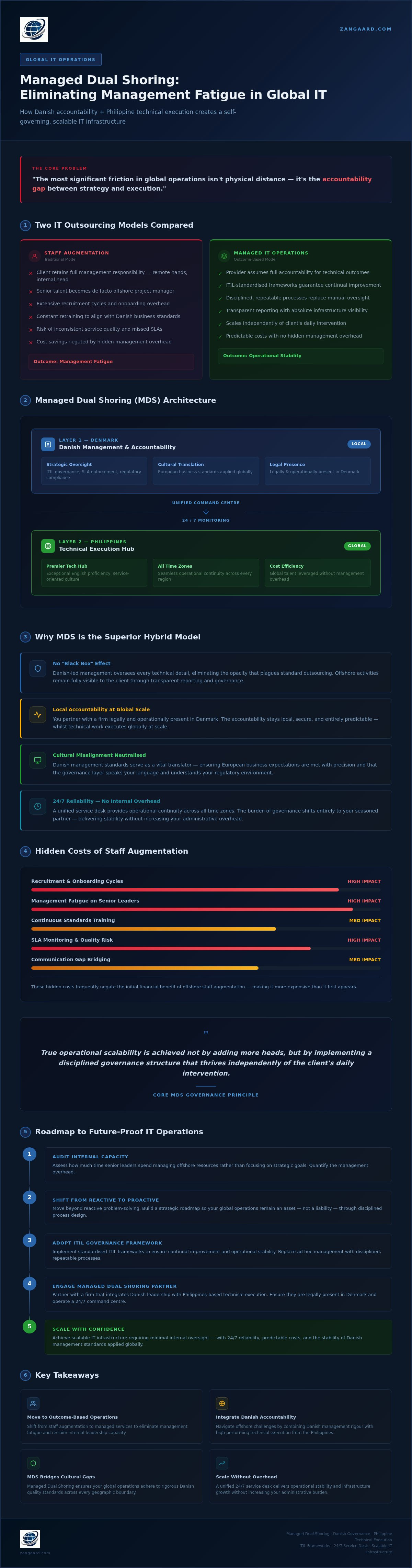
Traditional IT outsourcing models often promise cost efficiency but deliver administrative complexity. When firms opt for staff augmentation, they essentially hire remote hands whilst retaining the management head. This tactical approach frequently leads to severe management fatigue as internal leaders become de facto project managers for offshore resources. Instead of focusing on high-level strategy, your senior talent spends their day bridging communication gaps and monitoring individual performance. It's a drain on resources that often negates the initial financial benefits.
The hidden costs of this model are substantial. You must account for:
- Extensive recruitment cycles and onboarding overheads in foreign markets.
- Continuous training to align remote staff with Danish business standards.
- The constant risk of inconsistent service quality and missed SLAs.
True enterprise stability requires a shift toward Managed IT Operations. Here, the focus moves from tactical hiring to industrialised precision, where the provider assumes full accountability for technical outcomes. This shift addresses the core challenges of managing offshore IT teams by replacing manual oversight with disciplined, repeatable processes that guarantee performance without constant internal intervention.
The Governance Gap: Moving Beyond Simple Staffing to Strategic Oversight
A mature managed model relies on standardised frameworks like ITIL to ensure continual improvement and operational stability. By leveraging ZANGAARD's service portfolio, Danish organisations can remove the management burden whilst maintaining absolute transparency over their infrastructure. 'True operational scalability is achieved not by adding more heads, but by implementing a disciplined governance structure that thrives independently of the client’s daily intervention.' This transition ensures that your IT environment remains resilient, regardless of geographic distance, allowing you to scale with confidence.
Bridging Geographic Barriers: Why Managed Dual Shoring is the Superior Hybrid Model
Managed Dual Shoring (MDS) represents a strategic evolution in how global talent is harnessed. By integrating local Danish leadership with technical execution in the Philippines, organisations can effectively neutralise the cultural misalignment that often plagues standard outsourcing. In this model, Danish management standards serve as a vital translator, ensuring that European business expectations are met with precision. This architecture addresses the primary challenges of managing offshore IT teams by providing a governance layer that speaks your language and understands your regulatory environment.
The Philippines has emerged as a premier technical hub, offering exceptional English proficiency and a service-oriented culture. When governed by a 24/7 command centre, this workforce provides seamless operational continuity across all time zones. The distinct advantage of MDS is local accountability; you partner with a firm that is legally and operationally present in Denmark whilst executing at a global scale. If you are looking to refine your approach, discussing your infrastructure needs with a local expert can clarify the transition.
Mitigating Offshore Risk with Danish Management and Local Oversight
Strategic reassurance is built into the MDS framework through a Danish-led management layer that oversees every technical detail. This oversight eliminates the 'black box' effect where offshore activities become opaque to the client, solving many of the inherent challenges of managing offshore IT teams. By following a Strategic Guide to IT Infrastructure Management, firms can maintain high quality across borders through transparent reporting and disciplined governance. This hybrid structure ensures that whilst the technical work is performed globally, the accountability remains local, secure, and entirely predictable.
A Roadmap to Future-Proofing Your IT Operations and Scaling with Confidence
To build a resilient infrastructure, you must move beyond reactive problem-solving. A strategic roadmap ensures that your global operations remain an asset rather than a liability. Start by auditing your internal management capacity. If your senior architects spend more time on performance reviews than on innovation, management fatigue is already bottlenecking your growth. This is one of the most pervasive challenges of managing offshore IT teams today.
- Transition to a unified model: Shift from fragmented staffing to a 24/7 IT service desk. This centralises accountability and ensures global continuity without increasing your administrative load.
- Prioritise dual-shore capabilities: Evaluate partners based on their ability to enforce Danish quality standards rather than just their hourly rates or geographic reach.
- Embed continual improvement: Implement a cycle of continual improvement where technical execution in the Philippines is constantly optimised by European-led governance to maintain industrialised precision.
Implementing Managed Dual Shoring to Regain Operational Control
Managed Dual Shoring creates a seamless digital operating model that connects your high-level strategy directly with daily technical execution. The success of global operations hinges on the presence of a 'bridge-builder' who can navigate the complex challenges of managing offshore IT teams by aligning local Danish expectations with global talent. This disciplined approach allows you to regain control and focus on core business objectives. To explore how Managed Dual Shoring can simplify your complex IT infrastructure, contact ZANGAARD for a strategic consultation.
Mastering Global IT Governance with Dual Shoring
Transitioning from staff augmentation to managed operations resolves the primary challenges of managing offshore IT teams by shifting the weight of accountability to a disciplined partner. By integrating Danish management standards with high-performing technical execution in the Philippines, organisations can eliminate management fatigue whilst ensuring 24/7 operational reliability. Since 2014, ZANGAARD has utilised this hybrid model to provide a specialised command centre that operates with industrialised precision and total transparency.
The choice between cost efficiency and operational control is a false dichotomy. By adopting a bridge-builder approach, your organisation gains the freedom to scale without the administrative friction that traditionally hampers international growth. It's time to secure your operations with a partner who prioritises accountability as much as you do.
Book a Strategic Consultation for Managed Dual Shoring
Frequently Asked Questions
What are the most common challenges of managing offshore IT teams?
The most common challenges of managing offshore IT teams include cultural misalignment, communication barriers, and time zone friction. Many organisations find that traditional staff augmentation forces internal leaders into the role of project managers, causing significant management fatigue. This lack of a local governance layer often results in inconsistent service quality and missed SLAs, undermining the primary cost-saving objectives of the outsourcing strategy.
How does Managed Dual Shoring differ from traditional IT offshoring?
Managed Dual Shoring differs from traditional offshoring by introducing a local accountability layer. Whilst traditional models leave the client to manage remote resources directly, MDS integrates Danish leadership with technical execution in the Philippines. This hybrid architecture ensures that strategic oversight remains in Denmark, allowing the service provider to take full responsibility for technical outcomes and service delivery standards rather than just providing heads.
Is it possible to maintain Danish management standards with an offshore team?
Maintaining Danish management standards is entirely possible when using a hybrid governance framework. ZANGAARD achieves this by placing a Danish-led management layer between the client and the offshore technical team. This ensures that all operations adhere to local compliance and quality expectations. It provides the strategic reassurance that your infrastructure is managed with the same discipline you would expect from a domestic team.
Why is the Philippines considered a premier destination for IT outsourcing for European companies?
The Philippines is favoured for its exceptional English proficiency and strong technical talent pool. It serves as a premier hub because its workforce is highly aligned with Western business culture and communication styles. When coupled with a 24/7 command centre, it allows European companies to maintain operational continuity and global business stability without the friction typically associated with distant and difficult time zones.
How can I reduce the management overhead associated with my offshore technical staff?
To reduce management overhead, you should transition from tactical staffing to outcome-based managed operations. This move effectively solves the challenges of managing offshore IT teams by shifting the responsibility for recruitment, training, and daily oversight to your partner. By implementing a scalable service desk, your internal senior talent is freed from micromanagement, allowing them to focus on high-level organisational strategy and innovation.
Disclaimer
The purpose of this article is to generate inspiration, reflection and to start a debate across markets, industries and organizations. We do not recommend any actions soly based on the article statements, claims or opinions, but recommend you to reach out directly to ZANGAARD for a qualified review, dialogue and/or consultation. Reach out at [email protected] or visit our website www.zangaard.com


