

With over 90% of organisations reporting critical IT skills gaps in 2026, the strategic rationale for external partnerships has evolved far beyond simple labour-cost arbitrage. You are likely facing the dual challenge of escalating local talent costs and the persistent difficulty of maintaining 24/7 coverage amongst your internal staff. Understanding how to build a business case for IT outsourcing in this climate requires a shift in perspective, moving from a focus on savings to a focus on operational resilience and access to global expertise.
We recognise that the fear of losing control over critical infrastructure often stalls necessary transitions. This article promises to equip you with a structured ROI framework and a strategy to mitigate offshore risks through local accountability. We will explore how ZANGAARD Services and our service portfolio for Managed IT Operations and 24/7 Service Desk support can bridge the gap between high-level strategy and daily execution, ensuring your digital transformation remains disciplined and secure whilst driving long-term operational resilience.
Key Takeaways
- Align technical operational requirements with high-level executive strategy to ensure your IT infrastructure supports sustainable growth and organisational stability.
- Discover how to build a business case for IT outsourcing by identifying specific scalability bottlenecks and service gaps that currently hinder your internal team's performance.
- Master a framework for quantifying the full value of a partnership by measuring direct financial savings alongside indirect gains like improved uptime and enhanced operational resilience.
- Leverage the Managed Dual Shoring model to secure the cost benefits of global delivery whilst maintaining strict Danish management standards and local accountability.
- Connect your strategic goals to the practical solutions found in ZANGAARD Services and our comprehensive service portfolio for Managed IT Operations.
Analysing the Strategic Drivers: Why IT Outsourcing is Essential in 2026
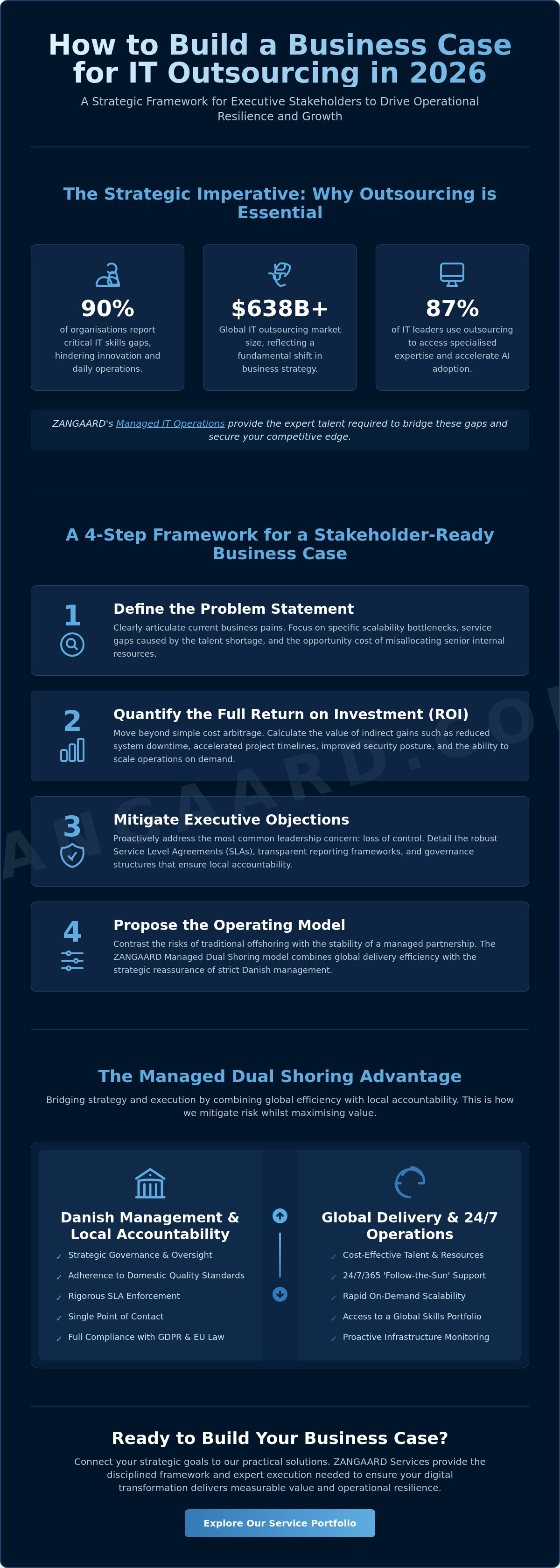
A successful business case serves as a vital bridge between technical necessity and executive strategy. In 2026, the global IT outsourcing market has surpassed $638 billion, reflecting a fundamental shift in how organisations approach growth. Understanding how to build a business case for IT outsourcing requires a transition from viewing external partners as a cost-saving measure to seeing them as a catalyst for operational agility. With 87% of IT leaders now using outsourcing to accelerate AI adoption, the primary goal is to secure the specialised expertise and speed to market required to stay competitive.
Identifying Hidden Costs in Internal IT Management
The true Total Cost of Ownership (TCO) for internal teams often remains obscured by fragmented budgets. Beyond base salaries, the financial burden includes escalating recruitment fees, continuous training, and the high cost of retention in a volatile talent market. There's also a substantial opportunity cost when senior leaders are consumed by managing daily tickets rather than driving Digital Transformation Consulting. Maintaining 24/7 infrastructure oversight internally is particularly taxing, often requiring a headcount that mid-sized firms find difficult to sustain. Transitioning these tasks to a 24/7 Service Desk ensures that your internal talent can focus on high-value strategic initiatives whilst experts handle the operational heavy lifting.
The Resilience Mandate: Risk and Compliance
Operational resilience is now a non-negotiable executive requirement. As data privacy laws like the GDPR and the new 2026 US state privacy mandates evolve, the complexity of compliance grows. A critical component of how to build a business case for IT outsourcing is demonstrating how an expert partner reduces the risk surface through enterprise-grade security protocols. By integrating Managed IT Operations, businesses gain access to sophisticated IT Infrastructure Management that adheres to global standards whilst maintaining the local accountability necessary for peace of mind. This synergy allows for a controlled environment where risk is managed by a disciplined hand, providing the strategic reassurance that modern leadership demands.
Developing the Framework: A Step-by-Step Business Case for Stakeholders
Presenting a proposal to the board requires more than a spreadsheet of potential savings. It demands a structured narrative that addresses the specific operational vulnerabilities of your organisation. Mastering how to build a business case for IT outsourcing involves moving through four critical stages of validation:
- Step 1: Define the Problem Statement. Focus on current scalability bottlenecks and the service gaps created by the global talent shortage.
- Step 2: Quantify ROI. Balance direct cost reductions with indirect gains such as reduced system downtime and accelerated project timelines.
- Step 3: Mitigate Objections. Address security, data sovereignty, and cultural alignment before they are raised as barriers to progress.
- Step 4: Propose the Operating Model. Contrast the inherent risks of traditional offshoring with the stability and local accountability of a managed dual shoring approach.
Calculating ROI Beyond the Initial Service Fee
True financial impact isn't found in a lower hourly rate; it's found in the ability to scale on demand without the three-to-six-month lag of internal recruitment. This agility allows your firm to respond to market shifts whilst maintaining a lean internal structure. The value drivers of this model are clear: enhanced security through enterprise-grade protocols, improved uptime via proactive infrastructure monitoring, and 24/7 availability through a global support network. Value Realisation is the precise alignment of IT performance metrics with your organisation's overarching business KPIs.
Addressing the Executive Concern: Loss of Control
The fear of losing control over critical infrastructure is the most common reason executive teams hesitate. You can resolve this by embedding rigorous Service Level Agreements (SLAs) and transparent reporting frameworks into the core of your proposal. Local oversight ensures that offshore technical execution never drifts from domestic quality standards, providing the "strategic reassurance" leadership requires. By utilising Managed IT Operations, you maintain the strategic reins whilst shifting the management burden to a disciplined partner. Reviewing our service portfolio can provide concrete examples of how these governance frameworks are applied in high-stakes environments to ensure peace of mind.
The Managed Dual Shoring Advantage: Bridging Strategy and Execution
The Managed Dual Shoring model represents the pinnacle of modern IT governance, specifically designed for organisations that demand Danish management standards alongside global scalability. It addresses the common pitfall of traditional offshoring where communication barriers and a lack of oversight often lead to service degradation. By maintaining local Danish oversight, you gain the strategic reassurance that high-stakes operations are handled with precision. This model creates a powerful synergy between the technical scalability found in the Philippines and the unwavering accountability of a local partner. It transforms your 24/7 Service Desk from a mere support function into an industrialised extension of your business.
When you finalise how to build a business case for IT outsourcing, the inclusion of a dual-shored model often proves to be the deciding factor for risk-averse stakeholders. It demonstrates a commitment to quality that simple labour-cost arbitrage cannot match. This approach ensures that your IT Infrastructure Management remains robust, transparent, and aligned with your core values.
Integrating Global Talent with Local Accountability
ZANGAARD serves as the Disciplined Global Architect, connecting high-level strategy in Denmark with rigorous execution in the Philippines. This structure provides the peace of mind that comes when the burden of management is shifted to proven experts. You no longer need to worry about the complexities of international employment law or time zone management. Instead, Managed IT Operations act as a catalyst for enterprise growth, allowing your internal leadership to focus on innovation whilst we maintain the stability of your infrastructure.
Transitioning to a Managed Model with ZANGAARD
Moving from an internal-only model to Managed Dual Shoring requires a methodical roadmap. We begin by auditing your current technical needs and identifying where global support can provide the most immediate relief. This transition isn't about replacement; it's about enhancement. Our approach ensures that every process is documented, every SLA is met, and every stakeholder remains informed. To begin your journey, Explore ZANGAARD’s Service Portfolio to build your custom business case and secure the operational resilience your organisation deserves.
Future-Proofing Your Infrastructure with Strategic Oversight
The transition from simple cost reduction to strategic capability-building marks the new standard for technology leadership in 2026. By aligning technical necessity with executive strategy, you transform your IT department from a potential bottleneck into a resilient growth engine. We've established that the most effective proposals prioritise governance and local accountability over simple labour-cost arbitrage. Mastering how to build a business case for IT outsourcing allows you to present a risk-aware, value-driven framework that secures long-term executive buy-in and operational stability.
To ensure your digital transformation remains on a disciplined path, Optimise your IT operations with ZANGAARD’s Managed Dual Shoring. Our model provides the strategic reassurance of Danish management and local oversight, combined with the scalability of a 24/7 Service Desk and expert Philippine technical team integration. This partnership shifts the burden of management to a steady hand, granting you the peace of mind to focus on high-level innovation. Taking this step ensures your organisation is not just keeping pace, but leading with confidence in a complex global market.
Frequently Asked Questions
What are the most common risks to include in an IT outsourcing business case?
A comprehensive business case must address risks such as data sovereignty, service delivery inconsistencies, and the potential loss of institutional knowledge. You should outline how these are mitigated through enterprise-grade security protocols and transparent governance frameworks. By integrating IT Infrastructure Management, organisations can shift the burden of risk to a partner that adheres to global standards whilst maintaining the local accountability required for peace of mind.
How do I calculate the ROI of shifting from in-house IT to managed services?
When determining how to build a business case for IT outsourcing, you should contrast the current internal Total Cost of Ownership with the predictable monthly retainer of a managed model. This calculation must include the recruitment cycle cost and the financial impact of downtime caused by internal staffing gaps. Factoring in the scalability of Managed IT Operations allows you to demonstrate value realisation beyond simple labour savings.
Can I maintain local management standards whilst using an offshore technical team?
Yes, maintaining local standards is entirely possible through a dual-management framework that places Danish leadership over offshore technical execution. This structure ensures that every ticket and project meets domestic quality expectations. It provides the strategic reassurance that high-stakes operations aren't being handled in a vacuum but are instead part of a disciplined, globally integrated architecture that aligns with your internal organisational culture.
What is the difference between traditional offshoring and Managed Dual Shoring?
Traditional offshoring typically requires the client to manage the offshore vendor directly, which often leads to communication gaps and quality drift. Managed Dual Shoring removes this burden by providing a local management layer that acts as a bridge between high-level strategy and daily execution. This approach, featured in our service portfolio, ensures that global talent functions as a seamless, industrialised extension of your internal business operations.
Disclaimer
The purpose of this article is to generate inspiration, reflection and to start a debate across markets, industries and organizations. We do not recommend any actions soly based on the article statements, claims or opinions, but recommend you to reach out directly to ZANGAARD for a qualified review, dialogue and/or consultation. Reach out at [email protected] or visit our website www.zangaard.com


