

With wasted cloud spend reaching 29% in 2026, the financial efficiency of your infrastructure is likely under more scrutiny than ever before. You probably feel the pressure of budget overruns caused by hidden management overheads or the difficulty of quantifying the true impact of service downtime on your bottom line. Calculating total cost of ownership for IT services is no longer a simple accounting exercise; it's a strategic necessity for maintaining operational resilience in an era where Google Cloud data transfer fees are doubling and AWS EC2 capacity costs have risen by 15%.
We understand that you seek a disciplined approach to governance that balances cost with high-performance outcomes. This guide provides a clear framework for identifying hidden cost-saving opportunities and explains how managed dual-shoring can optimise your long-term budget. By exploring ZANGAARD Services and our comprehensive service portfolio, you will learn how to justify a managed service model that shifts the burden of complexity from your internal teams to our expert oversight. We will move from high-level cost analysis to the granular details of how Managed IT Operations and IT Infrastructure Management create a state of streamlined simplicity for your organisation.
Key Takeaways
- Understand the strategic transition from CAPEX to OPEX whilst adjusting your financial framework for risk and long-term operational stability.
- Master a rigorous methodology for calculating total cost of ownership for IT services that accounts for both contract values and internal resource allocations.
- Identify the Management Friction Factor to reveal the hidden costs of senior leadership time spent on resolving technical inefficiencies.
- Learn how a managed dual-shore model provides the economic benefits of offshoring without sacrificing governance or quality standards.
- Explore how ZANGAARD Services and our service portfolio can transform your cost centre into a predictable, high-value asset.
Establishing the Framework for IT Service TCO Analysis
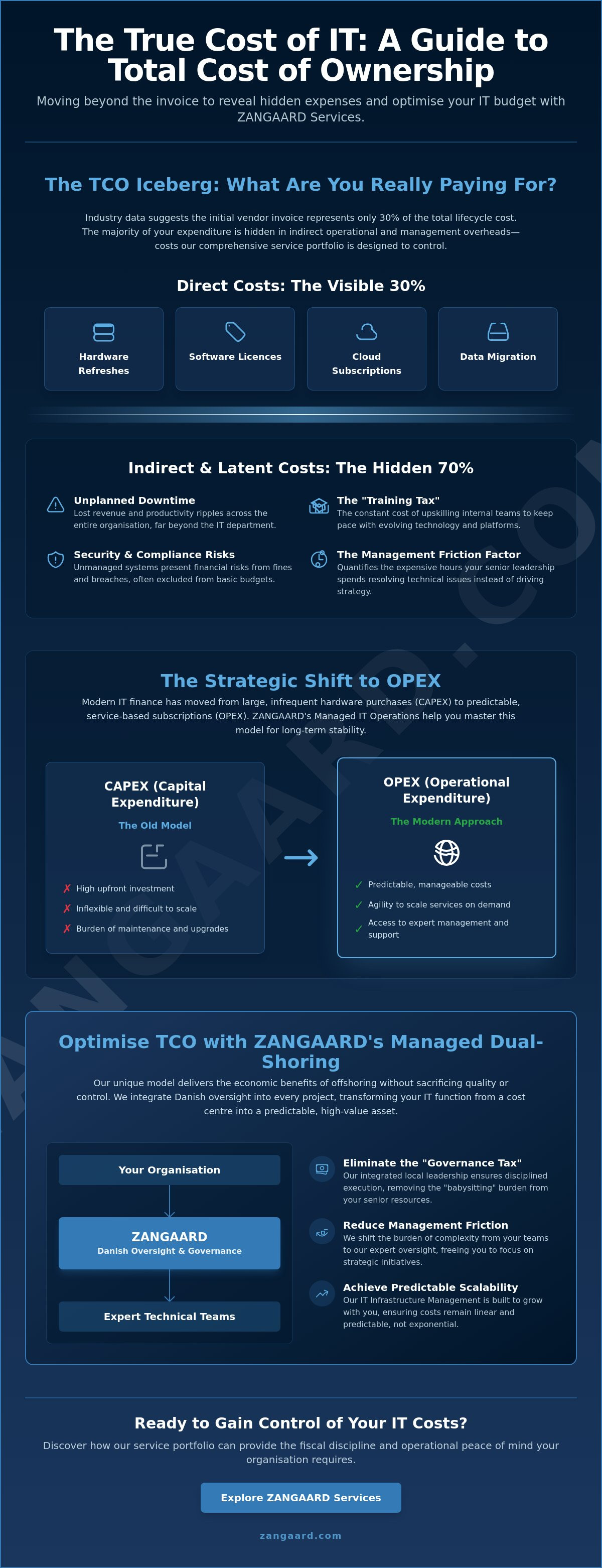
Effective fiscal oversight begins with a comprehensive definition of value. In the context of modern enterprise technology, Total cost of ownership (TCO) represents the holistic financial commitment required to sustain an asset or service throughout its entire lifecycle. This includes the initial acquisition, ongoing operational maintenance, and the intensive management oversight necessary to mitigate risk. We've seen a decisive shift from Capital Expenditure (CAPEX), where hardware was the primary cost driver, to Operational Expenditure (OPEX), where service-based models dominate the budget. This transition requires a more nuanced approach to calculating total cost of ownership for IT services, moving through distinct phases: discovery, implementation, steady-state operations, and eventual transition.
IT TCO is the cumulative sum of all direct and indirect expenditures, including the specific costs of governance, professional accountability, and the mitigation of operational risk.
Categorising Direct Costs and Capital Expenditure
Direct costs represent the visible surface of your budget, encompassing software licences, cloud subscriptions, and hardware refreshes. The initial onboarding phase, including data migration and system integration, demands focused resource allocation. Industry data suggests the initial vendor invoice often represents only 30% of the total lifecycle cost. The remaining 70% is consumed by the continuous effort required to maintain and manage the environment effectively. Our service portfolio is designed to provide transparency into these figures from day one, ensuring no surprises as your operations scale.
Uncovering Indirect and Latent Operational Expenses
Latent expenses are where financial control is frequently lost. Unplanned downtime impacts business productivity far beyond the IT department, creating a ripple effect of lost revenue. You must also account for the "training tax," which is the constant cost of upskilling internal teams to keep pace with evolving technology. Compliance failures and security vulnerabilities in unmanaged systems present significant financial risks that are often excluded from basic budgets. By leveraging Managed IT Operations, organisations can transform these unpredictable risks into steady, manageable operational costs. This shift provides the "peace of mind" that comes from knowing complex systems are under disciplined, expert control.
A Step-by-Step Guide to Calculating Your IT Service Costs
Establishing a baseline for your technology spend requires a rigorous audit of all active IT contracts and internal staff allocations. Whilst many organisations focus on the monthly invoice, calculating total cost of ownership for IT services must include the "Management Friction Factor." This metric quantifies the hours senior leadership spends resolving technical roadblocks or managing vendor performance. By following a structured step-by-step guide to TCO, you can move beyond surface-level accounting to identify where internal productivity is being drained by inefficient oversight.
Quantifying Management Oversight and Governance Overhead
One common pitfall is the "governance tax" associated with unmanaged offshore teams. Without local leadership, the burden of "babysitting" falls on your most expensive internal resources. We calculate the impact of cultural and timezone misalignment by measuring the delay in project timelines and the resulting increase in management hours. Our approach at ZANGAARD integrates Danish oversight as a cost-saving mechanism, ensuring that technical execution remains disciplined and aligned with your strategic objectives. If you're looking to stabilise these variables, exploring our ZANGAARD Services can provide the predictable framework your budget requires.
Factoring in Scalability and Risk Mitigation
Scalability introduces its own set of plateaus. Assessing the cost of expanding a team from 10 to 50 members reveals that service models without built-in governance often experience exponential cost increases. You must integrate business continuity planning and IT Infrastructure Management into your 3-year and 5-year projections. Assigning a monetary value to service desk responsiveness ensures that ticket resolution times are viewed as a productivity driver rather than a line item. Proactive governance effectively eliminates the "emergency spend" typically required to salvage IT crises. This methodical approach ensures your service portfolio remains an asset rather than a liability as your organisation grows.
Optimising TCO through Managed Dual Shoring
Capturing the economic efficiency of global talent often comes with a hidden "governance tax" that erodes the very savings you intended to achieve. Managed dual shoring addresses this challenge by providing a structured bridge between high-level strategy and daily execution. By integrating Danish management with Philippines-based technical execution, we remove the friction of cultural misalignment and timezone gaps. This model serves as a roadmap for optimising IT service TCO, ensuring that your budget is spent on performance rather than oversight. When calculating total cost of ownership for IT services, the ability to maintain 24/7 operational continuity whilst your local team rests creates a powerful multiplier for your technology spend.
Eliminating Friction with Local Danish Accountability
Direct offshoring frequently fails because it forces your internal leaders to navigate international legal frameworks and complex cultural nuances. Managed dual shoring shifts this burden to a local Danish partner who takes full accountability for the quality of output. The difference in management hours between these two models is stark. Direct offshoring requires constant "babysitting" of remote teams; our managed approach provides a transparent, predictable cost structure. We invite you to explore ZANGAARD’s Managed IT Operations to see how we industrialise precision in delivery.
Building a Sustainable Technology Roadmap
Long-term savings are built on the foundation of "industrialised" precision. Our Digital Transformation Consulting ensures your infrastructure remains lean as you scale, preventing the cost plateaus identified in previous sections. By prioritising TCO transparency, we help you transition from reactive emergency spending to a state of controlled stability. Use the following checklist when evaluating a partner:
- Does the provider offer local governance integrated with global execution?
- Is there a clear framework for 24/7 service desk accountability?
- Can they demonstrate a methodology for reducing management friction?
Securing Long-Term Value through Disciplined Governance
Mastering the methodology for calculating total cost of ownership for IT services is the first step toward regaining control over your operational spend. We've explored how identifying the management friction factor and transitioning from rigid CAPEX to flexible OPEX models can reveal significant hidden savings. By adopting a framework that prioritises accountability and operational precision, you can transform your technology department from a complex cost centre into a driver of predictable stability. A sustainable roadmap requires more than just technical execution; it demands a governance model that scales without increasing your management burden.
With over a decade of experience in reducing operational friction for Danish enterprises, ZANGAARD provides the transparent and predictable pricing models your organisation needs for long-term growth. Our ZANGAARD Services and comprehensive service portfolio are built on Danish management standards combined with global technical scalability. This synergy ensures that your high-stakes operations are handled with a disciplined, steady hand. Optimise your IT TCO with ZANGAARD’s Managed Dual Shoring and experience the peace of mind that comes from professional infrastructure oversight. Take the next step toward a more predictable and efficient future for your business today.
Frequently Asked Questions
What is the most commonly overlooked cost in IT TCO calculations?
The "Management Friction Factor" is the most frequently ignored cost, representing the significant hours senior leaders spend managing low-cost, unmanaged vendors. This hidden overhead often negates the perceived savings of cheaper contracts. By utilising Managed IT Operations, firms can eliminate this friction and ensure that their leadership remains focused on strategic growth rather than operational troubleshooting.
How does managed IT services pricing differ from traditional in-house budgeting?
Managed IT services pricing provides a predictable, subscription-based model that contrasts sharply with the variable and often opaque nature of in-house budgeting. In-house costs include not just salaries, but also recruitment, continuous training, and hardware lifecycle management. ZANGAARD’s service portfolio offers a transparent alternative where these operational complexities are handled by experts for a fixed, manageable fee.
Can dual shoring actually reduce the total cost of ownership compared to pure offshoring?
Yes, dual shoring frequently lowers the total cost of ownership by removing the expensive management burden associated with traditional offshoring. Whilst pure offshoring might offer lower hourly rates, the cost of cultural misalignment and timezone delays often inflates the final bill. Our dual-shore model combines local Danish accountability with global technical execution to ensure high standards without the governance tax.
What is the difference between CAPEX and OPEX in the context of IT services?
CAPEX involves large upfront investments in physical assets like servers, whilst OPEX refers to the ongoing subscription costs for services and cloud infrastructure. Modern budgeting favours OPEX because it allows for greater agility and easier scalability. When calculating total cost of ownership for IT services, shifting to an OPEX model helps businesses avoid the risk of owning depreciating hardware that requires constant maintenance.
How often should a firm re-evaluate its IT service TCO?
Organisations should conduct a comprehensive TCO review at least once per year or whenever significant changes to the technology stack occur. Frequent audits ensure that your IT spend remains aligned with business objectives and that you aren't paying for underutilised cloud capacity or redundant licenses. This regular oversight is a core component of IT Infrastructure Management, providing the data needed for informed decision-making.
Is it possible to calculate the ROI of improved IT governance?
It's entirely possible to quantify the ROI of governance by measuring the reduction in "emergency spend" and the increase in system uptime. Improved governance leads to faster ticket resolution and more stable environments, which directly impacts employee productivity. By integrating a 24/7 Service Desk, businesses can ensure that technical issues are resolved before they escalate into costly operational crises.
Disclaimer
The purpose of this article is to generate inspiration, reflection and to start a debate across markets, industries and organizations. We do not recommend any actions soly based on the article statements, claims or opinions, but recommend you to reach out directly to ZANGAARD for a qualified review, dialogue and/or consultation. Reach out at [email protected] or visit our website www.zangaard.com


