

Why is it that the very strategy designed to protect your budget often ends up costing you your peace of mind? With the global IT outsourcing market projected to exceed $638 billion in 2026, the strategic challenge is no longer whether to outsource, but how to do so without sacrificing oversight. You have likely experienced the friction of cultural barriers or the frustration of a service desk that feels worlds away when a critical system fails. At ZANGAARD, we recognise these challenges as the symptoms of a fragmented model. By exploring the strategic benefits of dual shoring, you can secure an IT infrastructure that delivers the scalability of a global workforce whilst maintaining the rigorous accountability of Danish management standards.
This article provides a roadmap for balancing global efficiency with the local reliability your business requires. We will demonstrate how the dual shoring model eliminates the risks of traditional offshoring whilst maintaining the cost-efficiency required for modern IT operations. By integrating our ZANGAARD Services and service portfolio with a dedicated technical centre in the Philippines, we provide a 24/7/365 Command Centre that feels local. You will discover how this disciplined approach ensures predictable costs and Danish-standard quality, moving your IT from a source of risk to a scalable asset that supports your long-term growth.
Key Takeaways
- Recognise how the dual shoring model integrates Danish governance with global technical execution to provide a more resilient alternative to traditional offshoring.
- Discover the primary benefits of dual shoring in reducing operational risks whilst maintaining the cost-efficiency required for a scalable 24/7 IT service desk.
- Learn why local oversight acts as the critical bridge that ensures offshore technical operations remain strictly aligned with your quality standards.
- See how ZANGAARD bridges the gap between strategy and execution within our Managed IT Operations and service portfolio to provide genuine peace of mind.
- Gain a practical framework for identifying which IT infrastructure components are best suited for a hybrid delivery model to optimise your global performance.
Beyond Traditional Offshoring: Defining the Dual Shoring Model for IT
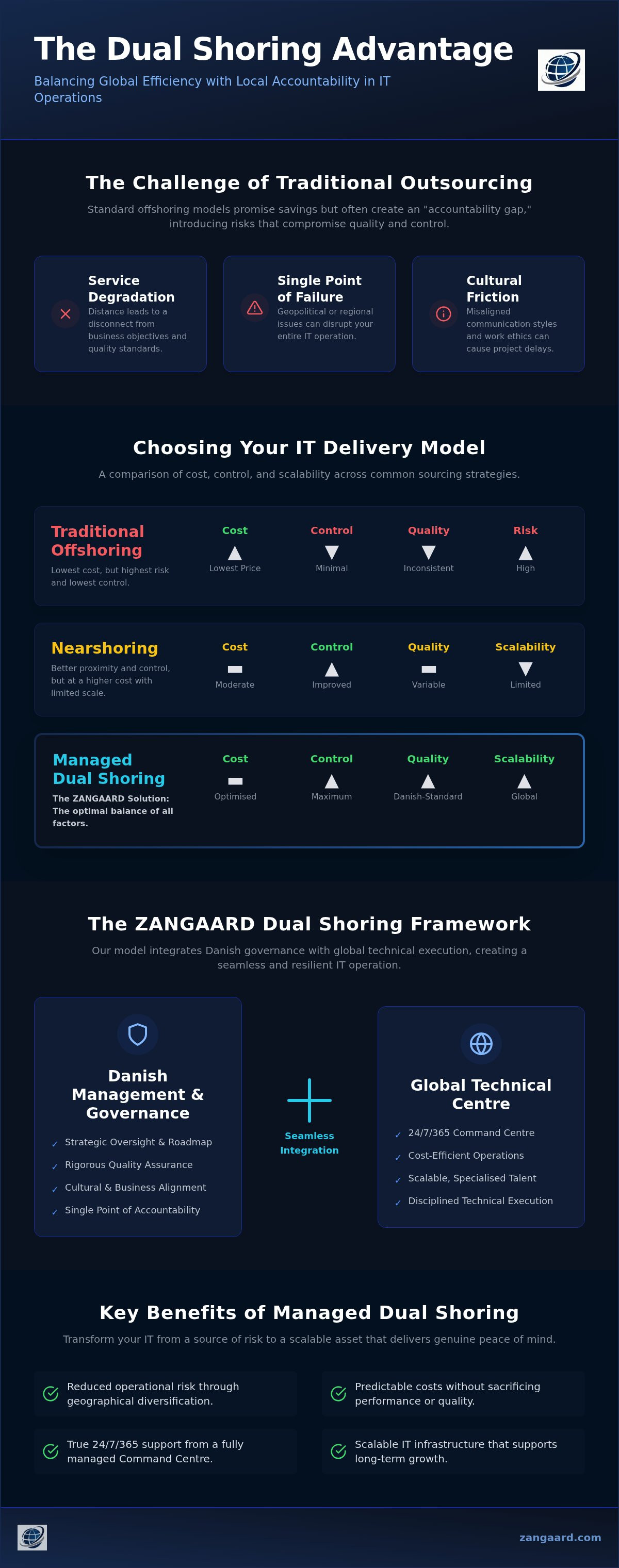
Dual shoring in the context of IT is a hybrid operational model that integrates local governance with offshore technical execution. Unlike traditional "single-shore" offshoring, which often leaves a vacuum of leadership, this approach ensures that high-level strategy and daily operations are synchronised across borders. While nearshoring offers proximity, it frequently fails to match the cost-efficiency required for large-scale Managed IT Operations. This is why many organisations are transitioning towards Managed Dual Shoring (MDS). They've realised that unmanaged offshoring creates a dangerous "accountability gap" where the distance between the client and the technical team leads to service degradation. By adopting MDS, businesses can access a strategic framework for IT Infrastructure Management that balances global talent with local oversight.
The Evolution of Sourcing: Why Single-Source Models Fail
Relying on a single geographical location for IT support introduces significant operational risk. Geopolitical instability or regional infrastructure failures can create a "single point of failure" that takes down critical systems. One of the key benefits of dual shoring is the built-in redundancy it provides for your business. By distributing resources across different regions while maintaining a centralised 24/7/365 Command Centre setup, businesses ensure that their service desks remain operational regardless of local disruptions. Stability is achieved through geographical diversification; it's about building a resilient architecture that doesn't falter when one region faces challenges.
Danish Management Meets Global Scalability
Local leadership is the vital link that maintains cultural alignment and strict quality standards. Without it, technical talent in offshore hubs can become disconnected from the client's business objectives. At ZANGAARD, we believe that professional maturity requires more than just technical skill; it requires a disciplined framework. Danish management standards act as a rigorous quality filter that refines offshore technical output to ensure it meets European expectations of excellence. This synergy allows for rapid scalability without the risk of losing control over the user experience or the technical roadmap.
The Strategic Benefits of Dual Shoring for Modern IT Operations
The strategic benefits of dual shoring stem from a precise optimisation of the cost-benefit ratio. By leveraging technical execution in the Philippines, where hourly rates for specialised talent remain highly competitive in 2026, businesses can achieve significant operational savings without compromising on performance. However, the true value isn't found in cost reduction alone. It's in the Danish expertise that oversees every ticket and infrastructure project. This dual approach protects your organisation against local talent shortages and regional disruptions by creating a geographically diversified workforce. Executive leaders gain genuine peace of mind knowing that while the work is global, the accountability is local. This synergy ensures that your 24/7/365 global support never loses its cultural or operational alignment with your headquarters.
Comparing IT Delivery Models: Offshoring vs. Nearshoring vs. Dual Shoring
Choosing between delivery models requires a clear-eyed evaluation of cost, control, and scalability. Traditional offshoring often provides the lowest price point but frequently fails on governance and quality control. Nearshoring offers better proximity but often lacks the massive scale or the true 24/7 capability required for modern IT Infrastructure Management. Dual shoring provides the best of both worlds for growing Danish enterprises. It offers the scalability of an offshore technical centre with the rigorous standards of a local partner. This model allows you to scale your operations up or down without the friction typically associated with unmanaged remote vendors.
Improving IT Service Quality Through Managed Governance
A managed dual-shore approach doesn't just resolve tickets; it drives continual improvement through embedded ITSM excellence. By integrating Managed IT Operations into your long-term strategy, you transform your IT from a reactive cost centre into a proactive engine for growth. This structured governance ensures that every process is documented, every incident is analysed, and every service is optimised for stability. Our disciplined architecture ensures that technical tasks are executed with precision whilst the strategic roadmap remains firmly under local control. If you're ready to see how this architecture could stabilise your own environment, you might consider how a strategic consultation could redefine your operational standards.
Implementing Managed Dual Shoring: A Framework for Success
Transitioning to a dual-shore model requires a methodical approach rather than a sudden shift. Success is built on four disciplined pillars that ensure your operations remain stable during the transition. First, you must identify the critical IT infrastructure and service desk requirements that demand 24/7 coverage. Not every process requires round-the-clock attention, but those that do must be robustly supported to prevent downtime. Second, establishing local oversight is non-negotiable. This leadership bridges the cultural and operational gaps that often derail traditional projects. Third, you leverage a 24/7/365 Command Centre for real-time monitoring and incident response. Finally, you ensure continuous optimisation through embedded ITSM consultation. One of the primary benefits of dual shoring is that it turns a static cost into a dynamic, improving service that matures alongside your business.
The ZANGAARD Approach: Managed Dual Shoring in Practice
ZANGAARD integrates Danish leadership directly into our Managed Dual Shoring (MDS) model to solve the accountability gap. We move organisations from unmanaged chaos to industrialised precision by applying rigorous governance to every technical task. Our model ensures that the technical centre in the Philippines operates as a seamless extension of your own team, filtered through Danish management standards. This structure provides the strategic benefits of dual shoring while ensuring that quality never fluctuates, regardless of the complexity of the task at hand.
Scaling Your Service Desk Without Increasing Management Burden
A common fear amongst executives is that scaling a technical team inevitably increases the management burden. The dual-shore model solves this by allowing for rapid scaling of technical resources whilst keeping the management layer local and lean. You gain the ability to handle higher ticket volumes or more complex infrastructure projects without the need to hire additional local managers. This efficiency allows your internal leadership to focus on high-level strategy rather than daily firefighting. We invite you to explore the full ZANGAARD service portfolio to see how this model delivers the stability and scalability your modern IT operations require.
Securing Your Operational Future with Managed Governance
Mastering the complexities of a global IT landscape requires more than just cost-cutting; it demands a disciplined architecture that prioritises stability. We've explored how the benefits of dual shoring extend beyond simple ticket resolution to provide a resilient framework for long-term growth. By integrating Danish management standards with global technical talent, you ensure that your operations remain under control whilst your budget remains optimised.
This model provides the 24/7/365 Command Centre capabilities your business needs to survive in a 2026 digital economy, all whilst maintaining local accountability for every offshore action. You don't have to choose between efficiency and quality. By shifting the management burden to a disciplined partner, you can focus on high-level strategy while we handle the operational rigour.
Regaining control over your IT infrastructure is the first step toward achieving industrialised precision in your service delivery. We're ready to help you build that bridge.
Frequently Asked Questions
What is the main difference between dual shoring and traditional offshoring?
Dual shoring differs from traditional offshoring by integrating local management and accountability into the global delivery model. While traditional offshoring often leaves you managing remote vendors directly, dual shoring places a local lead between your organisation and the technical centre. This structure ensures that the strategic benefits of dual shoring are realised without the cultural friction or loss of oversight typical of unmanaged models.
Is dual shoring more expensive than using a single offshore provider?
While the initial contract price might appear higher than a single unmanaged offshore provider, the total cost of ownership is often lower. Single-source models frequently incur hidden costs through service delays, miscommunication, and the need for internal staff to supervise remote teams. ZANGAARD's Managed IT Operations eliminate these inefficiencies by providing a disciplined governance framework that delivers predictable results and industrialised precision.
How does dual shoring improve IT service quality for Danish companies?
Quality is improved through the application of Danish management standards to global technical execution. This hybrid approach ensures that offshore teams in hubs like the Philippines operate with the same professional maturity and cultural alignment as a local team. Within the ZANGAARD service portfolio, this is achieved by embedding local experts who act as a quality filter, ensuring all technical output meets European performance benchmarks.
Can dual shoring help with 24/7 service desk requirements?
Yes, the model is specifically designed to support 24/7 service desk requirements through geographical diversification. By utilising a 24/7/365 Command Centre setup, businesses can maintain round-the-clock monitoring and incident response. This ensures your IT infrastructure is supported during all hours whilst maintaining a consistent point of local contact when critical issues arise, providing a truly scalable solution for modern enterprises.
Disclaimer
The purpose of this article is to generate inspiration, reflection and to start a debate across markets, industries and organizations. We do not recommend any actions soly based on the article statements, claims or opinions, but recommend you to reach out directly to ZANGAARD for a qualified review, dialogue and/or consultation. Reach out at [email protected] or visit our website www.zangaard.com


