

The belief that you must choose between the high cost of Danish expertise and the chaotic unpredictability of traditional offshoring is a strategic fallacy that limits your organisation's potential. As we move through 2026, the debate regarding onshore vs offshore IT services has evolved from a simple cost comparison into a complex discussion about governance and operational discipline. You likely recognise that the escalating cost of local talent is becoming unsustainable, whilst the typical "set and forget" offshore model often results in fragmented communication and a lack of accountability.
This article promises to show you how to resolve this tension by integrating local accountability with global scalability. We will explore how ZANGAARD's Managed IT Operations and infrastructure management bridge the gap between Danish professional standards and high-performing technical teams in the Philippines. By the end of this guide, you'll understand how to achieve predictable costs and a 24/7 Command Centre presence without sacrificing the quality your stakeholders expect. We'll begin by dissecting the strategic trade-offs of each model to help you build a more resilient, industrialised IT operation.
Key Takeaways
- Understand the fundamental shift from simple cost-saving to value-driven governance by evaluating the strategic trade-offs between proximity and global scalability.
- Identify the hidden costs within your Total Cost of Ownership (TCO) by accounting for management overhead and the communication friction often found in traditional models.
- Discover how to navigate the choice of onshore vs offshore IT services by adopting a Managed Dual Shoring approach that balances local accountability with international technical talent.
- Learn how ZANGAARD’s Managed IT Operations provide a disciplined bridge between Danish management standards and high-performing technical teams in the Philippines.
- Achieve 24/7 operational stability and predictable costs through an industrialised framework that integrates a Scalable Service Desk with a professional Command Centre.
Understanding the Fundamental Dynamics of Onshore and Offshore IT Delivery
In 2026, the global IT landscape has shifted towards specialised hubs where quality is measured by governance rather than just geography. To understand what is offshoring in a modern context, one must look beyond the simple relocation of tasks. It's about the strategic alignment of resources. The primary tension in the onshore vs offshore IT services debate lies in the "Distance Gap." This isn't merely a measurement of kilometres; it's a breakdown in operational standards that occurs when oversight is separated from execution. Without a disciplined hand, this gap leads to fragmented workflows and a loss of strategic control.
The Onshore Model: Proximity and Local Governance
Working within the same borders offers undeniable advantages in cultural alignment and real-time collaboration. For Danish organisations, maintaining local governance ensures that critical IT infrastructure remains compliant with strict regional standards. However, the domestic market faces acute talent shortages. High-velocity projects often stall because the cost of local senior engineers has reached a premium that restricts scalability. Relying solely on onshore talent can lead to a rigid operation that struggles to adapt to rapid market shifts whilst consuming a disproportionate share of the budget.
The Offshore Model: Scalability and Cost Optimisation
Offshore delivery provides access to vast talent pools in regions like the Philippines, where technical proficiency is paired with high English fluency. This model allows for exceptional scalability and significant cost-efficiency. The financial savings aren't just a bottom-line benefit; they allow leaders to reinvest capital into strategic innovation and higher-level Managed IT Operations. Success requires more than just a contract. It demands a framework that ensures global teams operate with the same precision as a local department. When managed through a structured methodology, the offshore model provides the 24/7 coverage necessary to maintain modern digital ecosystems.
Critical Factors for Evaluating Your IT Outsourcing Strategy
Evaluating the transition between onshore vs offshore IT services requires a shift from viewing IT as a line item to treating it as a strategic asset. A common failure in traditional models is the absence of a robust accountability framework. Without clear ownership, technical delivery often drifts from business objectives. This is why strategic global sourcing must prioritise a governance layer that mirrors your internal standards. At ZANGAARD, we address this through our Managed IT Operations, where Danish management acts as the single point of accountability for global technical teams.
Balancing Cost Efficiency with Operational Accountability
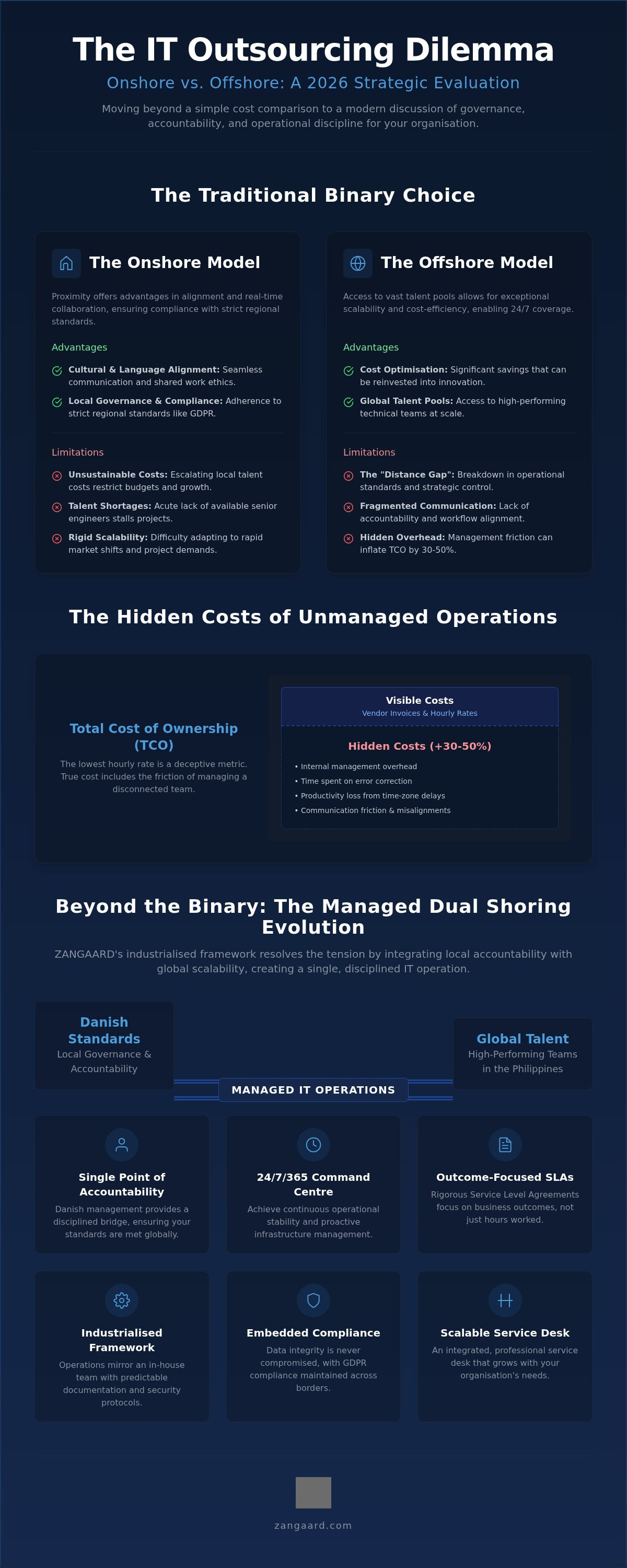
The lowest hourly rate is a deceptive metric. True cost includes the time your internal senior staff spend correcting errors or managing time-zone delays. This hidden management overhead can inflate the Total Cost of Ownership (TCO) by 30% to 50%. Disciplined delivery is instead enforced through rigorous Service Level Agreements (SLAs) that focus on outcomes rather than hours. If you're ready to move beyond fragmented support, you can consult with our team to define a framework that ensures quality.
Cultural Alignment and Communication Frameworks
Success depends on shared professional values. It isn't enough for a team to speak English; they must understand the no-nonsense quality expected in a Danish corporate environment. We organise our remote operations to mirror the behaviour of an in-house department. This ensures that documentation, security protocols, and 24/7/365 command centre operations are industrialised and predictable. Maintaining GDPR compliance across borders remains a core component of this infrastructure, ensuring data integrity is never compromised by geographical distance. By embedding these standards into our Managed Dual Shoring model, we provide the peace of mind that comes from knowing your infrastructure is in disciplined hands.
Beyond the Binary: Why Managed Dual Shoring is the Superior Evolution
The traditional binary choice of onshore vs offshore IT services is a relic of fragmented outsourcing. It forces a compromise between high domestic costs and the risks of unmanaged global delivery. Managed Dual Shoring (MDS) represents a superior evolution. It doesn't ask you to choose between Danish accountability and global efficiency. Instead, it integrates both into a single, industrialised workflow. By maintaining a local point of contact for governance whilst leveraging the technical depth of teams in the Philippines, ZANGAARD removes the operational burden from your internal staff. This allows your team to focus on core business growth, whilst we ensure the stability of your infrastructure through a Scalable Service Desk and 24/7/365 command centre operations.
Integrating Local Oversight with Global Technical Execution
The "Dual Shore" advantage is rooted in synergy. Danish management provides the strategic oversight and cultural alignment necessary to meet European standards, whilst the technical team in the Philippines executes tasks at a global scale. This model ensures business continuity through robust problem management and 24/7 command centre setups. You gain the peace of mind that comes from local accountability, knowing that your global team operates with the same precision as an in-house department. It's a disciplined approach that turns geographical distance into a round-the-clock operational advantage.
Furthermore, if your organisation requires specialised field engineering or end-to-end IT project delivery, you might visit Actlion Solutions to see how their on-demand technology support fits into a global delivery model.
Transitioning to a Managed IT Operations Portfolio
Future-proofing your IT requires a shift from reactive support to a scalable architecture. The first step is to audit your current IT services to identify where dual-shoring can provide the most immediate relief. Whether you need more predictable costs or a more resilient infrastructure, our framework is designed to grow with your enterprise. You can explore the ZANGAARD Service Portfolio to see how we manage global complexity for our partners. Learn more about Managed Dual Shoring and how it protects your business continuity whilst providing the scalability your organisation demands in 2026.
Achieving Global Scale with Local Accountability
Navigating the complexities of onshore vs offshore IT services requires a shift from viewing outsourcing as simple task delegation to seeing it as an industrialised operation. We've explored how the most resilient organisations in 2026 are those that move beyond binary choices. By prioritising a governance layer that ensures Danish management standards are applied to global talent, you can secure a predictable Total Cost of Ownership and a 24/7 operational presence.
ZANGAARD has been specialised in Managed IT Operations since 2014, acting as the disciplined architect for your infrastructure. Our approach provides you with the peace of mind that comes from local accountability whilst leveraging high-performing technical teams in the Philippines. It's about regaining control of your IT environment through a model designed for long-term stability and synergy.
Your organisation deserves an IT operation that matches your professional standards. Let's build a scalable foundation that supports your growth and secures your digital future.
Frequently Asked Questions
What is the main difference between onshore and offshore IT services?
The fundamental difference between onshore vs offshore IT services lies in the balance of proximity against scalability. Onshore models offer local cultural alignment but are often constrained by the high cost and scarcity of domestic technical talent. Offshore models provide access to vast, cost-efficient talent pools in regions like the Philippines. ZANGAARD’s Managed IT Operations bridge this gap by providing local accountability whilst leveraging international scale.
How does Managed Dual Shoring solve the risks of traditional offshoring?
Managed Dual Shoring (MDS) mitigates traditional risks by embedding a layer of Danish management between the client and the technical team. Traditional offshoring often suffers from a lack of transparency and broken communication channels. Our Managed Dual Shoring model ensures that all execution follows strict professional standards. This structure shifts the burden of management from your internal team to our disciplined experts, ensuring that strategic goals are met without operational friction.
Is offshore IT support secure for sensitive Danish enterprise data?
Security for sensitive Danish enterprise data is maintained through industrialised governance and strict adherence to GDPR standards. Offshore operations aren't inherently less secure; rather, they require a more rigorous IT Infrastructure Management framework to ensure compliance. We implement standardised security protocols and continuous monitoring to protect your assets. This approach provides peace of mind by ensuring that geographical distance never translates into a compromise of data integrity or regulatory alignment.
Can an offshore team handle 24/7 IT service desk operations effectively?
Offshore teams are exceptionally well-suited for 24/7 operations because they can leverage time-zone differences to provide seamless coverage. Effective delivery is achieved through a 24/7/365 Command Centre setup that monitors infrastructure around the clock. By utilising a Scalable Service Desk, organisations can ensure that support is available whenever it's needed. This model provides a level of availability that is often cost-prohibitive to maintain using purely domestic resources.
Disclaimer
The purpose of this article is to generate inspiration, reflection and to start a debate across markets, industries and organizations. We do not recommend any actions soly based on the article statements, claims or opinions, but recommend you to reach out directly to ZANGAARD for a qualified review, dialogue and/or consultation. Reach out at [email protected] or visit our website www.zangaard.com


