

Outsourcing IT needn’t mean giving up control. A practical approach to IT outsourcing risks and mitigation includes limiting access to sensitive data, agreeing clear responsibilities and performance measures, and testing the relationship with a small engagement before expanding it. Keep strategic decisions and oversight within your organisation, supported by defined incident and service-change processes.
It’s reasonable to have concerns about security, service quality and dependence on an external team. The answer isn’t to avoid outsourcing, but to build accountability into the operating model. Protect data, assess the provider’s capabilities, set clear working boundaries, and manage continuity, communication and performance as the relationship develops.
Key Takeaways
- Protect sensitive information with encryption, restricted access and a clear incident-response process.
- Assess a provider’s security, expertise and communication, then test the relationship with a small, well-defined engagement.
- Set measurable service expectations and review performance so operational issues are identified early.
- Keep strategic decisions and continuity planning under clear oversight as outsourced responsibilities grow.
1. Encryption, access controls, and incident response
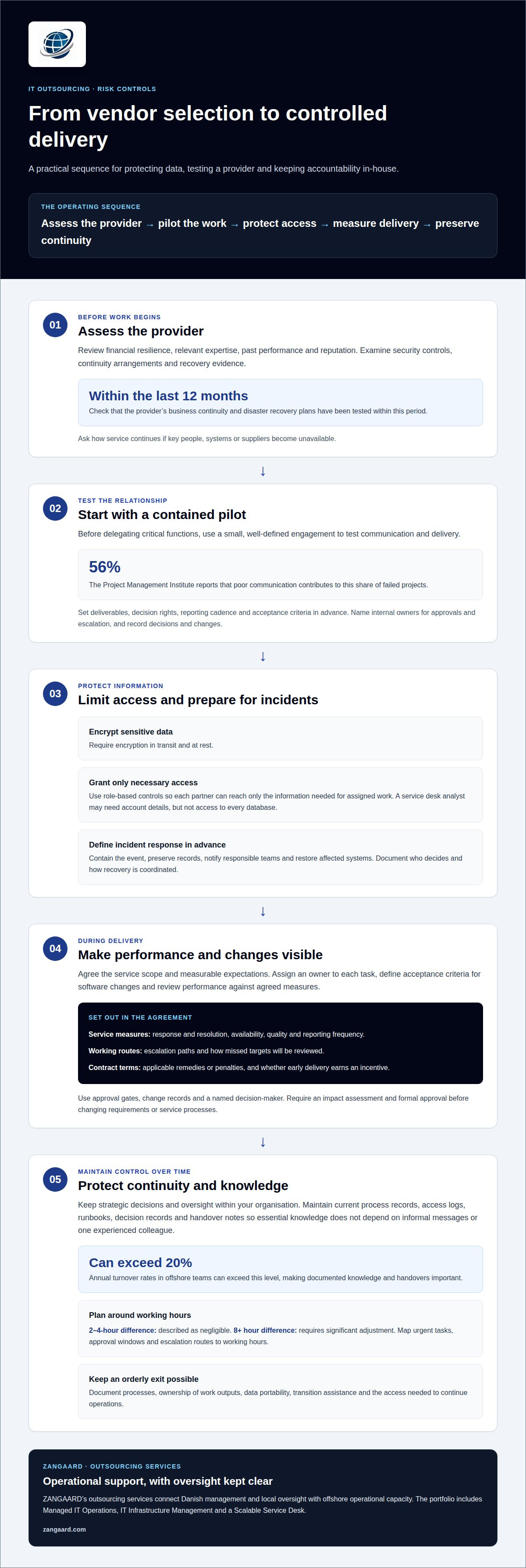
Protect sensitive data by requiring encryption in transit and at rest. Apply role-based access controls so each partner can reach only the information needed for assigned work. For example, a service desk analyst may need account details, but not access to every database. Define incident procedures in advance: contain the event, preserve records, notify responsible teams and restore affected systems. Document who makes each decision and how recovery is coordinated.
What are the risks of outsourcing IT to providers outside the EU? Data may be exposed to unauthorised access, different legal environments or weaker operational oversight. EUR-Lex states that the GDPR’s general principles for transferring personal data to an undertaking in a third country remain unaffected, so the transfer location does not remove data-protection considerations.
What service-level agreements and performance metrics should an IT outsourcing contract include? Specify the service scope, response and resolution measures, availability, quality standards, reporting frequency and escalation routes. Set out how missed targets will be reviewed, which remedies or contractual penalties apply, and whether early delivery earns an incentive.
Service quality can slip when delivery responsibilities are unclear. Assign an owner to each task, define acceptance criteria for software changes, and review performance against agreed measures. Maintain project control with approval gates, change records and a named decision-maker. A contingency plan should cover service disruption, data recovery and continuity of critical work.
Preserve institutional knowledge with current process records, access logs and handover documentation. These practices help the organisation maintain oversight when people or priorities change. A clear structure makes risk-mitigation strategies part of daily operations, rather than a response improvised after delivery fails.
2. Vetting vendors and starting with a small engagement
Assess a provider across financial resilience, relevant expertise, security practices and continuity planning. Review its financial health, past performance and reputation, then examine evidence of its security controls and recovery arrangements. Business continuity and disaster recovery plans should have been tested within the last 12 months. Ask how the provider maintains service if key people, systems or suppliers become unavailable.
How can companies assess an IT provider’s financial stability, security and business continuity plans? Review financial information and operational history, assess security evidence, and examine documented continuity and recovery plans, including recent test results. A pilot project can then test communication and delivery within a contained scope before the organisation delegates more critical functions.
Define the pilot’s deliverables, decision rights, reporting cadence and acceptance criteria before work begins. Name internal owners for approvals and escalation, and keep a record of decisions and changes. The Project Management Institute reports that poor communication contributes to 56% of failed projects, making regular project management routines essential. For software development, for example, agree how requirements changes are raised, assessed and approved.
A large vendor portfolio can fragment oversight, while a single supplier can create dependency. Assign an internal owner to coordinate vendors, clarify the boundaries between their functions and identify critical single points of reliance. Contracts should also support an orderly exit: document processes, ownership of work outputs, data portability, transition assistance and the access needed to continue operations. These provisions make switching vendors or bringing work in-house more manageable without losing essential knowledge.
3. Operational outsourcing risks
Operational risk often emerges between the agreed scope and daily delivery. A provider may close a support ticket without resolving the issue disrupting work. For example, restoring one employee’s access doesn’t address repeated account failures across a team. Trace a business process from request to outcome, noting hand-offs, delays and recurring incidents. A practical framework for IT outsourcing risks and mitigation connects these service patterns to their operational impact.
Team turnover can weaken understanding of systems and procedures. Annual turnover rates in offshore teams can exceed 20%, so undocumented knowledge may leave with departing staff. Keep runbooks, decision records and handover notes current. For a recurring incident, a replacement analyst should be able to follow documented steps without relying on informal messages or one experienced colleague.
Time-zone differences can affect coordination. A 2-4-hour difference is described as negligible, whilst an 8+ hour difference requires significant adjustment. Map urgent tasks and approval windows to working hours. If a Danish team needs a decision before its day ends, define who can make it and how unresolved issues are escalated.
Changes can create further outsourcing risk if teams overlook downstream effects. Require an impact assessment and formal approval before changing requirements or service processes. Review performance against agreed measures, recording recurring breaches and their causes. For Danish organisations, effective IT outsourcing risks and mitigation also depends on distinguishing an isolated disruption from patterns that affect continuity, service quality or customers across global operations.
ZANGAARD: Outsourcing Services
ZANGAARD helps organisations manage outsourced IT with clear operational oversight. Its outsourcing services connect Danish management and local oversight with offshore operational capacity, supporting accountability across delivery. Turn to ZANGAARD when your organisation needs to extend IT operations, strengthen infrastructure management or scale its service desk while retaining a clear view of responsibilities and performance.
Managed IT Operations can support coordinated day-to-day delivery, while IT Infrastructure Management provides oversight of the underlying environment. A Scalable Service Desk can align support capacity with operational needs. The right scope depends on the functions you outsource and where your organisation needs stronger governance.
Discuss your IT outsourcing requirements with ZANGAARD.
Make the next outsourcing decision deliberate
Treat each outsourcing decision as a governance choice, not simply a resource adjustment. Before expanding a service or adding another function, identify what must remain under internal control and how leadership will assess its contribution. This gives you a clearer basis for deciding whether the operating model still supports your organisation’s priorities.
A useful next step is to review an upcoming service change. Map its business owner, operational dependencies and measures of success, then consider how the arrangement will adapt as needs evolve. This makes IT outsourcing risks and mitigation an ongoing management discipline, rather than a document revisited only when a problem arises.
For organisations seeking a structured partner, ZANGAARD combines Danish management with delivery in the Philippines to align outsourced IT operations with local oversight. Book a meeting to discuss where support is needed and which outcomes matter most.
Clear decisions today can give your next stage of growth a steadier foundation.
Frequently Asked Questions
What are the main risks of IT outsourcing?
The main risks include security incidents, service disruption, inconsistent delivery and loss of operational knowledge. A provider’s delay can affect more than IT: unavailable account systems, for example, may prevent staff from completing customer-facing work. Dependencies between outsourced services and internal teams can make the impact harder to contain, so assess how a disruption would affect business processes, not just technical systems.
How can businesses assess and mitigate IT outsourcing risks?
Start by identifying the business process each outsourced function supports, then record what could interrupt it and the consequences. Assign an owner to each risk and define a response, such as maintaining an internal workaround for a critical approval process. Review the register when services, systems or responsibilities change, so controls reflect current operations rather than the project’s original assumptions.
What cybersecurity controls should an IT outsourcing contract require?
Set out confidentiality and data-security obligations, compliance expectations, audit rights, and procedures for reporting and resolving incidents. Define how security concerns are escalated, who provides relevant records, and how corrective actions are tracked. Contract terms should also cover contingency arrangements and dispute resolution, giving both parties an agreed process if a control fails or responsibilities are contested.
How can companies protect data and comply with GDPR when outsourcing IT in Denmark?
For personal data handled by an external processor, define the processing responsibilities and safeguards in the contract, including the requirements described in GDPR Article 28. Transfers to a provider outside the EU need careful assessment; EUR-Lex states that the GDPR’s general principles for transfers to an undertaking in a third country remain unaffected. Map data flows and document the purpose and handling of personal data.
How should businesses manage vendor lock-in and ensure data portability when outsourcing IT?
Make portability practical before a service begins: define which data and operational records must be returned, the required formats, and the access needed during transition. Test a sample export by loading it into a separate environment and checking that key records remain usable. Include knowledge transfer and responsibility for outstanding work, so the next operating team can continue without relying on undocumented, provider-specific processes.

Disclaimer
The purpose of this article is to generate inspiration, reflection and to start a debate across markets, industries and organizations. We do not recommend any actions soly based on the article statements, claims or opinions, but recommend you to reach out directly to ZANGAARD for a qualified review, dialogue and/or consultation. Reach out at [email protected] or visit our website www.zangaard.com


