

Your security posture shouldn't be a "black box" where visibility disappears the moment tasks move offshore. You're likely struggling with the skyrocketing costs of local Danish security talent whilst facing the relentless pressure of GDPR and ISO compliance. It's a common frustration to feel that you've traded control for cost-savings, leaving your organisation vulnerable to governance gaps. This article demonstrates how managing IT security and compliance outsourcing can be transformed through ZANGAARD's strategic dual-shore framework. By combining the efficiency of a 24/7/365 Philippines-based technical team with the disciplined oversight of local Danish management, you can industrialise your operations. We'll examine how this model reduces operational overhead and provides the peace of mind that comes from transparent governance. You'll discover how a structured approach to Managed IT Operations ensures your security remains scalable, compliant, and firmly under your command.
Key Takeaways
- Reframe security outsourcing from a transactional service to a strategic partnership that ensures full visibility across your global IT infrastructure.
- Bridge the oversight gap by integrating local Danish accountability with the 24/7 technical scalability of Philippines-based technical teams.
- Eliminate the "black box" risk when managing IT security and compliance outsourcing through structured governance and real-time executive reporting.
- Industrialise your security resilience by leveraging the ZANGAARD service portfolio to embed continual improvement into your daily operations.
The Governance Gap in Managing IT Security and Compliance Outsourcing
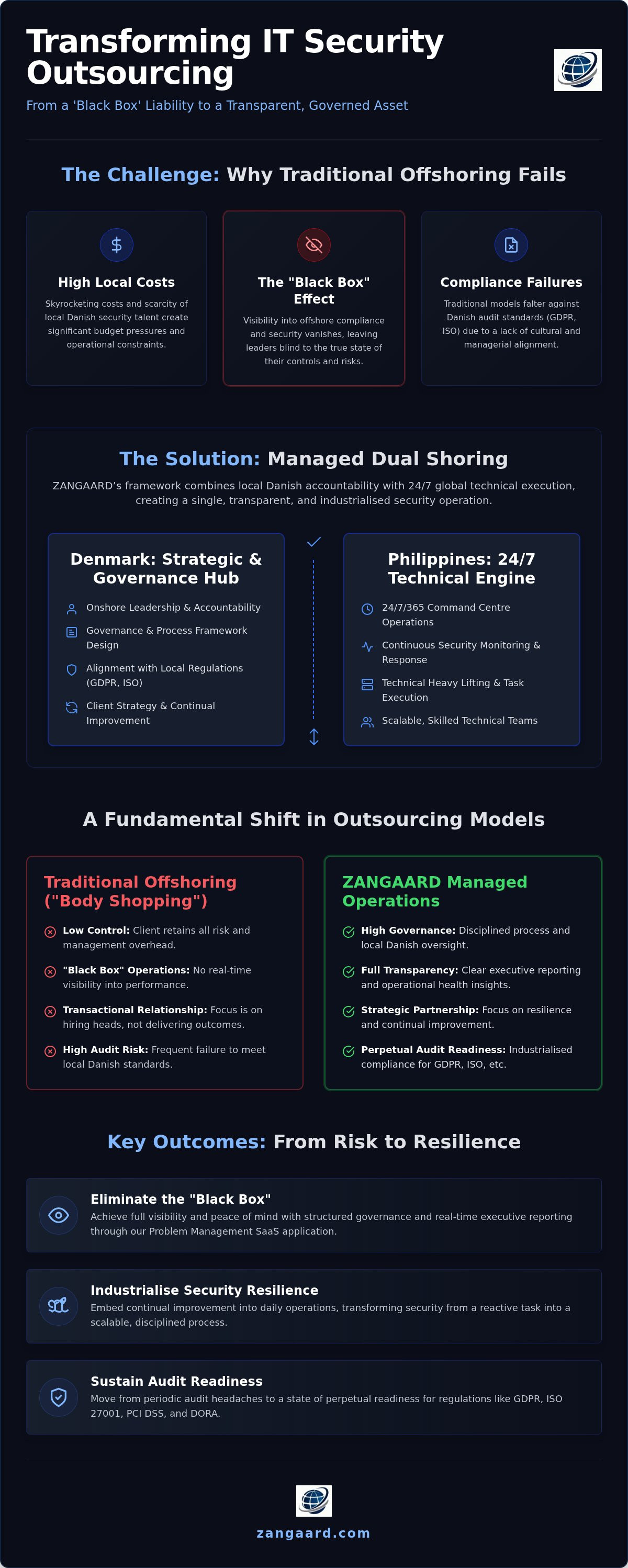
Managing IT security and compliance outsourcing requires more than a standard service level agreement; it demands a robust IT governance framework. Many organisations treat this as a transactional task, yet viewing it as a strategic partnership is vital for long-term resilience. The most pervasive risk is the "Black Box" effect. This occurs when visibility into offshore compliance vanishes, leaving Danish leaders blind to the actual state of their controls. Without transparency, you're not just outsourcing tasks; you're offloading your ability to manage risk effectively.
Traditional offshoring often falters against Danish audit standards. This isn't usually a technical failure but a lack of cultural and managerial alignment. Audits like ISO 27001 or GDPR require evidence that transcends simple tickets. Achieving audit readiness requires industrialised precision in governance, ensuring every action is documented and aligned with local regulatory expectations. It's about creating a steady, disciplined hand that bridges the gap between high-level strategy and daily execution.
Moving Beyond Traditional Offshoring to Managed IT Operations
Many firms rely on "body shopping" where they hire heads but retain all the risk. This model offers low control and high operational overhead for your internal team. In contrast, Managed IT Operations prioritise high governance and local accountability whilst leveraging global talent pools. It shifts the burden of management from your shoulders to a disciplined architect. Managed IT Operations is the deliberate integration of rigorous process, skilled people, and local Danish oversight to ensure consistent performance. This framework ensures that managing IT security and compliance outsourcing remains a source of stability rather than a liability.
Operationalising Compliance Through Managed Dual Shoring
Managing IT security and compliance outsourcing often feels like a choice between local control and global scale. The Managed Dual Shoring model resolves this paradox by creating a structured hierarchy where headquarters-based management serves as the strategic layer. This ensures that technical execution in the partner location isn't just efficient, but fundamentally aligned with client regulatory expectations. By establishing a 24/7/365 Command Centre setup, organisations maintain continuous security monitoring across time zones, closing the gaps that traditional nine-to-five operations leave open.
This model is particularly effective for upholding GDPR and ISO standards. Whilst the technical heavy lifting happens in the partner location, the process frameworks are onshore-led. This setup ensures that critical updates, such as the transition to PCI DSS v4.0.1 or compliance with the Digital Operational Resilience Act (DORA), are handled with disciplined precision. It transforms compliance from a periodic audit headache into a continuous, industrialised process that provides genuine peace of mind for executive leadership.
To further bolster these efforts, leveraging specialised cybersecurity providers like OAD Technologies for Managed Detection and Response (MDR) ensures that your technical defences are as disciplined as your management framework.
This peace of mind also depends on the physical integrity of your facilities; to explore advanced Swiss sensor technology for your premises, learn more about smartdetect AG.
Aligning Partner Location Technical Execution with Onshore Oversight
The success of this model relies on the "bridge-builder" role of onshore leadership. They translate complex local requirements into actionable technical tasks for teams in the partner location. By ensuring that these teams follow onshore management standards, we eliminate the cultural friction that often derails offshore projects. This high level of cultural intelligence ensures that security operations remain consistent, reliable, and deeply integrated into your broader business strategy. If you're looking to bridge this gap, discussing your specific framework needs can help clarify the path forward.
Sustaining Security Resilience and Audit Readiness
Effective security isn't a static achievement but a state of perpetual readiness. Visibility is the antidote to risk. When managing IT security and compliance outsourcing, the focus must shift from initial implementation to a culture of continual improvement. ZANGAARD’s Problem Management SaaS Application provides the essential transparency required for this transition, offering executive leaders a clear window into operational health. This tool transforms raw data into actionable insights, replacing the fog of offshore "black box" reporting with the clarity of structured governance. By moving from a state of fragmented complexity to one of streamlined simplicity, you secure the peace of mind that comes from knowing every risk is being managed by a disciplined hand.
The Role of Continual Improvement in Scalable Governance
Industrialising your security posture requires embedding IT Service Management Consultation directly into your daily operational rhythm. Our methodology for managing IT security and compliance outsourcing ensures we don't just solve tickets; we identify root causes and refine frameworks to prevent recurrence. A strategic Technology Roadmap is vital for anticipating future compliance shifts, such as the rigorous demands of DORA, whilst ensuring your current infrastructure remains stable. This disciplined approach shifts the burden of management from your internal team to a seasoned global architect who understands both Danish standards and offshore execution. You should evaluate whether your current oversight model matches this dual-shore standard or if your organisation remains vulnerable to governance gaps. True resilience is found when strategy and execution work in perfect harmony, allowing you to focus on growth without the distraction of compliance anxiety.
Industrialise Your Security for Long-Term Stability
Achieving a resilient security posture requires moving beyond transactional outsourcing to a model of disciplined governance. We have explored how managing IT security and compliance outsourcing can be transformed through a dual-shore framework that combines Danish accountability with global technical scale. By integrating a 24/7/365 Command Centre and leveraging our proprietary Problem Management SaaS, you eliminate the "black box" risk and regain total visibility. This strategic approach doesn't just reduce operational overhead; it provides the peace of mind that your organisation is audit-ready and protected against evolving threats. It’s time to shift the burden of management to a partner who prioritises your stability and growth.
Take the first step towards a controlled and scalable operational future today. We're ready to build a security framework that lasts.
Frequently Asked Questions
What are the primary risks of managing IT security and compliance outsourcing?
The primary risks include the "black box" effect, where visibility into technical controls vanishes, and a lack of local accountability. When managing IT security and compliance outsourcing, organisations often face cultural friction and misaligned standards that lead to audit failures. Without a disciplined governance framework, you risk offloading critical oversight along with the tasks, leaving your organisation vulnerable to regulatory penalties.
How does Managed Dual Shoring ensure GDPR compliance when teams are offshore?
Managed Dual Shoring ensures GDPR compliance by placing Danish management in direct control of offshore technical execution. Whilst technical tasks occur in the Philippines, all process frameworks are designed and overseen by local experts who understand European data protection laws. This model ensures that data processing remains transparent and audit-ready, providing a secure bridge between global scalability and local regulatory requirements.
What is the difference between simple IT outsourcing and Managed IT Operations?
Simple IT outsourcing often functions as "body shopping," where you hire technical capacity but retain the management burden and risk. In contrast, Managed IT Operations provides a high-governance framework where the provider takes accountability for performance and compliance. This model integrates people, rigorous processes, and local oversight, shifting the operational weight from your internal team to a disciplined global architect.
Can a dual-shore model reduce IT operational costs whilst improving security quality?
Yes, a dual-shore model reduces costs by leveraging the efficiency of Philippines-based technical teams whilst improving quality through 24/7/365 Command Centre monitoring. You avoid the high expense of local Danish security talent for round-the-clock operations without sacrificing standards. This industrialised approach ensures continuous oversight and rapid response, delivering a superior security posture and significant operational savings compared to traditional in-house models.
Disclaimer
The purpose of this article is to generate inspiration, reflection and to start a debate across markets, industries and organizations. We do not recommend any actions soly based on the article statements, claims or opinions, but recommend you to reach out directly to ZANGAARD for a qualified review, dialogue and/or consultation. Reach out at [email protected] or visit our website www.zangaard.com


