

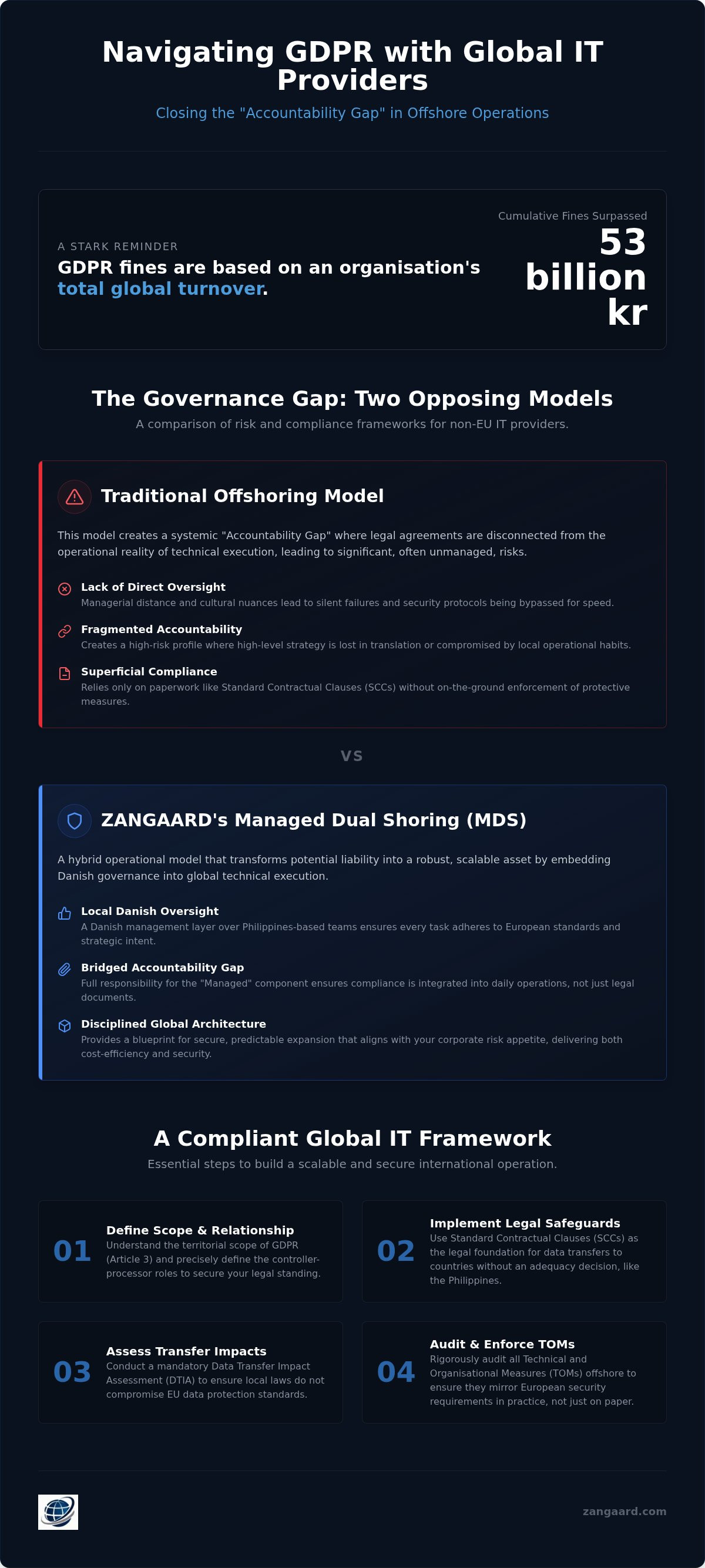
If your organisation is scaling via global talent, you're likely aware that cumulative GDPR fines have now surpassed 53 billion kr, with the 3.95 billion kr penalty against TikTok in May 2025 serving as a stark reminder of the risks associated with international data transfers. It's natural to feel trepidation when data moves beyond European borders, particularly as a February 2025 CJEU ruling clarified that fines are calculated based on a group's total global turnover. You shouldn't have to choose between cost-efficiency and legal security. This article outlines a strategic governance framework for GDPR compliance with non-EU IT providers whilst leveraging offshore talent.
We'll examine how ZANGAARD's Managed IT Operations and Managed Dual Shoring (MDS) model provide the local accountability required to satisfy Danish standards, transforming potential liability into a scalable operational advantage. By bridging the gap between high-level strategy and daily execution, we ensure your global IT footprint remains both performant and protected.
Key Takeaways
- Understand the territorial scope of Article 3 and how to precisely define the controller-processor relationship to secure your organisation's legal standing.
- Discover why achieving GDPR compliance with non-EU IT providers depends on closing the "Accountability Gap" through structured, Danish-led oversight of offshore technical teams.
- Explore how the Managed Dual Shoring (MDS) framework serves as a strategic bridge, applying rigorous European management standards to technical execution in the Philippines.
- Identify the essential steps for auditing technical and organisational measures (TOMs) to build a scalable IT operation that satisfies both cost-efficiency and Danish regulatory demands.
Understanding the Territorial Scope of GDPR in Global IT Operations
The extraterritorial reach of European law is often underestimated by firms seeking offshore efficiency. Under Article 3 of the General Data Protection Regulation (GDPR), achieving GDPR compliance with non-EU IT providers requires a deep understanding of how jurisdiction follows data. If your IT partner in the Philippines processes the personal data of Danish residents, they're legally bound by European standards. As the data controller, your organisation retains ultimate accountability; "out of sight" cannot mean "out of mind" when a single breach could trigger fines based on your group's global turnover.
Territorial Scope in 2026 dictates that regulatory jurisdiction is anchored to the location of the data subject, necessitating rigorous oversight of every technical touchpoint across global borders; this requirement for compliant frameworks is mirrored in maritime asset financing through EU regulated ship investment bonds.
This is especially pertinent for organisations in the healthcare sector, where specialised partners like Meridian RCM must ensure that revenue cycle management processes are fully aligned with these global data protection requirements.
Navigating Standard Contractual Clauses and Data Transfer Assessments
Since the Philippines lacks an adequacy decision from the European Commission, legitimising data transfers requires robust Standard Contractual Clauses (SCCs). However, SCCs are merely the starting point. A Data Transfer Impact Assessment (DTIA) is a non-negotiable step for GDPR compliance with non-EU IT providers to ensure local laws don't compromise EU protections. Ensuring your Managed IT Operations are built on a foundation of legal transparency is vital for long-term stability.
ZANGAARD bridges this gap by embedding compliance into our Managed Dual Shoring (MDS) framework. We provide the Danish leadership necessary to enforce these technical and organisational measures on the ground, giving you the peace of mind that your offshore talent operates within a strictly governed European shell.
The Governance Gap: Traditional Offshoring vs Managed Dual Shoring
Standard offshoring models often suffer from a systemic "Accountability Gap." While legal departments sign off on contracts, the operational reality of technical execution frequently happens in a vacuum. Without direct oversight, cultural nuances and managerial distance lead to silent failures where local staff might bypass security protocols for the sake of speed. Relying on a single-country provider without a European presence creates a significant risk profile, especially as international data transfer rules become more stringent. A hybrid operational model is the only way to ensure that high-level Danish strategy isn't lost in translation or compromised by local operational habits.
Bridging the Accountability Gap with Local Danish Oversight
Danish leadership acts as the critical anchor for GDPR compliance with non-EU IT providers. By placing a local management layer over Philippines-based teams, ZANGAARD ensures that every ticket handled and every server maintained adheres to European standards. It's not enough to simply hire talent; you need a partner who accepts full responsibility for the "Managed" component of Managed IT Services. This local accountability transforms your offshore operation from a potential liability into a robust, scalable asset. Our Managed Dual Shoring framework delivers the cost-efficiency of global talent without sacrificing the security of Danish governance. This synergy allows your business to scale rapidly whilst maintaining the peace of mind that your data remains under disciplined, European-led control. If you're ready to stabilise your international operations, reach out to our consultants for a strategic review of your current governance structure.
Implementing a Compliant Global IT Framework for 2026
Building a resilient international operation requires moving beyond high-level legal theory into the granular reality of operational discipline. The first step involves a rigorous audit of technical and organisational measures (TOMs) at the offshore site to ensure they mirror European security requirements in practice, not just on paper. Once this baseline is established, a unified governance layer must be constructed to connect Danish strategic intent with technical execution in the Philippines. This architecture effectively eliminates the communication silos that often lead to silent oversight failures and data leakage. ZANGAARD’s "Disciplined Global Architect" approach provides this exact blueprint, ensuring that your expansion remains secure, predictable, and fully aligned with your corporate risk appetite. Maintaining GDPR compliance with non-EU IT providers is not a one-time event; it's a continuous state of readiness achieved through meticulous process design and the oversight provided by our Managed IT Operations. This structure provides the strategic reassurance that high-stakes operations are handled by a steady, expert hand.
Establishing Continuous Monitoring and Command Centre Excellence
Operational stability depends on the ability to detect and remediate anomalies before they escalate into compliance breaches. By deploying a 24/7 IT Service Desk, organisations gain real-time visibility into global data flows. This level of oversight is essential for maintaining GDPR compliance with non-EU IT providers. Modern IT Infrastructure Management now demands a 24/7/365 Command Centre setup that integrates proactive compliance tracking with traditional performance metrics. This dual-focus ensures data integrity whilst maintaining maximum uptime across your entire global footprint. Ready to secure your global operations? Contact our strategic consultants today for a compliance-first IT roadmap.
Securing Your Global Operational Legacy
Navigating international data protection doesn't have to be an exercise in risk management. By establishing a local management layer, you bridge the accountability gap that often plagues traditional offshoring models. This framework allows you to leverage global talent whilst maintaining absolute control over your technical touchpoints. Achieving GDPR compliance with non-EU IT providers is ultimately a matter of operational precision. With ZANGAARD's specialised MDS framework and 24/7/365 Command Centre oversight, you gain the strategic reassurance that your infrastructure is governed by a steady, Danish hand.
You can now scale your operations with the confidence that local accountability and European standards are embedded into every process.
Frequently Asked Questions
Does GDPR apply to my IT provider if they are based in the Philippines?
Yes, the GDPR applies to any entity processing the personal data of individuals within the EU, regardless of the provider's physical location. This extraterritorial reach is established under Article 3. When you engage a provider in the Philippines, they act as a data processor and must adhere to the same rigorous standards as a European firm to ensure your organisation remains protected.
What are Standard Contractual Clauses (SCCs) and why do I need them for offshore IT?
Standard Contractual Clauses are legal templates provided by the European Commission to ensure data protection safeguards are in place when transferring information to countries without an adequacy decision. Since the Philippines currently lacks this status, SCCs are mandatory for GDPR compliance with non-EU IT providers. They provide a predictable legal framework for international transfers whilst defining the responsibilities of both parties.
Can I be fined if my non-EU IT provider has a data breach?
Yes, as the data controller, your organisation retains ultimate legal accountability for any breach occurring within your supply chain. Under current 2026 regulations, fines can reach up to 4% of your total global annual turnover. This risk makes it vital to move beyond simple contracts and implement active oversight to prevent silent compliance failures in offshore technical environments.
How does Managed Dual Shoring improve GDPR compliance compared to traditional outsourcing?
Managed Dual Shoring (MDS) eliminates the accountability gap by placing a local Danish management layer over offshore technical teams. Unlike traditional outsourcing, where visibility into daily execution is often lost, MDS applies Danish standards directly to technical operations. This hybrid model ensures that GDPR compliance with non-EU IT providers is operationally enforced through ZANGAARD's service portfolio, providing strategic reassurance for your high-stakes global operations.
Disclaimer
The purpose of this article is to generate inspiration, reflection and to start a debate across markets, industries and organizations. We do not recommend any actions soly based on the article statements, claims or opinions, but recommend you to reach out directly to ZANGAARD for a qualified review, dialogue and/or consultation. Reach out at [email protected] or visit our website www.zangaard.com


